October 13, 2026 · Kollavo
How to Find Which Sources AI Cites for Your Competitors
Run your buyer prompts several times on each AI engine, log every cited URL, and keep the sources cited when competitors appear and you don't. Here's the step-by-step citation gap analysis, with 2026 data and tool options.
Short answer: To find which sources AI cites for your competitors, run the buyer prompts where they show up in ChatGPT, Perplexity, Gemini and Google AI Overviews or AI Mode. Run each prompt several times, log every cited URL, and keep the ones that appear when a competitor is named and you are not. Then sort those sources by type (review sites, listicles, news, forums, competitor pages) and by how often they recur. Repetition matters because AI answers change from run to run. In SparkToro's 2026 study, ChatGPT and Google's AI gave the same list of brands twice less than 1 time in 100. One run tells you almost nothing. Twenty runs start to show a pattern.
This process is called citation gap analysis. It gives you a short list of pages to improve, publish or pitch, ranked by how often AI actually uses them.
Why the sources behind an answer matter more than the answer
An AI answer is the visible layer. Underneath it sits a set of pages the engine retrieved and chose to cite. If a competitor keeps getting recommended, they usually have something you don't: a mention in a comparison article, a strong review profile, a Reddit thread, or a page that answers the question in a way the model likes to quote.
You can't edit the answer. You can influence the sources.
Two things make this harder than classic competitor SEO research:
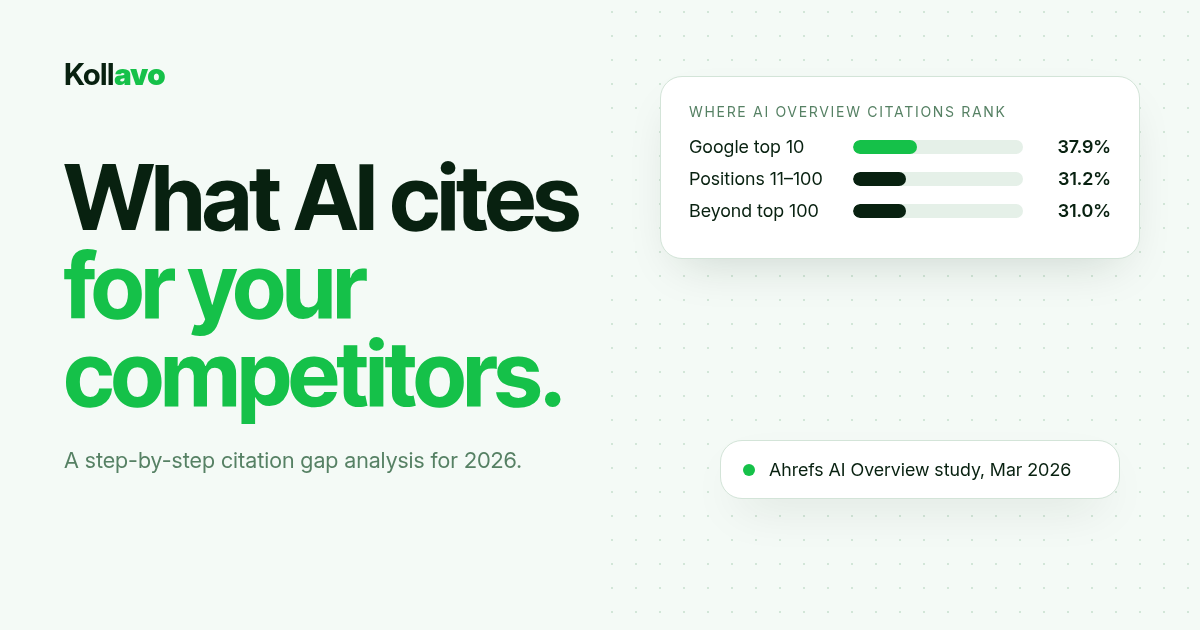
- Ranking pages aren't the same as cited pages. In Ahrefs' March 2026 analysis of 863,000 keyword SERPs and 4 million AI Overview URLs, only 37.9% of cited URLs also appeared in the top 10 results for the same query. 31.2% ranked between positions 11 and 100, and 31.0% didn't rank in the top 100 at all (Ahrefs). In July 2025, Ahrefs had put the top-10 share at 76%. Ahrefs says its parsing improved in between, so the two numbers aren't directly comparable. Still, checking the top 10 for your keyword no longer shows you most of what AI Overviews cite.
- Engines fan out. Google says AI Overviews and AI Mode may use a "query fan-out" technique, "issuing multiple related searches across subtopics and data sources," and that the two features may use different models, so their links vary (Google Search Central). A competitor can be cited from a page that ranks for a sub-question you never tracked.
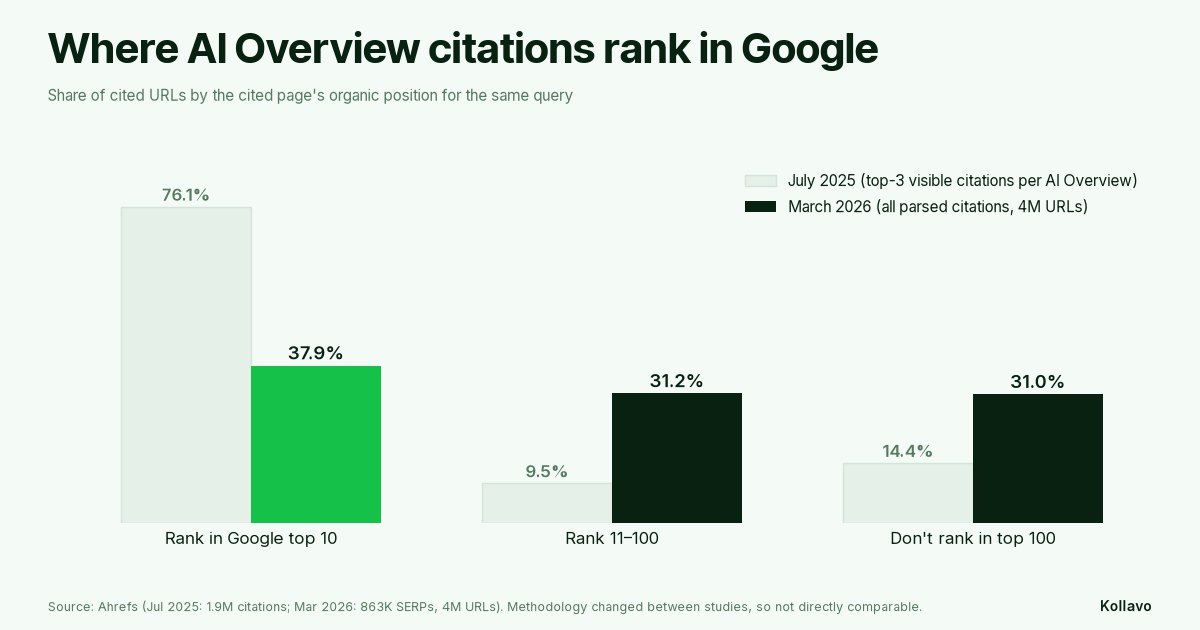
So you have to look at what is actually cited, prompt by prompt, rather than guess from keyword rankings.
Step 1: Build the prompt set your buyers actually use
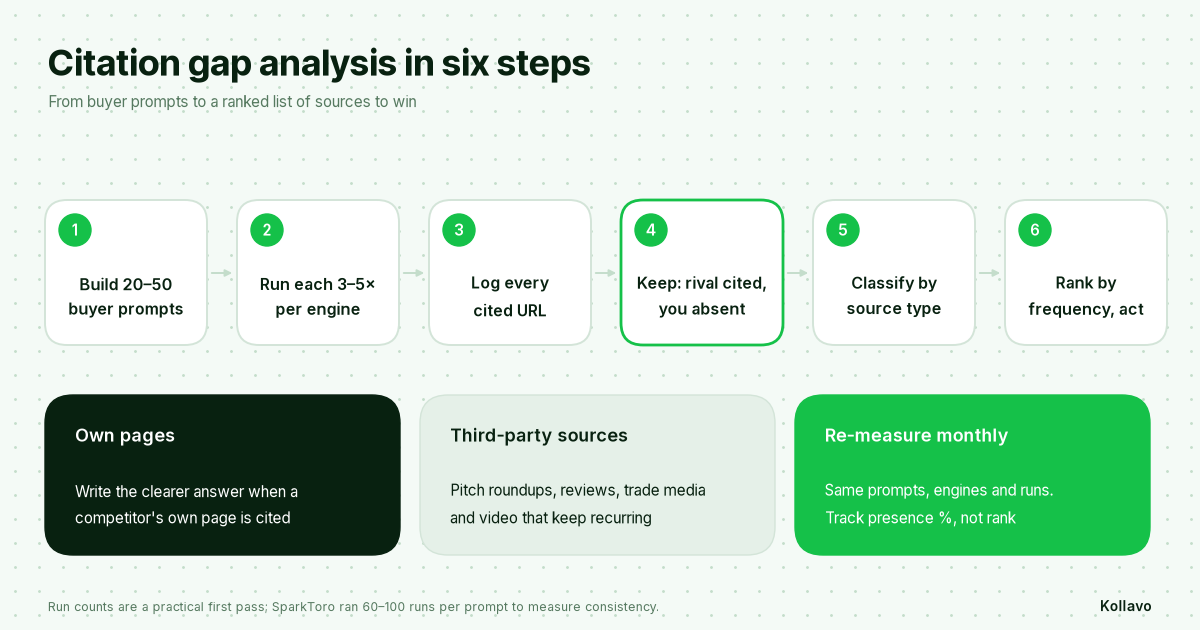
Start with 20 to 50 prompts, grouped by intent:
- Category prompts: "best [category] for [use case]", "top [category] tools for small teams"
- Comparison prompts: "[competitor] vs [competitor]", "[competitor] alternatives"
- Problem prompts: "how do I [job your product does]"
- Validation prompts: "is [competitor] worth it", "[competitor] pricing"
Don't rely on one perfect wording. SparkToro's panel found human-written prompts with the same intent had an average semantic similarity of just 0.081, yet the AI tools still returned similar sets of brands (SparkToro). Cover each intent with two or three phrasings rather than one prompt per keyword.
If you need a starting list, the free AI Prompt Generator produces buyer questions across the funnel, and the Query Fan-Out Generator shows the sub-questions an engine is likely to search behind each one.
Step 2: Run each prompt more than once, on every engine that matters
AI answers are probabilistic. In the SparkToro and Gumshoe study, 600 volunteers ran 12 prompts through ChatGPT, Claude and Google's AI a combined 2,961 times. The odds of getting the same brand list twice were under 1 in 100, and the same list in the same order closer to 1 in 1,000. But presence across many runs was meaningful: City of Hope appeared in 69 of 71 ChatGPT answers about West Coast cancer hospitals, even though it was the first name mentioned in only 25 of them.
For citation research, that means:
- Run each prompt at least 3 to 5 times per engine for a first pass. Use more runs for the prompts that matter most.
- Use a logged-out or clean session where you can, so personal history doesn't skew results.
- Record the date, engine, prompt, brands mentioned, and every cited URL.
Where to find the citations:
| Engine | Where cited sources appear | What to record |
|---|---|---|
| ChatGPT (with search) | Inline citations, plus a Sources panel with cited sources and other relevant links (OpenAI) | Cited URLs separately from "more" links that were found but not cited |
| Perplexity | Source links shown with each answer | Every source URL and its position |
| Google AI Overviews | Supporting links inside the AI Overview | Linked URLs, plus whether an Overview showed at all |
| Google AI Mode | Supporting links alongside the response | Linked URLs. Expect different links than AI Overviews for the same query |
| Gemini | Source links when the answer is grounded in search | Linked URLs when shown. Note answers with no sources |
The "found but not cited" distinction is worth keeping. Ahrefs' documentation describes ChatGPT's Sources view as two groups: sources that are cited in the answer, and additional pages that were retrieved but not referenced. A competitor page that is retrieved but never cited is a weaker signal than one cited every time.
Step 3: Isolate the gap: competitor cited, you absent
Now filter your log down to the rows that matter:
Gap source = a URL cited in an answer where at least one competitor is mentioned and your brand is not.
For each gap source, count:
- Frequency: in how many answers it appears, across all runs and engines
- Competitor coverage: how many competitors it mentions
- Prompt coverage: how many different prompts or intents pull it in
- Engine spread: whether one engine cites it or several
A page that shows up in 40% of runs for five different prompts and names three of your competitors is a priority. A page cited once by one engine is noise until it repeats.
This is the same logic the commercial tools use. Peec AI's Gap Analysis highlights sources "where your competitors appear, but your brand does not." It ranks them by a Gap Score that combines how often AI uses the source with how many competitors appear there. Semrush's Competitor Research report has a Missing filter for "external domains [that] are cited sources in AI answers that mention your competitors — but not you".
Step 4: Classify each source and pick the right play
Different sources need different actions. Sort every gap source into one of these buckets:
| Source type | Typical examples | What it tells you | Best move |
|---|---|---|---|
| Listicles and "best X" roundups | Industry blogs, review publishers | AI pulls multi-brand pages for recommendation prompts | Pitch inclusion with a clear differentiator and proof. Offer data or a quote |
| Review and directory sites | G2-style review sites, niche directories | Engines lean on aggregated social proof | Complete your profile and ask real customers for reviews |
| News and trade media | Trade publications, industry news | Authority signal for "who leads this category" | Earned coverage, expert commentary, original data (see our guide to trade publications) |
| Community and forums | Reddit, Quora, niche forums | First-hand discussion for "what do people recommend" | Genuine, disclosed participation. Never astroturf (see does Reddit get cited by AI?) |
| Competitor-owned pages | Their comparison, pricing or docs pages | They answer a question better than you do | Publish your own clearer page for that exact question |
| Video | YouTube reviews and tutorials | Video is a major citation source in AI Overviews | Get reviewed, or publish your own explainer |
Two data points help you weight these buckets. Ahrefs found YouTube made up 5.6% of all AI Overview citations in its March 2026 dataset, and 18.2% of the cited pages that didn't rank in the top 100. Otterly.AI reports that across 1.4 million citation links it analyzed in September 2025, the most frequently cited sources were brand websites, news and media outlets, and Reddit.
Step 5: Turn the gap list into a 30-day plan
Gap analysis only pays off if it becomes work. A practical first month:
- Week 1: Fix your own pages. For every gap where a competitor's own page is cited, write or rewrite your page for that exact question. Put the answer first and keep it specific, with a comparison table if the prompt is comparative. The AI Citation Checker helps you test the wording against a single prompt.
- Week 2: Claim the easy third-party wins. Review profiles, directories and listicles with open submission or update processes.
- Weeks 3 and 4: Outreach. Pitch the editorial sources that recur most. Lead with something the writer can use: a data point, a customer result, an expert quote.
- Re-run the same prompt set at the end of the month. Use the same prompts, engines and number of runs so the comparison holds.
Measure presence, not rank. SparkToro's conclusion was that visibility percentage across many prompts and runs is a reasonable metric, but "ranking position in AI" isn't. Our guides to share of voice in AI search and LLM citation rate cover the formulas.
Manual research vs tools
You can do all of this in a spreadsheet. It's slow, but it's the best way to learn what your category's answers look like. Past roughly 20 prompts across four engines, most teams switch to a tool. Here's how the main options handle competitor source analysis. Prices are from vendor pricing pages and help docs, checked October 2026. Verify them before buying.
| Option | How it finds competitor sources | Entry price (published) |
|---|---|---|
| Manual (spreadsheet) | You run prompts and log citations by hand | Free, but takes hours per cycle |
| Kollavo free tools | Citation Gap Audit and Competitor Citation Map give AI-estimated gaps and a source shortlist to verify live | Free, 5 runs per tool per day |
| Kollavo Track | Weekly visibility scoring, competitor share of voice and citation gap alerts | $49/mo |
| Otterly.AI | Citations report with brand-mentioned filters, domain categories and competitors referenced per URL | Lite $29/mo (15 prompts) |
| Peec AI | Sources > Domains and URLs with Gap Analysis and Gap Score | Starter about $85–103/mo, per Peec's own summary |
| Semrush AI Visibility Toolkit | Competitor Research > Sources with a Missing filter (up to 4 competitors) | $99/mo per domain, no free trial |
| Ahrefs Brand Radar | Cited Domains and Cited Pages reports, filterable by competitor domains | Custom prompts in paid Ahrefs plans. AI index $199/mo per platform or $699/mo for all |
A caveat on our own free tools: the Citation Gap Audit and Competitor Citation Map are AI-estimated. They model likely gaps and source types rather than querying the engines live. Use them to build a shortlist fast, then confirm the important sources in the real answers.
If you'd rather not run outreach yourself, Kollavo's Managed plan ($99/mo) takes your gap list and handles placement end to end. Your first placement's publisher fee is covered up to $99, and you approve every later fee before anything is paid. You can compare it with the trackers above on our comparison pages.
Common mistakes
- Treating one run as the truth. Answers vary. Aggregate before you act.
- Only checking Google's top 10. Most AI Overview citations in Ahrefs' 2026 data came from outside it.
- Mixing engines. Perplexity, ChatGPT and Google often cite different sources for the same question. Keep per-engine columns.
- Chasing every gap. Ten recurring sources beat a hundred one-offs.
- Spamming communities. Manufactured Reddit or forum posts can backfire on your reputation and on the threads themselves.
FAQ
What is an AI citation gap?
A buyer question where AI assistants cite sources that mention your competitors but not your brand. The gap is the source, not just the answer. Closing it usually means getting included in that source or publishing a better one.
How many times should I run a prompt?
There's no agreed standard yet. SparkToro ran its prompts 60 to 100 times each to measure consistency. For practical competitor research, 3 to 5 runs per engine is a sensible first pass, with more for your highest-value prompts.
Can I see which sources AI cites for a competitor without tracking prompts?
Partly. Some tools keep large pre-built databases of AI responses. Ahrefs Brand Radar and Semrush's AI Visibility Toolkit let you look up domains and cited pages for any brand. Prompt databases won't match your exact buyer questions, though, so verify the key prompts yourself.
Do I need special markup or an llms.txt file to get cited by Google's AI features?
Google says no. There are "no additional requirements" to appear in AI Overviews or AI Mode, and you don't need new machine-readable files or special schema. A page must be indexed and eligible to show a snippet (Google Search Central).
How often should I redo a citation gap analysis?
Monthly is a good default, with weekly checks on your top prompts. Sources shift as engines change models and as new content is published.
Is this different from share of voice?
Yes. Share of voice measures how often you're mentioned compared with competitors. Citation gap analysis explains why, by showing the sources behind those mentions. Use share of voice to spot the problem and gap analysis to find the fix.
Want a head start? Run the free AI visibility audit to see which sources AI cites in your category and where competitors appear without you.