October 14, 2026 · Kollavo
What Is an AI Citation Checker? How to See If AI Cites Your Brand
An AI citation checker shows whether ChatGPT, Gemini, Perplexity or AI Overviews mention your brand and which URLs they cite. Here's how to run one, why multi-run presence beats one screenshot, and what to do with the results.
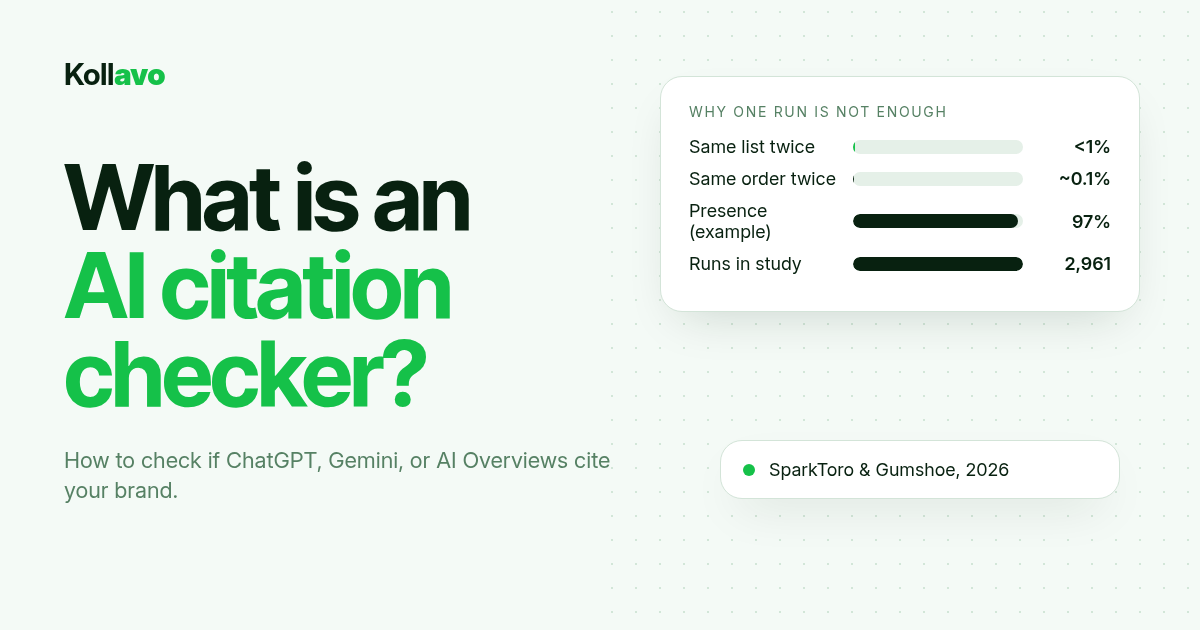
Short answer: An AI citation checker is a process (or tool) that shows whether ChatGPT, Gemini, Perplexity, Google AI Overviews, or similar products mention your brand and which URLs they cite when answering buyer questions. You run the same prompts several times, log mentions versus linked sources, and score how often you appear. That presence rate matters more than any single answer: in SparkToro and Gumshoe's 2026 study, ChatGPT and Google's AI returned the same brand list twice less than 1 time in 100, and the same list in the same order about 1 time in 1,000. One screenshot is noise. A checker turns that noise into a repeatable metric.
This guide explains what a citation checker is, how to run one by hand, how commercial tools fit, and what to do with the results — including an honest note on Kollavo's free AI citation checker.
What an AI citation checker actually checks
A citation checker answers three questions for a prompt (or set of prompts):
- Mention: Did the answer name your brand (or product)?
- Citation: Did it link a specific URL as a source?
- Presence: Across many runs, how often did (1) or (2) happen?
Those are not the same thing. A model can name you from training data with no link. It can cite a review site that never mentions you. It can cite your competitor's homepage every time and yours never. A useful checker logs all three.
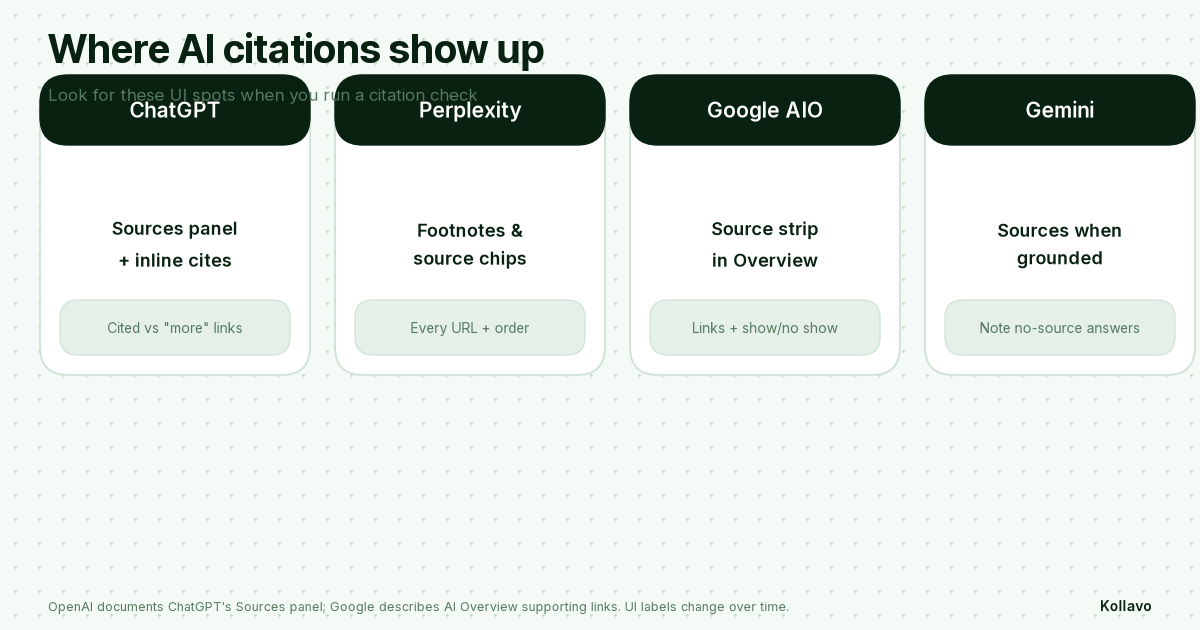
Where the UI puts those signals:
| Engine | Where to look | What to log |
|---|---|---|
| ChatGPT (with search) | Inline citations plus a Sources panel (OpenAI) | Cited URLs separately from other relevant links that were found but not cited |
| Perplexity | Footnotes and source chips on every answer | Each URL and its order |
| Google AI Overviews | Supporting links in the Overview strip | Linked URLs, plus whether an Overview appeared at all |
| Google AI Mode | Supporting links beside the response | Linked URLs (often different from Overviews for the same query) |
| Gemini | Sources when the answer is grounded in search | Linked URLs when shown; note answers with no sources |
Google notes that AI Overviews and AI Mode may use query fan-out — issuing multiple related searches across subtopics — and may use different models, so their links vary (Google Search Central). A checker that only looks at one engine, or one wording of a question, will miss that.
Mention vs citation (and why both matter)
| Signal | What it means | Typical next move |
|---|---|---|
| Mention only | Brand named in the text, no link to you | Strengthen owned pages and third-party sources so the next run can attach a URL |
| Citation to you | Your URL appears as a source | Defend and expand: keep that page fresh; earn related pages |
| Citation to others while you're absent | Someone else's URL backs the answer | Citation gap work — see how to find which sources AI cites for competitors |
| Neither | You don't appear at all | Build presence first: clearer category pages, reviews, listicles |
Presence percentage is usually: runs where you appear ÷ total runs for that prompt (or prompt set). SparkToro argued that visibility across many prompts and runs is a reasonable metric, while "rank position in AI" is not. City of Hope showed up in 69 of 71 ChatGPT answers about West Coast cancer hospitals in their panel — about 97% presence — even though it was the first name mentioned in only 25 of those answers. Presence held; order did not.
Why multi-run checking is non-negotiable
AI answers are probabilistic. SparkToro and Gumshoe recruited 600 volunteers, used 12 prompts, and collected 2,961 runs across ChatGPT, Claude, and Google's AI. Key findings for anyone building a checker (SparkToro):
- Same brand list twice: <1 in 100
- Same list in the same order: about 1 in 1,000
- Human prompts with the same intent had average semantic similarity of only 0.081, yet tools still returned similar brand sets — so cover each intent with a few phrasings
- Presence across many runs was still meaningful (the City of Hope example above)
Practical first pass for a manual checker:
- 3–5 runs per prompt per engine for discovery
- More runs for your highest-value prompts
- Same date window, logged-out or clean session when you can
- Record: date, engine, prompt wording, brands mentioned, every cited URL
Do not invent a "rank #1 in ChatGPT" KPI. Track presence and citation frequency instead. For formulas, see LLM citation rate: how to track and share of voice in AI search.
How to run a manual AI citation checker
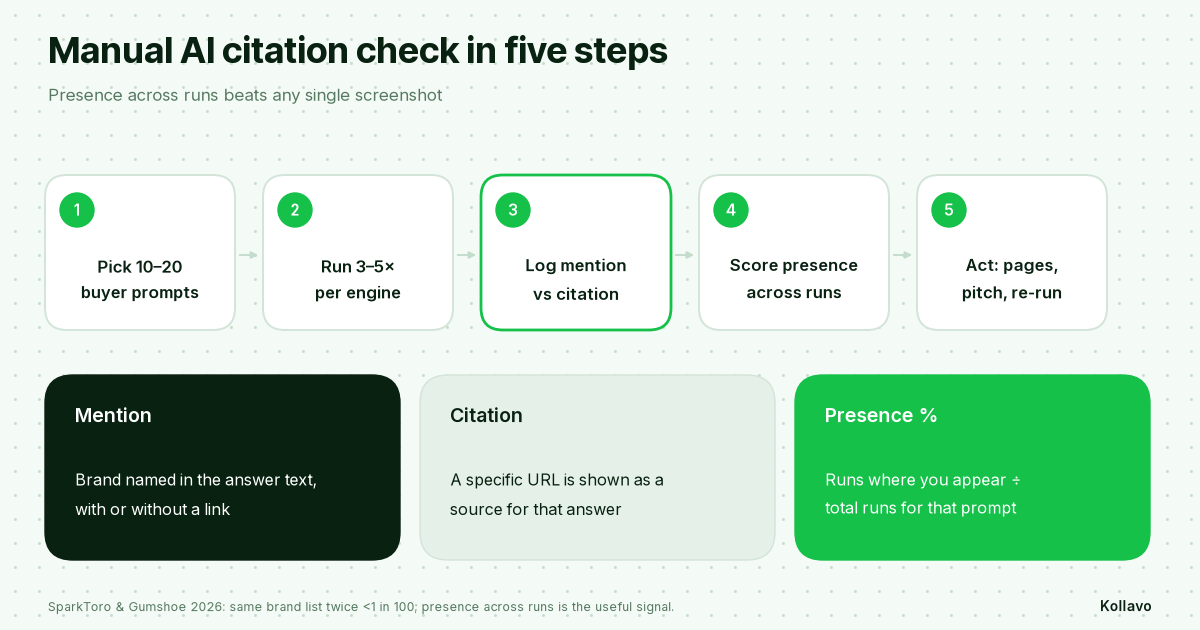
1. Build a small prompt set
Start with 10–20 prompts buyers actually ask:
- Category: "best [category] for [use case]"
- Comparison: "[you] vs [competitor]", "[competitor] alternatives"
- Problem: "how do I [job your product does]"
- Validation: "is [brand] worth it", "[brand] pricing"
Use two or three phrasings per intent. Free helpers: AI Prompt Generator and Query Fan-Out Generator.
2. Run each prompt on every engine that matters
ChatGPT with search, Perplexity, Gemini, Google AI Overviews, and AI Mode if your buyers use them. Paste into a spreadsheet: one row per run.
3. Separate mention from citation
Columns that work: brand_mentioned (yes/no), your_url_cited (yes/no), cited_urls (list), notes. Keep "found but not cited" links in a separate column for ChatGPT's Sources panel.
4. Score presence
For each prompt and engine: presence % = runs with a mention (or with a citation — pick one primary metric and stick to it) ÷ total runs. Also tally which external domains recur when you are cited and when you are not.
5. Act, then re-run the same set
- Own pages that answer the question poorly → rewrite with the answer first
- Recurring third-party listicles and reviews → pitch inclusion
- Competitor-only sources → gap analysis and outreach
- Re-measure with the same prompts, engines, and run counts
Manual spreadsheet vs tools
You can run a checker entirely by hand. Past ~20 prompts × 4 engines × several runs, most teams switch to software. Options people use in this space (names as plain text; verify pricing on vendor sites before buying):
| Approach | What it does | Notes |
|---|---|---|
| Manual spreadsheet | You run prompts and log mentions/citations | Free; best for learning; slow at scale |
| Kollavo free AI citation checker | Simulated likelihood estimate for a prompt | Not a live ChatGPT / Gemini / Perplexity lookup — see honesty note below |
| Kollavo Track | Weekly visibility scoring, share of voice, citation gap alerts | From $49/mo on pricing |
| Peec AI | Prompt tracking, sources, gap analysis | Commercial tracker |
| Profound | Enterprise AI visibility / citation monitoring | Commercial platform |
| Otterly.AI | Prompt tracking and citation reports | Commercial tracker |
| Semrush AI Toolkit | AI visibility and competitor source views | Part of Semrush |
| Ahrefs Brand Radar | Cited domains / pages style reports | Part of Ahrefs |
Honesty note on Kollavo's free checker
Kollavo's free tool at /tools/ai-citation-checker is a simulated likelihood estimate. It does not query live ChatGPT, Gemini, Perplexity, or Google AI Overviews. Use it to stress-test wording and get a directional score quickly, then confirm important prompts in the real products (or with a live tracker). The same honesty applies to related free estimators like the Citation Gap Audit: shortlist fast, verify live.
If you want done-for-you tracking and placement, compare Track vs Managed on pricing and the product pages under /compare. A free AI audit is a low-friction starting point, and get cited covers the outreach path.
What to do with checker results
A checker is only useful if it changes work:
- High presence, weak citations → Improve pages so engines have a clean URL to attach; earn reviews and listicles that already talk about you.
- Low presence everywhere → You are not in the source set. Publish clearer category and comparison pages; earn mentions on domains AI already cites in your niche.
- Present on one engine only → Don't average into one "AI score." Fix the weak engines' source mix separately.
- Competitors present, you absent → Run gap analysis on the cited URLs (guide).
- Volatile week to week → Increase run count; judge trends on multi-week windows, not one day.
Common mistakes
- Treating one ChatGPT reply as the truth
- Counting only mentions and ignoring which URLs were cited
- Mixing engines into a single average
- Chasing "rank in AI" instead of presence %
- Trusting a simulated checker as if it were live engine data
- Never re-running the same prompt set after you publish or pitch
FAQ
What is an AI citation checker?
A method or product that measures whether AI answer engines mention your brand and which sources they cite for your buyer prompts — ideally across multiple runs and engines.
Is a mention the same as a citation?
No. A mention is your name in the answer text. A citation is a linked source URL. Track both.
How many times should I run each prompt?
SparkToro used 60–100 runs per prompt to study consistency. For day-to-day checking, 3–5 runs per engine is a practical first pass; use more for critical prompts.
Can I check Google AI Overviews the same way as ChatGPT?
The idea is the same — run the query, log links — but the UI and retrieval differ. Google may fan out into related searches, and AI Mode links can differ from AI Overviews for the same query (Google Search Central).
Does Kollavo's free AI citation checker query ChatGPT live?
No. It returns a simulated likelihood estimate. Confirm important prompts in the live products or with a tracker that runs real queries.
How is this different from share of voice or citation rate?
A citation checker is the measurement process (or tool). Share of voice compares your mentions to competitors. Citation rate is usually presence or citation frequency over a defined prompt set. Use the checker to produce those metrics.
Want a directional score in minutes? Try the free AI citation checker, then verify the prompts that matter in the live engines — or start with a free AI audit.