October 16, 2026 · Kollavo
LLM Citation Decay: Why AI Citations Fade and How to Keep Them
LLM citation decay is how fast AI engines stop citing a page. 2026 studies put the median at 11 days from peak to half share. Here's what drives it, per-engine data, and how to slow it.
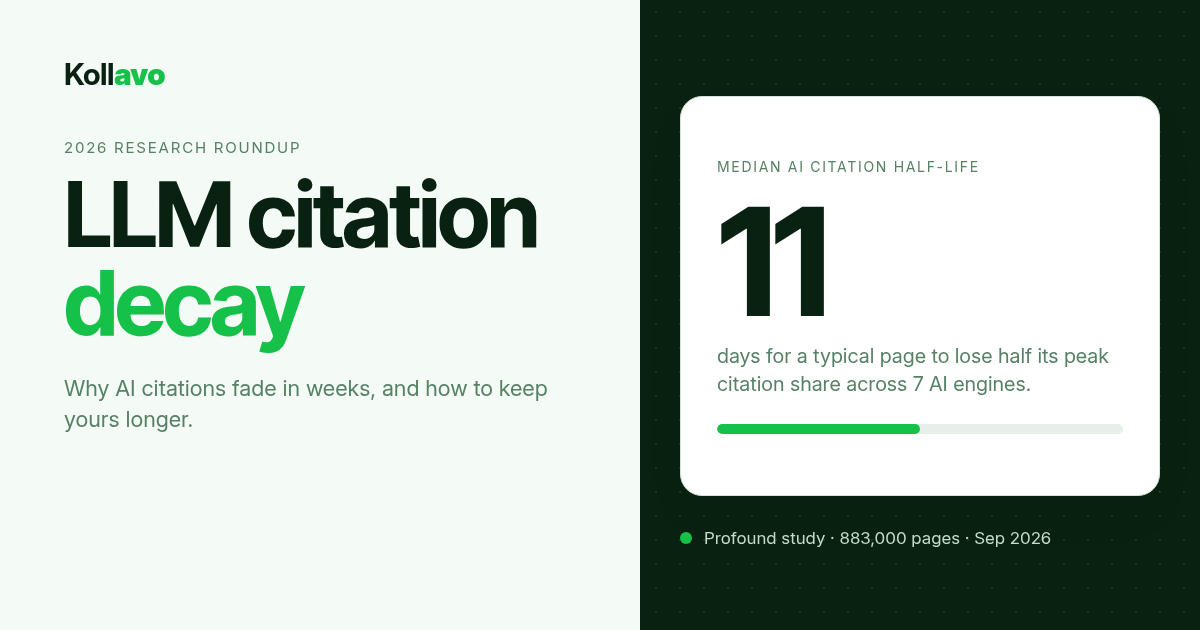
Short answer: LLM citation decay is the drop in how often AI answer engines cite a page after it is first picked up. It is fast. In Profound's 12-month study of 883,000 pages across seven engines, the median page lost half its citation share within 11 days of peaking, and 78% of cited pages fell to half their peak within two weeks. A citation is a position you have to keep earning, not an asset that compounds by itself.
This guide covers what citation decay is, what the 2025–2026 research says about how fast it happens on ChatGPT, Perplexity, Claude and Google's AI surfaces, how to tell real decay from normal day-to-day noise, and a practical playbook to slow it down.
What is LLM citation decay?
LLM citation decay describes how a page's (or a brand's) citations in AI-generated answers fall away over time for the same set of prompts. A page gets cited, often in a burst, reaches a peak share of citations, and then its share declines as the engine rotates in other sources.
Researchers measure it in slightly different ways:
| Term | What it measures | Typical unit |
|---|---|---|
| Citation half-life | Time for a page's (or cohort's) citation share to fall to 50% of its peak | Days or weeks |
| Citation drift | Share of cited domains that are different between two time windows, same prompts | % per month |
| One-and-done rate | Share of cited URLs that appear once and never return in the window | % of URLs |
| Run-to-run overlap | Share of sources repeated between consecutive answers to the same query | % or 0–1 score |
Decay is related to, but not the same as, freshness. Freshness is about how recently a page was crawled or updated. Decay is about what happens to your citations afterwards, even if nothing on your page changed. For how AI crawlers revisit pages, see our guide to the freshness signal and LLM recrawl.
How fast do AI citations decay? What the research shows
Four independent datasets published between mid-2025 and September 2026 point in the same direction: AI citations turn over in weeks, not months.
| Study (published) | Sample | Key decay finding |
|---|---|---|
| Profound, "The half-life of an AI citation is 11 days" (Sep 2026) | 883,000 pages, 7 engines, Sep 2025–Sep 2026 | Median page halves its citation share 11 days after peak; 42 days median from first citation to half-peak |
| Scrunch × Stacker (Mar 2026) | 3.5M citation events, Sep 2025–Mar 2026 | Average source loses half its citation activity in about 4.5 weeks |
| Trakkr Research (updated Mar 2026) | 108,650 URLs; 857K daily brand reports | 73.5% of citation URLs appear once; median brand drops to half in 31 days |
| Ahrefs, AI Overview change study | 43,000+ keywords, 16+ observations each | 45.5% of AI Overview citations change between consecutive observations |
A few details matter more than the headline numbers.
Most citations are single bursts
Profound found that cited pages split into two populations. Burst pages (78%) are cited intensively over a short window and then not again at that rate. Sustained pages (22%) keep getting cited after the first burst and have a median half-life of 27 to 29 days, depending on the engine.
Trakkr's URL-level data shows the same pattern from another angle: 73.5% of citation URLs appeared exactly once in its observation window.
Brands decay slower than individual URLs
Brands have many pages, so brand-level visibility holds longer than any single URL. Trakkr measured a median of 31 days for a brand's citation count to fall to half its peak, with an average week-over-week swing of 51.8%. Only 13.2% of brands held steady. Trakkr also notes that part of that drop is regression from an unusually high peak, which is exactly why you should measure from a stable baseline, not from your best day.
Domain drift compounds over months
An earlier Profound analysis (June vs July 2025, about 80,000 prompts per platform) measured monthly domain-level drift: 59.3% on Google AI Overviews, 54.1% on ChatGPT, 53.4% on Microsoft Copilot and 40.5% on Perplexity. Comparing January with July, drift rose to 70–90%.
Citation decay by AI engine
Which engine cites you changes how long a citation lasts.
| Engine | Scrunch × Stacker half-life | What Profound observed |
|---|---|---|
| ChatGPT | 3.4 weeks (fastest) | Cites a page intensively over a few days, then stops |
| Google AI Mode, Gemini, AI Overviews | 4.3–4.8 weeks | Google's three surfaces correlate with each other (0.12–0.17) |
| Perplexity | 5.8 weeks (longest) | Returns to pages repeatedly, spreading citations over weeks |
| Claude | Not reported separately | A sustained Claude citation is 2.8x as likely as a ChatGPT one to hold half its peak at eight weeks |
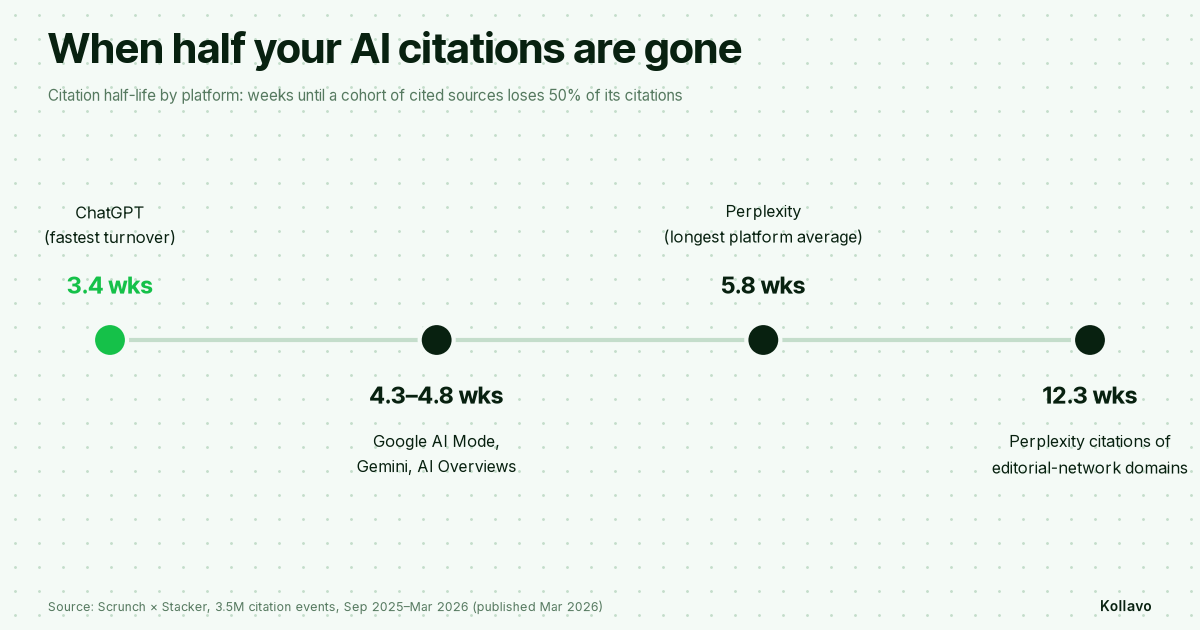
Two findings from Profound change how you should plan:
- Engines decide independently. The correlation between how long a page lasts on one engine and another was 0.03 to 0.09, effectively zero, outside Google's own surfaces. Losing a ChatGPT citation tells you almost nothing about your Perplexity position.
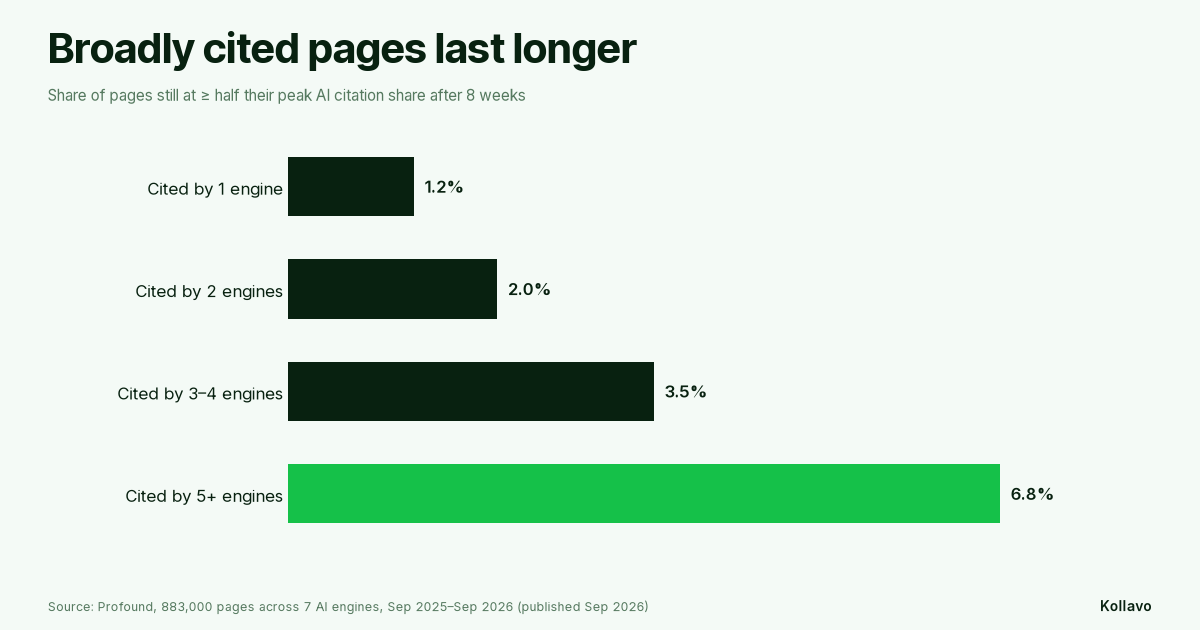
- Breadth predicts durability. Pages cited by five or more engines were 5.5x as likely as single-engine pages to still be above half their peak share after eight weeks (6.8% vs 1.2%, with 2.0% for pages cited by two engines and 3.5% for three to four).
For Google specifically, Ahrefs found AI Overview content changed in 70% of consecutive observations, even though the meaning stayed stable (0.95 semantic similarity). The answer stays the same; the sources rotate. Our Google AI citation analysis guide covers how to log that properly.
Why AI citations decay
No engine publishes its source-selection logic, so treat these as the most likely drivers, supported by the studies above:
- A huge source pool. Profound points out that answer engines draw from a pool several orders of magnitude wider than ten blue links. When the pool is that wide, the chance of a given page being picked again is low.
- Non-deterministic generation. The same prompt produces a different answer and a different source list on each run. Google's documentation notes that AI Overviews and AI Mode may use query fan-out and different models, so supporting links vary (Google Search Central).
- Time-bound content. In Profound's data, "Report" pages (news, announcements, research reports) had the shortest life: 27 days median half-life and 7.0% still above half-peak at day 56, while comparisons and listicles ("Choose") held longest at 29 days and 11.2%.
- New competitors. Every new comparison, review or Reddit thread on your topic is another candidate for the same slot.
- Retrieval access. If a crawler cannot reach the updated page, it cannot be re-cited. OpenAI, for example, says sites opted out of OAI-SearchBot will not be shown in ChatGPT search answers (OpenAI crawler docs).
How to tell real decay from normal noise
Because citations churn on every run, a single missing citation proves nothing. Before you rewrite a page, check these signals:
| Signal | Probably noise | Probably real decay |
|---|---|---|
| Time window | 1–3 days missing | Down for 2+ weeks against a 2–4 week baseline |
| Scope | One prompt, one engine | Many prompts in the same topic cluster |
| Engines | One engine only | Several engines, or your strongest engine |
| Competitors | Same co-cited set, you rotate in and out | A new page or domain consistently takes your slot |
| Your page | Unchanged and indexable | Outdated facts, broken access, or a stale date |
Practical rules:
- Use rates, not snapshots. Track citation rate over a rolling window (for example 14 or 28 days). Our guide to tracking LLM citation rate shows the formula.
- Anchor to a baseline, not the peak. Trakkr warns that measuring from the best day exaggerates decay.
- Track per engine. Since engines decay independently, a blended number hides where the loss happens.
- Watch share, not just presence. A falling share of voice in AI search against named competitors is the clearest decay signal.
A playbook to slow LLM citation decay
You cannot stop decay, but you can lengthen it and re-earn citations faster.
1. Get cited on more engines
Breadth was the strongest durability signal in Profound's data. Check where each priority page is cited today with the AI citation checker or your LLM visibility score, then close engine gaps first (for example, a page cited only on Perplexity).
2. Refresh on a cadence that matches the engine
With half-lives of roughly 3.4 to 5.8 weeks in the Scrunch data, a monthly review of your top cited pages fits most programs, with ChatGPT-heavy categories checked more often. A refresh should add real substance: new data, updated pricing checks, a sharper answer block, a new FAQ.
Keep dates honest. Google's guidance on byline dates says the date should describe when the page was published or significantly updated, and that visible dates and structured data (datePublished, dateModified) should match (Google Search Central). Changing the date without changing the content is not a refresh.
3. Favor evergreen formats for your core pages
Comparisons, how-tos and reference pages decayed slower than news-style pages in Profound's classification. Use announcements to win a burst, then link them into an evergreen page that can keep the citation.
4. Earn placement on durable third-party sources
Scrunch and Stacker found citations from domains in Stacker's editorial partner network lasted twice as long as the average non-network domain. The strongest combination in their data, Perplexity citing a partner-network domain, held for 12.3 weeks. Editorial coverage, trade publications and well-maintained review profiles give you citations that do not depend on one owned URL. Use the citation gap audit to see which third-party sources AI already cites for your competitors.
5. Keep the page easy to retrieve and quote
Make sure AI crawlers are allowed, the page renders without heavy client-side JavaScript, and the key answer sits in a short, self-contained block near the top. Clear headings and tables make a page easier to re-cite when the engine rotates sources.
6. Re-measure the same prompt set
After a refresh, run the same prompts on the same engines for another full window. Compare citation rate and share before and after, not one check against another.
Decay-aware AI visibility reporting
| Metric | Why it matters for decay | Review cadence |
|---|---|---|
| Citation rate per engine (rolling 14/28 days) | Shows whether you are holding position | Weekly |
| Citation share vs competitors | Shows who takes your slot when you rotate out | Weekly or monthly |
| Pages cited on 1 vs 3+ engines | Breadth predicts durability | Monthly |
| Days since last citation, top pages | Early warning for decay | Weekly |
| One-and-done share of new citations | Shows whether wins stick | Monthly |
If you would rather have this run for you (prompt sets, multi-engine tracking, decay alerts and refresh briefs), see Kollavo pricing, start with an AI audit, or compare approaches on /compare.
FAQ
What is LLM citation decay?
It is the decline in how often AI answer engines such as ChatGPT, Perplexity, Claude and Google's AI surfaces cite a page or brand over time for the same prompts. It is usually measured as a citation half-life: the time for citation share to fall to half its peak.
How long does an AI citation last?
It depends on the engine and the page. Profound measured a median of 11 days from peak to half share across 883,000 pages, and 27 to 29 days for pages that keep being cited. Scrunch and Stacker measured an average half-life of about 4.5 weeks, from 3.4 weeks on ChatGPT to 5.8 weeks on Perplexity.
Which AI engine keeps citations longest?
In the Scrunch and Stacker data, Perplexity held citations longest (5.8 weeks) and ChatGPT shortest (3.4 weeks). Profound also found that Perplexity and Claude return to pages repeatedly, and that a sustained Claude citation was 2.8 times as likely as a ChatGPT one to hold half its peak share after eight weeks.
Is optimizing for AI citations a one-time effort?
No. Every study cited here shows citations turning over within weeks. Treat AI visibility as an ongoing program: monitor citation rate per engine, refresh priority pages with real updates, and keep earning third-party coverage.
Does updating content stop citation decay?
Substantive updates can help pages get re-crawled and re-cited, but no study shows updates stop decay. Scrunch notes that recency likely matters but says the exact effect needs more research. Breadth across engines and placement on durable editorial sources had clearer effects in the data.
How often should I check my AI citations?
Weekly checks on a fixed prompt set are a practical minimum for priority topics, reported as rolling 14- or 28-day rates. Trakkr points out that a once-a-quarter audit sees about two half-lives of drift before the next review, given its 31-day median brand half-life.
Is citation decay the same as citation drift?
They are related. Decay follows a page or brand from its peak downward. Drift compares two time windows and measures how many cited domains changed, for example 40.5% to 59.3% month over month in Profound's 2025 analysis.
Bottom line
LLM citation decay is the default state of AI search: most citations are short bursts, and even durable ones halve within about a month. The teams that keep their visibility treat it as a running position. They track rates per engine, spread citations across more engines and third-party sources, refresh core pages with real substance, and re-measure the same prompts before claiming a win.