October 15, 2026 · Kollavo
Google AI Citation Analysis: How to Track What AI Overviews Cite
Google AI citation analysis means tracking AI Overview and AI Mode citations as a rate over many days — not a one-search yes/no. Here's the workflow, metrics, and what 2026 data shows about day-to-day volatility.
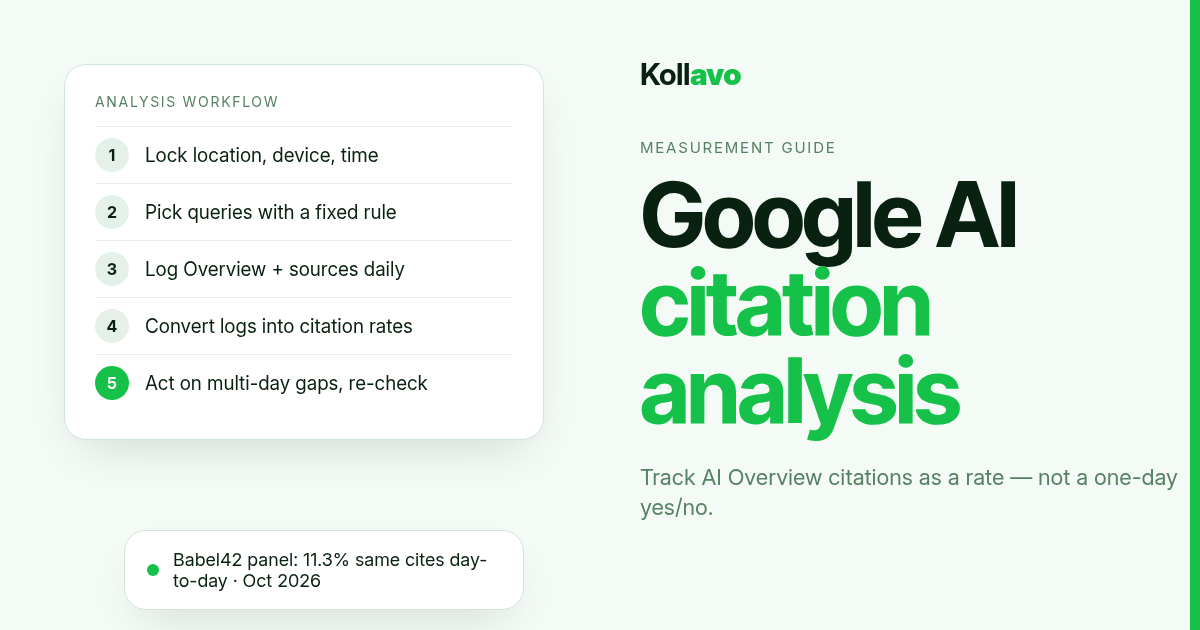
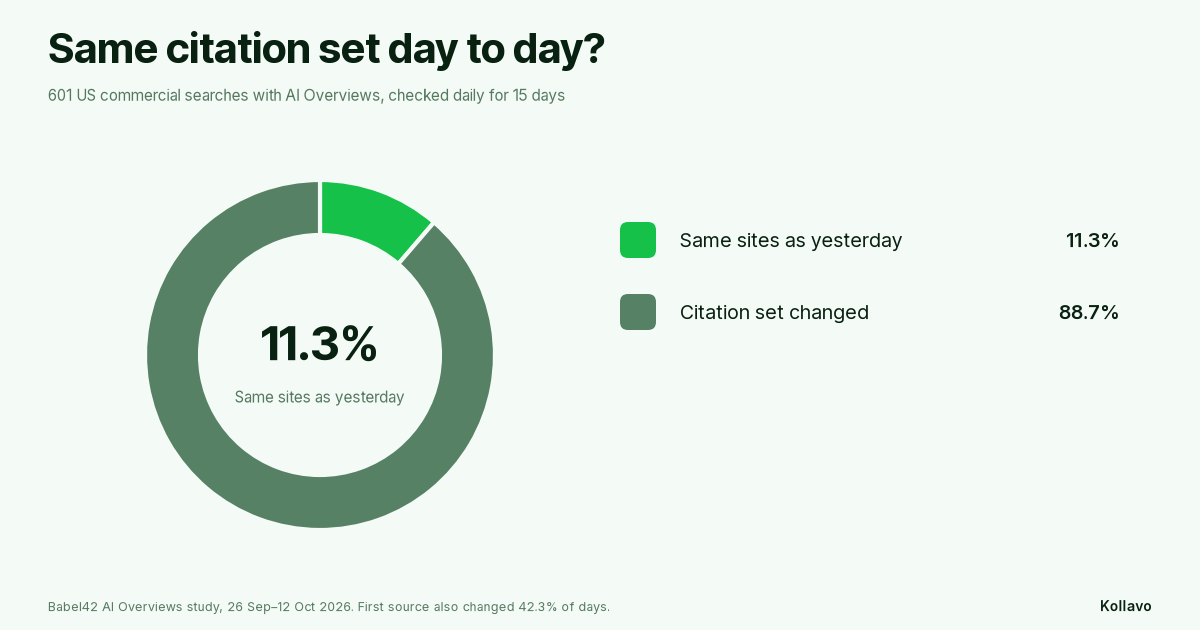
Short answer: Google AI citation analysis means tracking, over many days, whether AI Overviews and AI Mode cite your pages — and which other sources they cite with you. Treat it as a rate, not a yes/no from one search. In a September–October 2026 panel of 601 commercial US searches run daily for 15 days, only 11.3% of AI Overviews cited exactly the same sites as the day before, and the first-listed source changed in 42.3% of searches. One screenshot can look like a win or a loss when it is mostly noise.
This guide is the Google-specific workflow: what to measure, how AI Overviews differ from classic rankings, which fields to log, and how to act on gaps. It is not a product explainer for AI citation checkers in general, and it is not competitor reverse-engineering across ChatGPT and Perplexity — those are covered in separate posts.
What Google AI citation analysis actually means
Google AI citation analysis is the practice of measuring:
- Whether an AI Overview (or AI Mode answer) appears for a tracked query
- Whether your domain or URL is among the supporting links
- Your position in that source list, and which other domains share the answer
- How those observations change when you repeat the same check over days or weeks
Google’s own documentation describes AI Overviews and AI Mode as Search features that surface supporting links so people can dig deeper. Both may use a query fan-out technique — issuing related searches across subtopics — and they may use different models, so the links they show for the same question can differ (Google Search Central).
Eligibility is the same bar as classic Search snippets: the page must be indexed and eligible to appear with a snippet. Google states there are no additional technical requirements and no special schema required to be shown as a supporting link.
Citation vs mention vs ranking
| Concept | What it is | Why it matters for analysis |
|---|---|---|
| Ranking | Position in classic blue-link results | Still useful, but not the same as being cited inside the Overview |
| Mention | Brand named in the Overview text, with or without a link | Visibility without a click path |
| Citation | Your URL (or domain) shown as a supporting source | The core “we got cited” event |
| Citation rate | Share of tracked checks where you were cited | The metric that survives day-to-day volatility |
Search Console rolls AI Overviews and AI Mode into overall Web search performance. Google does not give you a separate “AI Overview citations” report, so citation analysis has to come from SERP observation, third-party trackers, or your own logging — not from a single GSC column.
How Google AI citations differ from classic SEO rankings
Three structural differences change how you analyze results.
1. Presence of the feature is part of the measurement
Classic rank tracking always has a top 10. AI Overviews only appear when Google decides the feature is additive. On high-volume commercial queries, that can be common — Babel42’s 26 September 2026 snapshot found AI Overviews on 90.2% of 600 generic US English searches across six industries — but rates still vary by category (finance and health at 98%, local services at 79% in that sample). Days with no Overview are not “you lost”; they are a different row in the log.
2. Cited pages are not simply “the top 10”
Industry analyses consistently find that Overview sources and organic top-10 lists only partly overlap. Ahrefs’ March 2026 analysis of large SERP samples reported that a substantial share of cited URLs sit outside the classic top 10 (and some outside the top 100). That matches Google’s description of fan-out: the model can pull supporting pages for sub-questions you never ranked for.
3. The source set is volatile day to day
Babel42’s 15-day repeat of 601 searches with AI Overviews (26 Sep–12 Oct 2026) is the clearest public panel on daily change:
| Day-to-day measure | Result |
|---|---|
| Same exact set of cited sites as yesterday | 11.3% |
| First-listed source changed | 42.3% |
| Average sites cited per Overview per day | 6.7 |
| Different sites cited by the same search over 15 days | 17.8 |
| Searches that kept the same first source all 15 days | 14% |
| AI Overviews identical on first and last day | 0.9% |
Industry stability also differs: B2B software had the same site set day-to-day 21.3% of the time; health only 4.0%. If your reporting is a weekly screenshot, you are sampling noise.
The metrics that belong in a Google AI citation dashboard
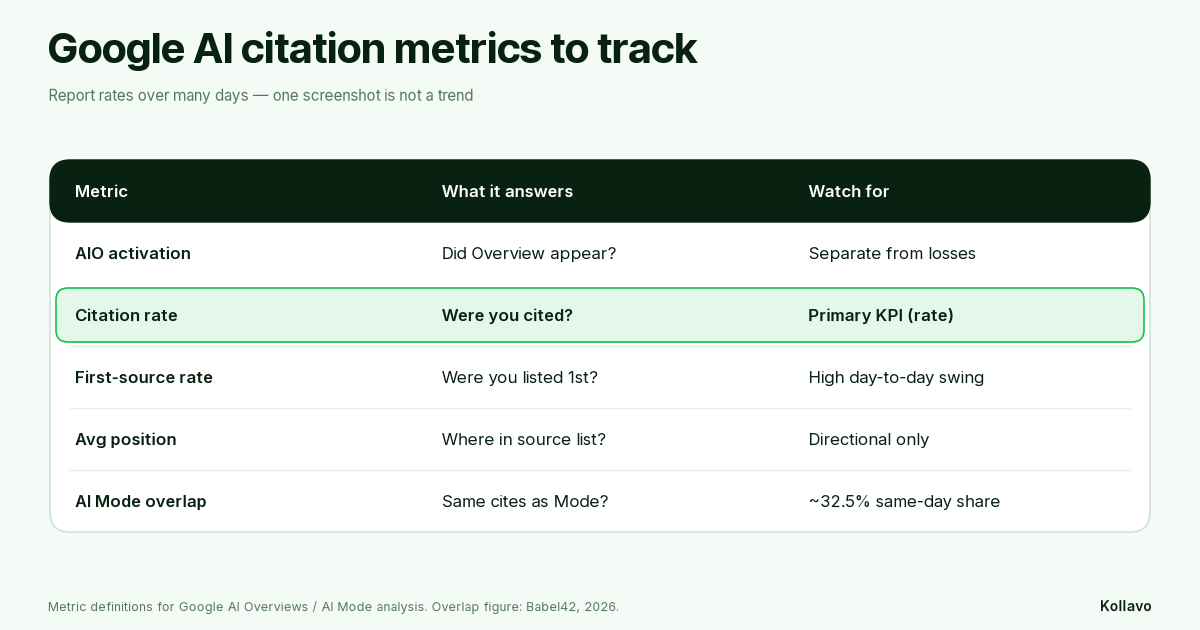
Build the dashboard around rates and distributions, not single-day flags.
| Metric | Definition | How to use it |
|---|---|---|
| AIO activation rate | % of checks where an AI Overview appeared | Separates “no Overview” from “Overview without you” |
| Citation rate | % of checks (or of Overview-present checks) where your domain is cited | Primary KPI; always state the denominator |
| First-source rate | % of Overview-present checks where you are listed first | More volatile; pair with citation rate |
| Average citation position | Mean rank in the source list when cited | Directional; expect swings |
| Citation share (prompt) | Your citations ÷ all citations logged for that prompt set | Useful for competitive share of voice |
| Source-type mix | Share of co-cited domains by type (publisher, review, forum, brand, docs) | Shows which ecosystems you must enter |
| AI Mode overlap | Share of cited domains shared with AI Mode for the same query | Babel42 found average overlap of 32.5% same day — track Mode separately |
| Indirect CTR signal | CTR drops on informational queries with stable position | Proxy only; GSC does not isolate AIO clicks |
For traffic impact, treat CTR patterns as hypothesis tools, not proof. Ahrefs has published large-sample analyses showing CTR declines on informational queries that trigger Overviews (for example, a ~34.5% click decrease in one before/after study design). Use those as context for leadership, then verify with your own GSC cohort of question-shaped queries.
A practical analysis workflow (manual or tool-assisted)
Step 1 — Lock the tracking context
Fix the variables that change what Google shows:
- Country / language (e.g. US English)
- Device (desktop vs mobile)
- Time of day for scheduled checks
- Logged-out or clean profile when possible
Record date_time, query, country, device on every row. If context drifts, your “trend” is garbage.
Step 2 — Choose queries with a fixed rule
Do not only track queries where you already win. Prefer:
- Highest-volume non-navigational queries in your category
- Buyer and research intents (“best…”, “vs”, “how to…”, “[brand] reviews”)
- A mix that actually triggers AI Overviews in your niche
Drop near-duplicates and pure navigational brand-home queries unless you specifically want branded coverage.
Step 3 — Log every check the same way
Minimum fields:
| Field | Example |
|---|---|
aio_present | yes / no |
brand_mentioned | yes / no |
cited | yes / no (your domain) |
citation_position | 1–n or null |
cited_domains | ordered list |
cited_urls | if visible |
ai_mode_domains | separate list if you also check Mode |
notes | personalization quirks, local pack, empty source UI |
Count a domain once per answer even if two of its URLs appear, so the rate does not inflate.
Step 4 — Convert logs into rates
For each query after N days:
- Citation rate = days cited ÷ days checked (or ÷ days with Overview — label which)
- First-source rate = days first ÷ days with Overview
- Co-citation partners = domains that appear with you most often
Fifteen daily checks already show how thin a one-day sample is. Even comparing day one to day fifteen in Babel42’s panel, only 62% of day-one sites were still cited on the last day.
Step 5 — Validate a sample on the live SERP weekly
Automated trackers can drift (UI changes, parsing errors). Spot-check a sample of queries live: does aio_present match? Are the same domains visible? When citations differ, note whether the Overview text also changed — that is expected volatility, not necessarily a bug.
Step 6 — Act on gaps, then re-measure
A gap is a query where competitors (or trusted third-party sources) are cited and you are not, across enough days that it is a pattern. Typical actions:
- Improve or publish the owned page that best answers the fan-out sub-question
- Earn placement on the recurring co-cited publishers (listicles, reviews, docs)
- Strengthen classic SEO for pages that already almost appear
- Re-run the same query set for another full window before claiming a win
Manual methods vs trackers
| Approach | Strengths | Limits |
|---|---|---|
| Manual spreadsheet | Full control, cheap, forces you to see the UI | Does not scale past dozens of queries |
| SERP API + parser | Schedulable, exportable | Parsing breaks when Google changes the UI; cost per query |
| Rank trackers with AIO flags | Familiar keyword UI | Often presence-only; weak on source lists and rates |
| GEO / AI visibility platforms | Multi-engine, history, competitor views | Pricing and coverage vary; validate a sample manually |
Commercial options people compare in this space include Ahrefs Brand Radar, Semrush AI visibility reports, Profound, Peec AI, Otterly, and Kollavo. Check current pricing on each vendor’s site — plans change. Mentions here are for orientation only, not endorsements or live price quotes.
For Google-only work, pair any tracker with:
- The free Google AI Mode Tracker for Mode-specific checks
- The AI citation checker when you need a quick multi-engine presence pass
- The competitor citation map when the question is “who else is in these answers?”
Deeper competitor reverse-engineering across engines is covered in How to Find Which Sources AI Cites for Your Competitors. For the product-level definition of checkers, see What Is an AI Citation Checker?.
How to turn analysis into GEO actions
Citation analysis only pays off when it changes what you publish and pitch.
- Prioritize high-activation queries. If Overviews rarely appear, classic SEO may still dominate that SERP.
- Separate “not cited” from “Overview absent.” Different problems, different owners.
- Chase the recurring co-cited domains. If three review sites appear with your competitors most days, that ecosystem is the work — not another blog post only your team reads.
- Write for fan-out sub-questions. Google Search Central notes that fan-out pulls supporting pages across subtopics; pages that clearly answer those sub-questions become citation candidates even when they are not #1 for the head term.
- Keep AI Mode on a separate board. With ~one-third domain overlap in Babel42’s same-day comparison, Mode wins do not automatically mean Overview wins.
- Re-baseline after major Google UI or model updates. Volatility is normal; a regime shift is not.
If you want this run as a managed program — prompt sets, daily Google AI logging, gap briefs, and content priorities — see Kollavo pricing, the AI audit, or compare approaches on /compare.
FAQ
What is Google AI citation analysis?
It is the measured practice of recording whether Google AI Overviews (and optionally AI Mode) cite your site for a fixed query set, under a fixed location/device context, then reporting rates and trends instead of one-off screenshots.
Is Google AI Overview citation tracking the same as rank tracking?
No. Rank tracking measures classic result positions. Citation tracking measures supporting links inside AI Overviews / AI Mode, plus whether the feature appeared at all. The two overlap only partly.
Why did my citation disappear overnight?
Daily source churn is normal. In Babel42’s 15-day commercial panel, only 11.3% of Overviews kept the exact same cited sites day to day, and the first source changed 42.3% of the time. Judge presence across many days before changing strategy.
Does Search Console show AI Overview citations?
Not as a dedicated citation report. Google includes AI Overviews and AI Mode in overall Web search performance in Search Console. You still need SERP-level observation or a tracker to see which URLs were cited.
Should I track AI Mode separately from AI Overviews?
Yes. Google notes the features may use different models and techniques. Empirical panels find limited same-day domain overlap between Mode and Overviews for the same query, so one rate should not stand in for the other.
How many days of data do I need?
There is no official minimum. Public panels show that 15 daily checks already reveal far more than a single day, and that no commercial query kept an identical source set across the full window. Treat short samples as directional only.
What should I do first if competitors are cited and I am not?
Confirm the gap persists across enough days, list the recurring co-cited domains, and choose an action per source type (owned page upgrade, listicle pitch, review profile, docs/PR). Then re-measure the same queries before claiming improvement.
Are there special technical requirements to get cited in AI Overviews?
According to Google Search Central, pages must be indexed and eligible for a Search snippet. There are no extra technical requirements or special schema for AI Overviews or AI Mode.
Bottom line
Google AI citation analysis is a measurement discipline: fixed context, repeatable logs, rates over time, and separate boards for Overviews vs AI Mode. The headline research takeaway for 2026 is simple — do not trust a single check. Build citation rate and co-citation maps, then spend effort on the gaps that survive a full tracking window.