October 19, 2026 · Kollavo
AI Citation Statistics 2026: What the Latest Studies Show
The AI citation statistics that matter in 2026: ChatGPT cites 3.7 sources per answer vs 20 for Perplexity, only 38% of AI Overview citations rank in Google's top 10, and the median citation fades in 11 days.
Short answer: AI engines cite only a few sources per answer, they rarely agree with each other, and they move on fast. In September 2026 data from Suff Digital, a ChatGPT answer cited 3.7 sources on average against 20 for Perplexity. Ahrefs found that only 38% of pages cited in Google AI Overviews also rank in Google's top 10 for the same query, down from 76% in mid-2025. And Profound measured a median citation half-life of 11 days: that is how long a cited page takes to lose half its citation share after its peak. Getting cited has become its own competition, separate from ranking, and you have to keep winning it.
Below are the AI citation statistics that matter most for marketers in 2026, grouped by question, with the source and sample for each. Every figure comes from a published study.
AI citation statistics at a glance
| Statistic | Figure | Source |
|---|---|---|
| Average sources cited per ChatGPT answer | 3.7 | Suff Digital, Sep 2026 |
| Average sources cited per Perplexity answer | 20 | Suff Digital, Sep 2026 |
| AI Overview citations that also rank in Google's top 10 (same query) | 37.9% (37.1% counting blue links only) | Ahrefs, Mar 2026 |
| The same figure in mid-2025 | 76.1% | Ahrefs, Jul 2025 |
| Cited domains that were cited only once (16,069 citations) | 67% | Hendricks Answer Index, Sep 2026 |
| Best source overlap between two different engines (Jaccard, 0 to 1) | 0.181 | Hendricks Answer Index, Sep 2026 |
| Median AI citation half-life after peak | 11 days | Profound, Sep 2026 |
| Cited pages that fall to half their peak within two weeks | 78% | Profound, Sep 2026 |
| Visits with a click on a classic result: AI summary shown vs not shown | 8% vs 15% | Pew Research Center, 2025 |
| Organic CTR on informational queries: cited in the AI Overview vs not cited | 2.07% vs 0.94% | Seer Interactive, Apr 2026 |
| AI platforms' share of all website traffic | 0.32% | SE Ranking, Jun 2026 |
| Visibility gain from adding citations, quotes or statistics to a page | 30% to 40% | Aggarwal et al., KDD 2024 |
How many sources do AI engines cite per answer?
Suff Digital asked five engines 4,984 questions from a US location on September 23, 2026: 2,984 general questions and 2,000 "best" product questions. For each answer they counted the distinct web pages cited.
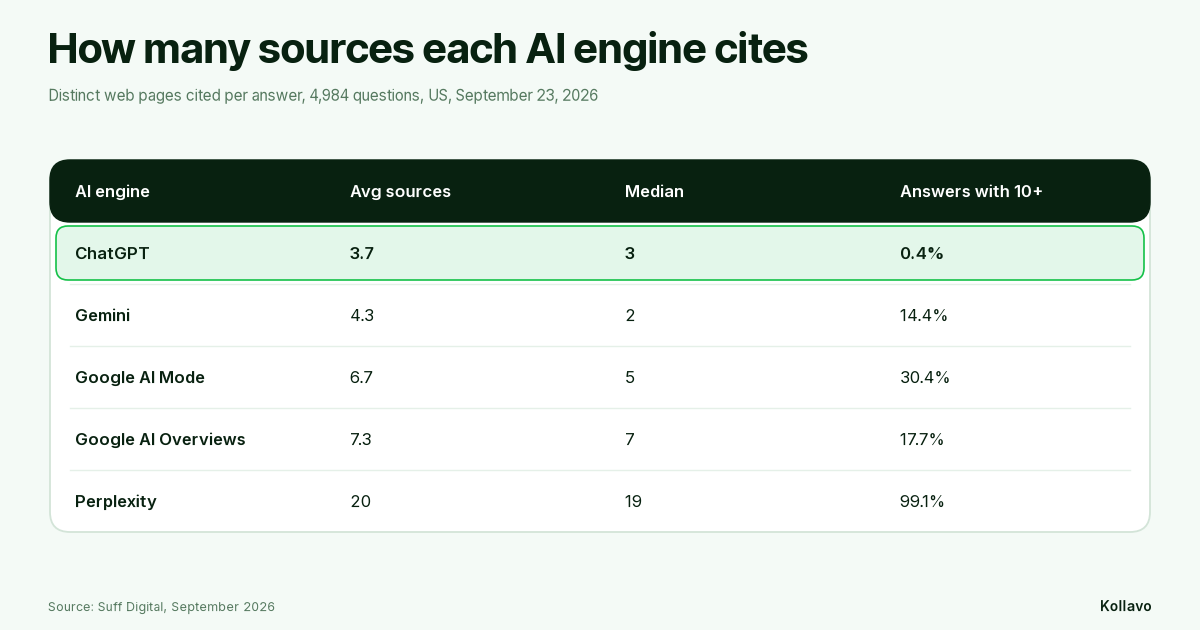
- ChatGPT cites 3.7 sources per answer on average, with a median of 3. Only 0.4% of its answers cite 10 or more pages.
- Gemini cites 4.3 on average, with a median of 2, because it often cites nothing at all.
- Google AI Mode cites 6.7 and AI Overviews 7.3. AI Mode varies the most: 30.4% of its answers cite 10 or more sources, against 17.7% for AI Overviews.
- Perplexity cites 20 on average, with a median of 19, and 99.1% of its answers cite 10 or more.
- Product questions get more sources. Gemini goes from 2.8 sources on general questions to 6.6 on "best" product questions. Perplexity rises from 18.4 to 22.3, AI Mode from 5.8 to 8 and ChatGPT from 3.4 to 4.1. AI Overviews is the exception, at 7.5 and 7.
The Hendricks Answer Index (480 questions, four engines, one API capture on September 1, 2026) found the same order: about 15.3 sources per answer for Perplexity, 10.6 for Gemini, 7.4 per AI Overview panel and 7.1 for ChatGPT when it cited anything. But in that run, ChatGPT (gpt-4.1 with web search, reached through an API rather than the consumer app) cited at least one source in just 15.0% of its 480 answers. Nearly all of those were two question types: "who provides X" (72.9% cited a source) and "what does X cost" (70.8%). On six of the ten question types, including definitions and explainers, it cited nothing in any industry. The other three engines cited something in 93% to 100% of answers.
What this means: on ChatGPT you need to be one of three or four sources, mostly on provider and pricing questions. On Perplexity, being one of 20 useful pages can be enough.
Does ranking on Google still get you cited in AI Overviews?
Less than it used to. Ahrefs has run the same analysis twice:
| Organic position of the cited URL (same query) | July 2025 | March 2026 (all SERP blocks) | March 2026 (blue links only) |
|---|---|---|---|
| Top 10 | 76.1% | 37.9% | 37.1% |
| 11 to 100 | 9.5% | 31.2% | 26.2% |
| Not in the top 100 | 14.4% | 31.0% | 36.7% |
The July 2025 study covered 1.9 million citations from 1 million AI Overviews. The March 2026 study covered 863,000 keyword SERPs and 4 million AI Overview URLs, all from Ahrefs Brand Radar.
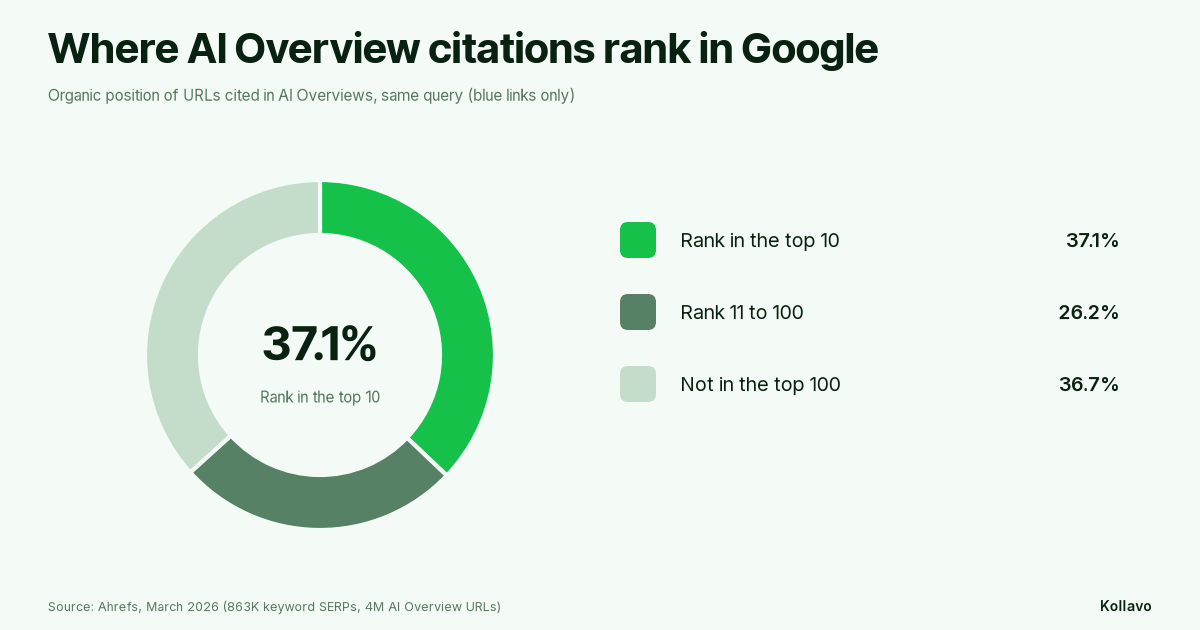
Ahrefs connects the drop to AI Overviews moving to Gemini 3 in January 2026 and to query fan-out. Google's own documentation says AI Overviews and AI Mode may issue "multiple related searches across subtopics and data sources" to build a response, and that the two features may use different models, so their links vary (Google Search Central). Our query fan-out guide explains how to map those sub-questions, and the free query fan-out tool generates them for a topic.
Two more figures from the same Ahrefs study:
- 18.2% of cited pages that did not rank in the top 100 were YouTube URLs, which made YouTube 5.6% of all AI Overview citations in the dataset.
- Ahrefs Brand Radar data shows YouTube as the most cited domain in AI Overviews, up 34% over the previous six months.
Which sources do AI engines cite?
The Hendricks corpus gives one of the clearest public views of the long tail. Across four engines and 480 questions it recorded 16,069 citations from 7,775 distinct domains. Of those domains, 5,201 (67%) were cited exactly once, and the average domain was cited 2.1 times.
Three findings stand out:
- Presence is not the same as share. Reddit appeared in 68.1% of Perplexity's answers but held only 4.45% of its citations, because Perplexity cites around fifteen sources per answer. In AI Overviews, Reddit appeared in 38.3% of panels and held 5.59% of citations. Our analysis of whether Reddit gets cited by AI goes deeper on this.
- AI Overviews love video. YouTube appeared in 47.0% of the 462 AI Overview panels that rendered, against 8.1% of Gemini answers, 2.3% of Perplexity answers and none of ChatGPT's.
- Your own site still counts. Sites owned by companies selling the thing being asked about held 54.0% of all citations, from 64.4% in B2B SaaS to 27.0% in education. Hendricks publishes this as a floor, because its source classifier disagreed with a blind audit on 28% of sampled domains.
For a ranked view of domains, see which sites LLMs cite most.
Do AI engines agree on which sources to cite?
Barely. Hendricks measured the overlap between the sets of domains two engines cited for the same question (a Jaccard score, where 1 means identical lists and 0 means nothing in common):
| Comparison | Mean overlap per question |
|---|---|
| Perplexity vs Google AI Overviews (closest pair) | 0.181 |
| Perplexity vs Gemini | 0.151 |
| Gemini vs Google AI Overviews | 0.151 |
| Any engine vs ChatGPT | 0.020 or lower |
| Perplexity vs itself, re-asked 38 minutes later | 0.900 |
| Google AI Overviews vs itself, 38 minutes later | 0.622 |
Each engine resembles itself far more than it resembles any other engine. Profound found the same pattern over time: the correlation between how long a page stays cited on one engine and on another was 0.03 to 0.09 for every pair except Google's own three surfaces (0.12 to 0.17).
What this means: a single blended "AI visibility" number hides most of the story. Check each engine separately. Our AI citation checker and Google AI Mode tracker report results per engine for that reason.
How long do AI citations last?
Profound tracked 883,000 pages across seven engines (ChatGPT, Perplexity, Claude, Google AI Overviews, Google AI Mode, Gemini and Microsoft Copilot) from September 2025 to September 2026. That gave 1.19 million page and engine lifecycles.
- The median page lost half its citation share 11 days after its peak.
- The median time from first citation to that half-peak point was 42 days.
- 78% of cited pages fell to half their peak within two weeks. The other 22% had a median half-life of 27 to 29 days.
- Among those longer-lasting pages, a Claude citation was 2.8 times as likely as a ChatGPT citation to still be relevant eight weeks later.
- Pages cited by five or more engines were 5.5 times as likely as pages cited by one engine to stay above half their peak after eight weeks (6.8% vs 1.2%).
- News, announcements and research reports faded first on all seven engines.
We cover what drives this, and how to slow it, in our guide to LLM citation decay.
Do AI citations drive clicks and traffic?
Pew Research Center tracked the browsing of 900 US adults in March 2025, covering 68,879 Google searches. About 18% of those searches produced an AI summary. When a summary appeared, users clicked a traditional result in 8% of visits, against 15% when there was no summary. They clicked a link inside the summary in just 1% of visits, and ended their browsing session on 26% of those pages, against 16% without a summary (Pew Research Center).
Seer Interactive tracked 53 brands, 5.47 million queries and 2.43 billion organic impressions from January 2025 to February 2026:
| Informational queries, full-year average | Organic CTR |
|---|---|
| No AI Overview on the page | 3.35% |
| AI Overview shown, brand cited | 2.07% |
| AI Overview shown, brand not cited | 0.94% |
Being cited brought about 120% more organic clicks per impression than not being cited, but still 38% fewer than a page with no AI Overview. Seer also found AI Overviews on 95.4% of comparison queries and 85.9% of question-style queries, against 36% of informational queries overall and 5% of transactional ones. Across all queries, organic CTR on AI Overview pages bounced from 1.3% in December 2025 to 2.4% in February 2026.
SE Ranking analyzed 101,574 websites from January 2025 to April 2026. AI platforms sent 0.32% of all website traffic in 2026, up from 0.24% in 2025 and 0.02% in 2024. Organic search still sent 42.75%. ChatGPT accounted for 74.78% of AI referrals, followed by Gemini (11.56%) and Perplexity (7.23%).
To see what AI traffic you already get, follow our guide to tracking AI referral traffic.
What content changes increase AI citations?
The most cited lab evidence is still the GEO paper from Princeton and IIT Delhi researchers, presented at KDD 2024 (Aggarwal et al.). On a benchmark of 10,000 queries, three edits worked best: citing sources, adding quotations from credible sources, and adding statistics. They lifted visibility in generated answers by 30% to 40% on the paper's position-adjusted word count metric. Keyword stuffing gave little or no improvement. Tested on Perplexity, statistics addition improved one visibility metric by up to 37%. The gains were largest for lower-ranked pages: citing sources raised visibility by 115.1% for pages ranked fifth in search.
This was a controlled benchmark with a 2024-era model, so treat it as a direction, not a guaranteed lift. It supports writing answer capsules with specific, sourced figures, and using the on-page citation anchors that make a passage easy to quote.
Why AI citation statistics disagree
Studies often report very different numbers for what sounds like the same metric:
| Difference | Example from this page |
|---|---|
| Pages vs domains | Suff Digital counts pages per answer; Hendricks counts domains |
| Consumer app vs API | Hendricks reached ChatGPT through an API, which may retrieve differently from the app |
| Presence vs share | Reddit is in 68.1% of Perplexity answers but holds 4.45% of its citations |
| Which answers count | Hendricks' 7.1 ChatGPT figure only covers answers that cited something |
| Time window | Ahrefs' top-10 share fell from 76.1% to 37.9% between two studies eight months apart |
| Query mix | Seer found AI Overviews on 95.4% of comparison queries but 5% of transactional ones |
Use benchmarks to set expectations, then measure your own prompts.
How to turn these benchmarks into your own baseline
- Get a starting point. Run the free LLM visibility score to see how often AI engines mention your brand today.
- Check citations per engine. Use the AI citation checker on your priority prompts. Engines overlap so little that one result tells you almost nothing about the others.
- Find the sources you are missing. The citation gap audit shows which third-party pages AI cites for competitors but not for you.
- Track rates, not snapshots. With an 11-day median half-life, a single check goes stale fast. Follow our guides to LLM citation rate and share of voice in AI search and re-measure weekly.
If you would rather have this done for you, Kollavo tracks your brand across ChatGPT, Gemini and Google AI Overviews and gets you placed in the sources they cite, with plans from $49/month. Start with a free AI audit, or see how we compare with other tools.
FAQ
How many sources does ChatGPT cite per answer?
In Suff Digital's September 2026 test of 4,984 questions, ChatGPT cited 3.7 sources per answer on average, with a median of 3. Only 0.4% of its answers cited 10 or more. Perplexity averaged 20 sources, Google AI Overviews 7.3, Google AI Mode 6.7 and Gemini 4.3.
What percentage of AI Overview citations rank in Google's top 10?
Ahrefs' March 2026 study of 863,000 keyword SERPs found that 37.9% of URLs cited in AI Overviews also appeared in the top 10 results for the same query (37.1% counting blue links only). In July 2025 the figure was 76.1%.
How long does an AI citation last?
Profound's study of 883,000 pages across seven engines found a median half-life of 11 days after a page's citation peak. 78% of cited pages fell to half their peak within two weeks.
Do people click on links in AI answers?
Rarely. Pew Research Center found that Google users clicked a link inside an AI summary in 1% of visits to pages with one. Seer Interactive found that brands cited in an AI Overview still got about 120% more organic clicks per impression than brands that were not cited.
How much website traffic comes from AI platforms?
SE Ranking measured AI platforms at 0.32% of all website traffic in 2026 across 101,574 sites, with ChatGPT sending 74.78% of AI referrals.
Sources
Checked against the original publications in October 2026: Suff Digital, "ChatGPT Cites 3.7 Sources per Answer vs 20 for Perplexity" (September 24, 2026); Hendricks, "The Answer Index" (September 1, 2026, updated October 4, 2026); Ahrefs, "Update: 38% of AI Overview Citations Pull From The Top 10" (March 2, 2026) and "76% of AI Overview Citations Pull From the Top 10" (2025); Profound, "The half-life of an AI citation is 11 days" (September 30, 2026); Pew Research Center (July 22, 2025); Seer Interactive, "AIO Impact on Google CTR: 2026 Update" (April 24, 2026); SE Ranking, AI traffic research study (June 18, 2026); Aggarwal et al., "GEO: Generative Engine Optimization," KDD 2024.