August 10, 2026 · Kollavo Team
Updated 17 November 2026
Which Sites Do LLMs Cite Most? What We See Across Thousands of Answers
AI answers do not pull from random corners of the web. Here are the source types that show up again and again — and what that means for where you publish.
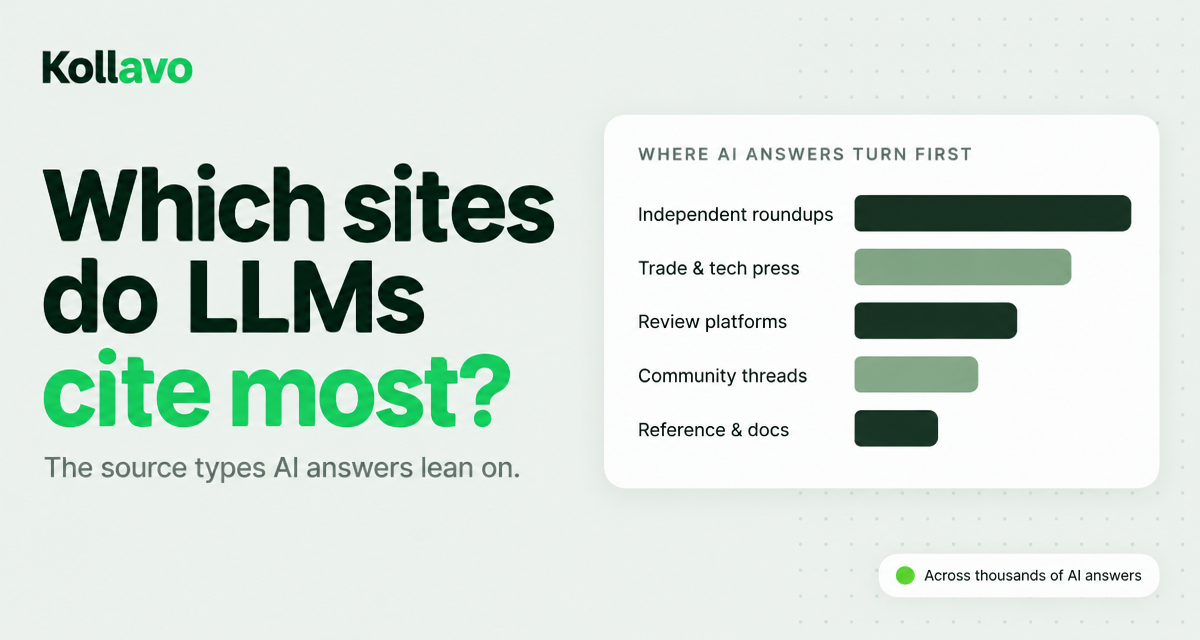
Answer: Across commercial prompts, AI answers cluster around a small number of source types: independent roundups and comparison pages, established trade or tech publications, review platforms, community threads, and reference sites. Vendor-owned pages appear mostly for factual product questions, not recommendations. In Google AI Overviews, YouTube is now the single most cited site; see does YouTube get cited by AI.
The pattern behind the citations
Run the same buyer prompt through several assistants and the cited domains rhyme. That is not coincidence — the models are looking for evidence that is (a) independent of the vendor, (b) comparative, and (c) recent enough to trust.
Grouped by role in the answer:
| Source type | What it supplies | Typical prompts |
|---|---|---|
| Independent roundups | The candidate list itself | "best X for Y" |
| Comparison / alternatives pages | Differentiation and trade-offs | "X vs Y", "X alternatives" |
| Trade & tech publications | Credibility, context, quotes | "is X legit", "who leads in X" |
| Review platforms | Sentiment and recency | "is X any good" |
| Community threads | Real-use detail and gotchas | "does X work for [edge case]" |
| Reference & docs | Hard facts, definitions | "what is X", "how does X work" |
| Vendor sites | Features, pricing, specs | "what does X cost" |
To understand what makes a page citable in the first place, see LLM citations.
Which off-site sources influence LLM answers?
Independent roundups, comparison pages, trade and tech publications, review platforms, community threads and reference sites influence LLM answers for commercial questions. They supply candidate lists, trade-offs, credibility and real-use detail. As this article explains, vendor pages mainly answer factual product questions; inspect your category’s live citations before prioritizing an off-site source.
Why vendor pages lose recommendation queries
A vendor claiming to be the best is the weakest possible evidence for "best". Models behave like a sceptical reader: they use your site to establish what you are, and independent sources to establish whether you are good. That is the single most useful thing to internalise — more detail in why LLMs cite some sources and ignore others.
The practical implication
Your publishing strategy should be split, roughly: For community-source context, read Reddit and AI citations before choosing where to participate. Once you know which sites AI cites, the next step is how to get cited by AI on those sources.
- On your site: answer-shaped pages for factual and use-case questions, plus honest comparison pages. (Ours live at /compare — including where competitors beat us.)
- Off your site: presence inside the independent sources that supply candidate lists for your category.
Ignoring the second half is why plenty of brands with excellent content still never appear in recommendations.
For ChatGPT specifically, our guide on how to get cited by ChatGPT turns this citation pattern into concrete steps.
How to find your citation landscape
Category patterns are useful; your actual landscape is what matters. Two free ways to get it:
- Competitor Citation Map — the sources feeding your competitors' answers.
- Citation Gap Audit — prompt-level gaps with the specific source that would close each one.
Then baseline the number with the LLM Visibility Score.
How to reverse engineer LLM citations
To reverse engineer LLM citations, repeat a fixed buyer prompt set across engines, log cited URLs and inspect the passages behind them. Classify the source types and answer formats that recur, then compare them with your pages. Fill useful on-site gaps or pitch relevant publishers, using actual citations rather than estimated source lists as evidence.
- Fix a prompt set that reflects your buyers’ questions.
- Run each prompt several times per engine, keeping the testing context consistent.
- Log every cited URL and domain.
- Classify each source by type and inspect the cited passage: definition, list, table, first-party data, freshness and whether it names the entity.
- Compare with your own page and either fill the gap on-site or pitch the source. Learn to find the sources AI cites for your competitors, and use the estimated competitor citation map as a shortlist to verify.
What makes a source get cited repeatedly
Not domain authority alone. The sources that recur tend to share:
- A clear, answer-shaped structure with tables and named options
- Visible update dates and genuinely maintained content
- Named authors and stated methodology
- Topical focus rather than general-interest sprawl
Which also describes what your own pages should look like — see citation anchors: the on-page signals that make LLMs quote you.
FAQ
Which off-site sources influence LLM answers?
Independent roundups, comparison pages, trade and tech publications, review platforms, community threads and reference sites influence LLM answers for commercial questions. They supply candidate lists, trade-offs, credibility and real-use detail. As this article explains, vendor pages mainly answer factual product questions; inspect your category’s live citations before prioritizing an off-site source.
What are the top cited sources in LLMs?
The recurring source types in this article are independent roundups, comparison and alternatives pages, trade and tech publications, review platforms, community threads, and reference or documentation sites. Vendor pages supply features, pricing and specifications. There is no universal domain ranking here: the leading sources depend on your category and buyer prompts.
How do I see which links LLMs cite for my category?
Run your category’s buyer prompts in live AI engines and log every cited URL, domain and date across repeated answers. Use the AI citation checker for an estimated single-prompt assessment and the competitor citation map for likely source opportunities. Neither verifies live links, so confirm each URL before treating it as evidence.
How can I reverse engineer what LLMs are citing?
Reverse engineer what LLMs cite by fixing a buyer prompt set, repeating each prompt per engine and logging every cited URL and domain. Classify source types and inspect the cited passages for definitions, lists, tables, first-party data, freshness and entity names. Compare those patterns with your pages, then fill gaps or pitch relevant competitor sources.
Choosing where to place
When evaluating a publication for a placement, ask:
- Does it already appear in AI answers for my prompts? (Check, do not assume.)
- Is it topically relevant, or a general site that publishes anything?
- Does it maintain and date its content?
- Would a buyer recognise it?
Cheap placements on unfocused sites tend to do nothing. A relevant, maintained, already-cited publication is worth several of them — which is the logic behind how we vet our own 700+ site inventory.
Related: do press releases get cited by AI? and how to earn citations in trade publications.