November 18, 2026 · Kollavo Team
AI Citation Overlap: How Often ChatGPT, Gemini and Google AI Cite the Same Sources (2026)
AI citation overlap explained with 2026 data: AI Mode and AI Overviews share 13.7% of cited URLs, ChatGPT shares about 5% of domains with other engines, and ChatGPT repeats only about 16% of its own URLs between runs. How to measure overlap and what to do about it.
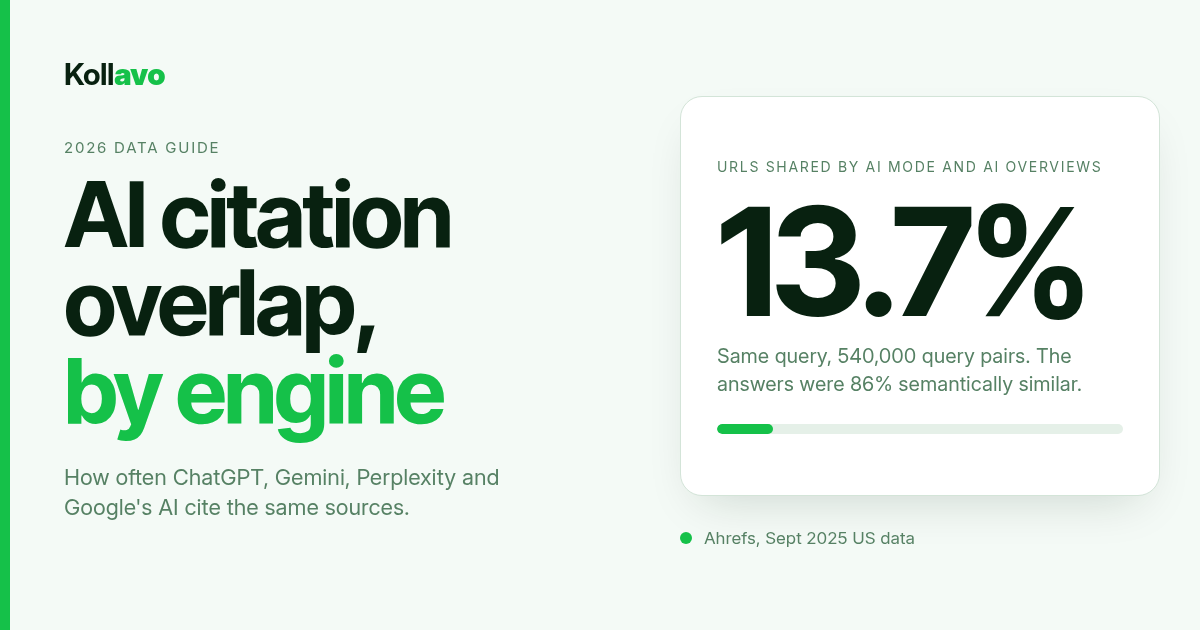
Short answer: AI citation overlap is the share of sources two AI answers have in common for the same question. Across engines it is low. In Ahrefs' study of 540,000 query pairs, Google AI Mode and AI Overviews cited the same URLs only 13.7% of the time, even though their answers were 86% semantically similar. BuzzStream found 76.1% of citations appeared on just one of four platforms and 0.8% on all four. ChatGPT overlaps least: about 5% of domains per question with Claude, Gemini or Perplexity in Tonecast's October 2026 data. Even the same engine repeats itself only partly. In our own ChatGPT panel, two runs of the same question shared about 16% of cited URLs.
So a citation on one engine says little about the others. Track each engine separately, measure overlap the same way every time, and put your effort into the few sources that show up across engines.
Below: how citation overlap is measured, what the main studies found, how much ChatGPT overlaps with itself, and what to do about it.
What citation overlap means
An AI citation is a link an AI answer attaches as a source. Citation overlap compares two sets of those links. The two sets can be:
- Two engines answering the same question (ChatGPT vs Perplexity, AI Overviews vs AI Mode)
- Two runs of the same engine on the same question (today vs an hour later)
- Two dates (this week's answers vs last week's)
- AI vs search: the pages an AI answer cites vs the pages that rank in Google's top 10 for the same query
The word gets used for all four, which is why published numbers seem to disagree. A 13.7% figure and a 59% figure can both be correct if one counts exact URLs for a single query and the other compares each engine's top 100 domains across a whole prompt set.
How to measure it
There are two common formulas. Pick one and keep it.
| Measure | Formula | Example (A cites 10 domains, B cites 4, 2 shared) | Best for |
|---|---|---|---|
| Jaccard similarity | shared ÷ all distinct sources in either set | 2 ÷ 12 = 0.17 | Comparing engines of similar citation volume |
| Overlap coefficient | shared ÷ size of the smaller set | 2 ÷ 4 = 0.50 | Asking "of what the smaller engine cites, how much does the bigger one also cite?" |
| Single-platform share | sources cited by one engine only ÷ all sources | depends on pool | Showing how fragmented a prompt set is |
Two more choices move the number as much as the formula:
- URL or domain. Domain overlap is always higher. Two engines often cite the same site but different pages on it.
- Per question or pooled. Overlap per question (then averaged) is lower than overlap between two engines' overall top-domain lists, because aggregate lists converge on big sites like Wikipedia, YouTube and Reddit.
Jaccard also punishes volume gaps. Perplexity attached about 22 links per answer in Tonecast's data and ChatGPT 2.5, so even if every ChatGPT link also appeared in Perplexity, their Jaccard score would stay low. That is why one small study of five engines reported a mean Jaccard of 0.08 but a mean overlap coefficient of 0.25 on the same data.
What the studies found
| Study | Engines | What was compared | Headline overlap |
|---|---|---|---|
| Ahrefs, AI Mode vs AI Overviews (Sept 2025 US data) | AI Overviews, AI Mode | Exact URLs, same query, 540,000 query pairs | 13.7% of citations shared; 16.3% for the top 3 citations |
| BuzzStream (2026) | ChatGPT, Gemini, AI Overviews, AI Mode | URLs per prompt, 595 prompts, 30,000 citations | 76.1% on one platform only, 0.8% on all four; closest pair AI Overviews and AI Mode at 37.4% Jaccard |
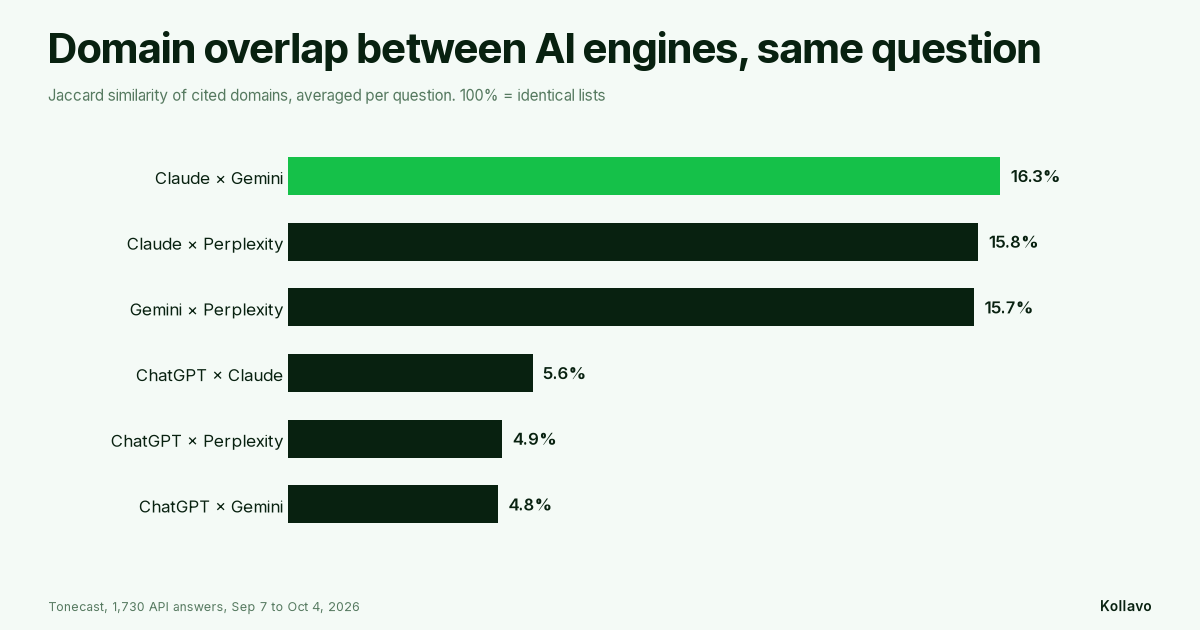
| Tonecast (Sep 7 to Oct 4, 2026) | ChatGPT, Claude, Gemini, Perplexity | Domains per question, 1,730 answers | 77.2% of question-domain pairs cited by one engine, 0.9% by all four; ChatGPT about 5% with each other engine |
| LIFE, Inc. (Feb 27 to Mar 29, 2026, Japanese queries) | ChatGPT, Gemini, Perplexity, AI Overviews | Domains per query-day, 9,891 citations | Highest pair Perplexity and AI Overviews 18.9%; ChatGPT pairs 6.0% to 6.9% |
| Ahrefs, AI vs Google top 10 (Aug 2025) | ChatGPT, Gemini, Copilot, Perplexity | AI-cited URLs vs Google top 10, 15,000 prompts | 12% on average; Perplexity 28.6%, the others about 8% |
Four patterns repeat across all of them.
1. Google's two AI surfaces are the closest pair, and still mostly different. AI Overviews and AI Mode came out on top in BuzzStream's data (37.4%) and share a search index, yet Ahrefs found 87% of the time they cite different URLs. A win in one is not a win in the other, which is why we keep them on separate boards in Google AI citation analysis.
2. ChatGPT is the outlier. Every multi-engine study puts ChatGPT furthest from the rest. Part of it is volume: Tonecast found ChatGPT cited sources in only 54.8% of answers, because it cites nothing when it answers from memory rather than searching (see training data vs live retrieval). Part of it is retrieval. When Ahrefs ran 118,931 of ChatGPT's own search queries through Google, only 6.82% of ChatGPT's results were in Google's top 10.
3. AI citations and Google rankings overlap less than most teams assume. Ahrefs found that about 80% of the URLs cited by ChatGPT, Gemini, Copilot and Perplexity did not rank anywhere in Google for the original prompt. Engines split a question into sub-queries (query fan-out) and cite pages that answer those, not only the head term. Google's AI Overviews track rankings more closely, but less than they used to: Ahrefs found 76% of their top three citations ranked in the top 10 in July 2025, and its March 2026 update, counting every cited URL, found 37.9%.
4. Agreement concentrates on a few source types. When all four platforms in BuzzStream's study cited the same URL, 35% of the time it was Wikipedia, mostly for "what does this company do" prompts. Yet Wikipedia was only 3.8% of all citations. Most citations are long-tail and engine-specific.
How much does an engine overlap with itself?
Cross-engine overlap only means something next to a baseline: how often one engine cites the same sources twice. We measured that in Kollavo's buyer-question panel. It runs 52 questions about AI visibility tools and GEO services through ChatGPT (OpenAI API, web search on) three times each, on four dates between October 23 and November 9, 2026: 624 answers in total.
| Comparison (same question) | URL overlap (Jaccard) | Domain overlap (Jaccard) |
|---|---|---|
| Two runs on the same day | 0.15 to 0.17 | 0.29 to 0.34 |
| Same week vs 17 days later (Oct 23 vs Nov 9, all runs pooled) | 0.19 | 0.34 |
| Share of a question's sources cited in all 3 same-day runs | 4.8% to 7.4% | 18.2% to 21.0% |
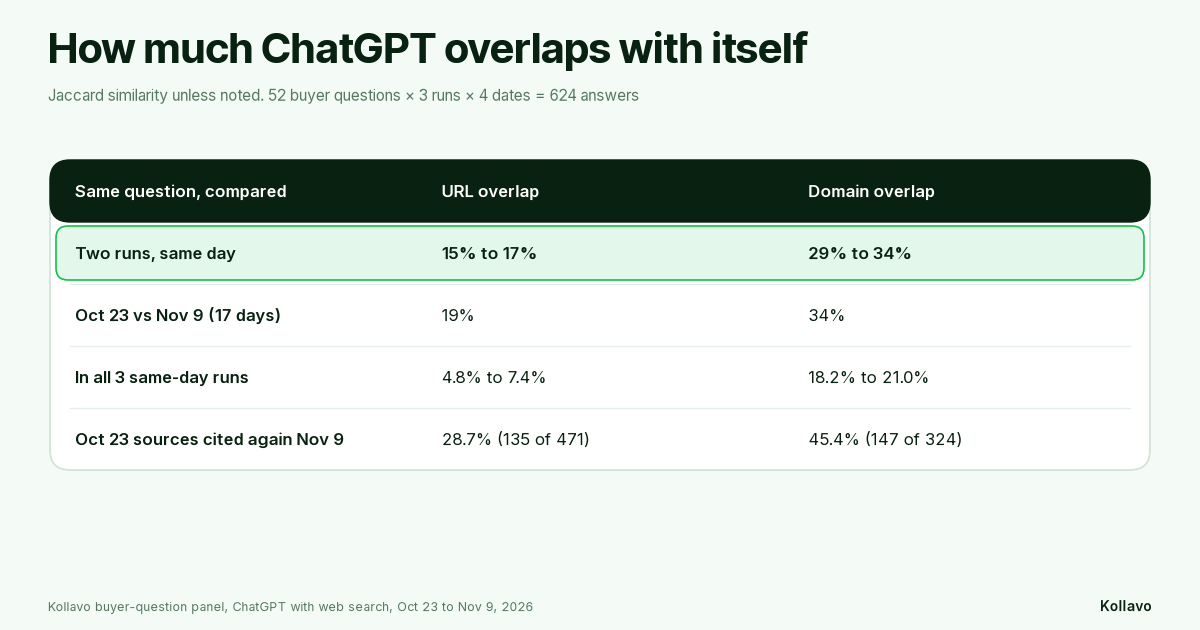
Two more numbers from the same panel: 28.7% of the URLs ChatGPT cited for a question on October 23 (135 of 471) were cited again for that question on November 9, and 45.4% of the domains (147 of 324). Answers carried 3.5 to 3.8 cited URLs on average, and 12 to 18 of the 156 answers each week cited nothing.
That matches outside data. Ahrefs reports that 45% of AI Overview citations change between generations, and Strandline Research found ChatGPT cited 23.9% of the same pages again the next day, against 82.3% for Perplexity.
The practical reading: if ChatGPT only shares about a sixth of its URLs with itself from one run to the next, a single screenshot is not evidence of anything. It also means low cross-engine overlap is partly noise. Engines might pull from a larger common pool than one snapshot shows, which Ahrefs also notes. For the full picture of run-to-run change, see AI citation volatility.
Why engines cite different sources
- Different indexes. Gemini and AI Overviews draw on Google's index, Copilot on Bing's, Perplexity on its own crawler, and ChatGPT on a mix. Ahrefs' fan-out analysis suggests ChatGPT combines several sources and re-ranks them.
- Different searches. Engines rewrite the prompt into their own sub-queries, and the number varies. Ahrefs found ChatGPT ran 1.78 searches per prompt on average.
- Different volume. An engine that attaches 20 links per answer will cite pages a 3-link engine never shows.
- Different source preferences. In Ahrefs' data, YouTube led AI Overview citations while AI Mode leaned more on Wikipedia and cited Quora 3.5 times as often. Tonecast found Gemini cited Reddit in 21.9% of answers while ChatGPT and Claude cited it in none of 850.
- Answering from memory. When ChatGPT does not search, it cites nothing at all, which drags its overlap toward zero.
What low overlap means for your GEO plan
- Measure each engine separately. One blended "AI visibility" score hides most of what is going on. Use a fixed prompt set and log citations per engine, as covered in share of voice in AI search.
- Run each prompt at least three times. With same-day URL overlap around 0.16 in our panel, one run per prompt per week is not enough to tell a real loss from rotation.
- Find the shared sources first. Pool all engines' citations for your buyer questions and rank domains by how many engines cite them. Sources cited by two or more engines give the best return on a placement, because one mention compounds across engines. Our competitor citation map and AI citation gap analysis walk through this.
- Then fill engine-specific gaps. For ChatGPT, that usually means comparison pages and third-party roundups it can find through its own searches (how to get cited by ChatGPT). For AI Overviews, classic rankings still help most, including rankings for the sub-queries Google fans out to.
- Do not copy "most cited domains" lists. BuzzStream's conclusion is blunt: what gets cited depends on the platform and the prompt. Use the sources cited for your own questions, not an industry average. Our AI citation statistics roundup gives the benchmarks, not a target list.
- Report overlap as a range. State the formula, the unit (URL or domain), the number of runs and the dates. Otherwise next month's number will not be comparable.
How Kollavo handles it
Kollavo tracks your buyer prompts on ChatGPT, Gemini and Google AI Mode separately, logs which URLs each one cites, and flags the sources that appear across engines so outreach goes where it counts twice. Plans start at $49/month (Entry), $99/month (Managed), and Autopilot from $549/month for done-for-you placements; see pricing. To check a single question first, run the free AI citation checker or the citation gap checker, or request an AI visibility audit. Comparing tools instead? Start with our comparison hub.
FAQ
What is AI citation overlap? The share of sources two AI answers have in common for the same question, usually measured as Jaccard similarity (shared sources ÷ all distinct sources). It can compare two engines, two runs of one engine, two dates, or AI citations against Google rankings.
Do ChatGPT, Gemini and Perplexity cite the same sources? Rarely. In Tonecast's 2026 study, 77.2% of the domains cited for a question came from one engine only and 0.9% from all four tested. ChatGPT shared about 5% of domains per question with each of the others; Claude, Gemini and Perplexity about 16% with each other.
How much do Google AI Overviews and AI Mode overlap? Ahrefs found they cited the same URLs 13.7% of the time across 540,000 query pairs (16.3% for the top three citations). BuzzStream measured 37.4% Jaccard similarity, the highest of any pair in its study. Both are Google, but treat them as separate channels.
Why is overlap higher for domains than for URLs? Engines often cite the same site but a different page on it, such as a different help article or review. Domain overlap tells you where to get coverage; URL overlap tells you which exact page earns the citation.
Does ranking in Google's top 10 get me cited by AI assistants? Only partly. Ahrefs found 12% of URLs cited by ChatGPT, Gemini, Copilot and Perplexity ranked in Google's top 10 for the same prompt, though Perplexity reached 28.6%. Google's AI Overviews follow rankings more closely: 37.9% of their cited URLs ranked in the top 10 in Ahrefs' March 2026 update.
How often should I measure citation overlap? Weekly, on a fixed prompt set, with at least three runs per prompt per engine. In our ChatGPT panel, two runs of the same question on the same day shared only 15% to 17% of URLs, so fewer runs mostly measure noise.
Sources
- Ahrefs, "Are AI Mode and AI Overviews Just Different Versions of the Same Answer?" (September 2025 US Brand Radar data, 540,000 query pairs for citations)
- Ahrefs, "Only 12% of AI Cited URLs Rank in Google's Top 10 for the Original Prompt" (August 2025, 15,000 prompts)
- Ahrefs, "Is ChatGPT Really Powered by Google? 118,931 Fan-Out Queries Analyzed"
- Ahrefs, "76% of AI Overview Citations Pull From the Top 10" (July 2025) and "Update: 38% of AI Overview Citations Pull From The Top 10" (March 2026)
- BuzzStream, "AI Citation Overlap: Do AI Platforms Cite the Same Sites?" (updated June 29, 2026)
- Tonecast, "What do AI assistants cite? 19,713 citations from ChatGPT, Claude, Gemini and Perplexity" (published October 7, 2026, data September 7 to October 4, 2026)
- LIFE, Inc., "Citation Overlap Across 4 AI Engines" (data February 27 to March 29, 2026)
- Strandline Research, "ChatGPT, Perplexity, Gemini and Claude rarely cite the same page for the same buyer question" (data July 27 to September 9, 2026)
- GetCited Labs, "Five AI Engines, One Question" (Jaccard vs overlap coefficient example)
- Kollavo AI buyer-question panel: 52 questions, ChatGPT via OpenAI API with web search, 3 runs each on October 23, October 26, November 2 and November 9, 2026