October 29, 2026 · Kollavo Team
Digital PR for AI Search: How Earned Media Gets You Cited (2026)
More than 84% of AI citations come from earned and third-party sources, and 0.3% from paid content. How digital PR for AI search works, which outlets ChatGPT, Gemini, Claude and Perplexity cite, a six-step process, pitch formats that get quoted and how to measure results.
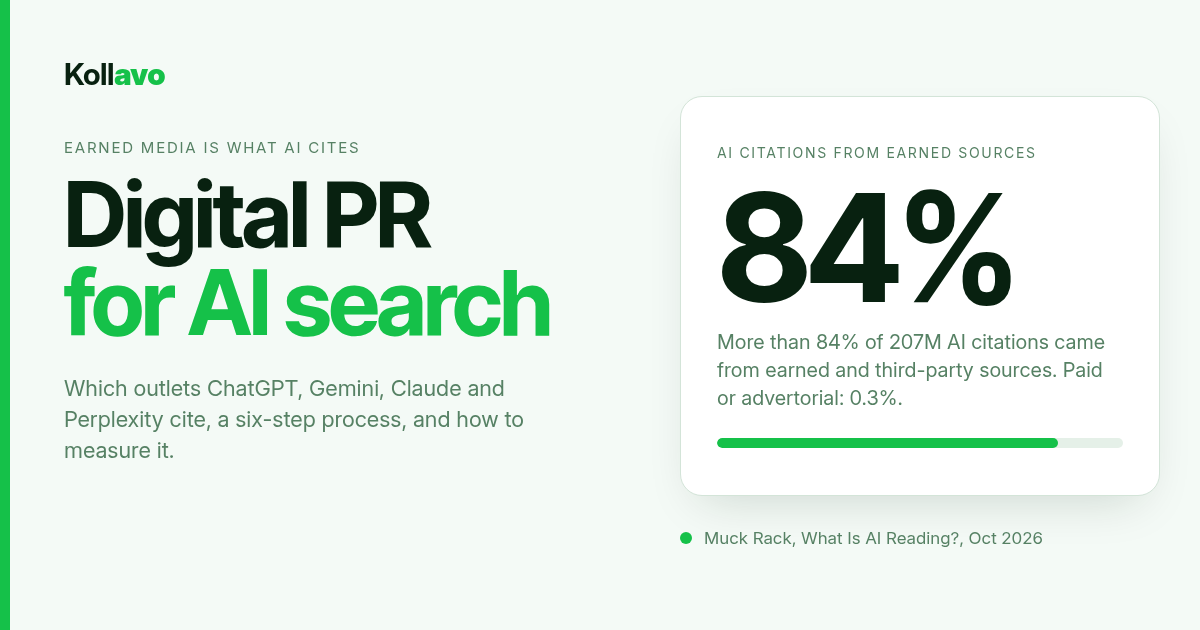
Short answer: Digital PR for AI search is earning coverage on the independent sites that ChatGPT, Gemini, Claude and Perplexity cite when they answer questions about your category. It matters because those sites supply most of the sources. In Muck Rack's October 2026 study of 207 million AI citations, more than 84% came from earned and third-party sources and just 0.3% from paid or advertorial content. Good AI-focused PR starts from the prompts buyers ask, targets the outlets already cited for them, pitches data that can be quoted, and measures citation rate over repeated runs, not just coverage counts.
Below: which sources AI engines cite, a six-step process, pitch formats that get quoted, and how to measure results. To see where you stand first, run the free AI visibility audit.
What is digital PR for AI search?
Classic digital PR earns links and coverage to build search rankings, referral traffic and brand awareness. Digital PR for AI search (also called PR for GEO or AI visibility PR) has a narrower goal. It earns mentions on the specific pages that AI engines retrieve and quote, so that your brand is named in the generated answer itself.
The difference shows up in three places:
| Classic digital PR | Digital PR for AI search | |
|---|---|---|
| Starting point | A media list or a campaign idea | The prompts buyers type into AI tools, and the pages AI cites for them |
| Success metric | Links, domain authority, coverage volume | How often you are named or cited when those prompts run, per engine |
| Best target | Highest-authority outlet that will run the story | The outlet AI already cites for your topic, even if it is a niche trade title |
| Shelf life | Years (the link keeps passing value) | Weeks to months (recent coverage is cited far more) |
| What gets quoted | Headlines and brand stories | Specific facts, numbers and comparisons inside the article |
It is a subset of earned media work. The craft is the same; what changes is how you choose targets and judge results.
Why earned media drives AI citations
The evidence is consistent across studies that use different methods.
| Finding | Number | Source |
|---|---|---|
| AI citations from earned and third-party sources (journalism, government, encyclopedic, academic, third-party corporate) | More than 84% (82% to 89% across four editions) | Muck Rack, October 2026 |
| AI citations from paid or advertorial content | 0.3% | Muck Rack, October 2026 |
| AI citations from journalism | 22%, down from 27% in May 2026 | Muck Rack, October 2026 |
| AI citations from brand-owned media | 15.2%, up from 13.7% | Muck Rack, October 2026 |
| Domains cited by all four of ChatGPT, Claude, Gemini and Perplexity | 212 | Muck Rack, September 2026 sample |
| Earned share of cited sources on "best X" style consideration queries | 59% to 86% across AI engines | Chen et al., University of Toronto, 2026 |
| Strongest correlate of Google AI Overview brand visibility | Branded web mentions (0.664), against 0.218 for backlinks | Ahrefs, 75,000 brands |
Muck Rack's October 2026 "What Is AI Reading?" report draws on more than 40 million AI responses and 207 million citations from January to September 2026, plus a fresh set of 1,020 prompts run across ChatGPT, Claude, Gemini and Perplexity in September.
The University of Toronto team behind "Generative Engine Optimization: How to Dominate AI Search" found the same pattern in controlled tests: AI search leaned heavily toward earned media over brand-owned and social content, while Google returned a more balanced mix. In their follow-up study, presented at an EDBT/ICDT 2026 workshop, Google's sources split 41% earned, 34% social and 26% brand. Claude 4.5 Sonnet cited 65% earned sources and 1% social; GPT-4o cited 57% earned.
In its study of 75,000 brands, Ahrefs found branded web mentions correlated with Google AI Overview visibility far more strongly than backlinks. A mention without a link still counts.
Journalism's share is falling. Does PR still matter?
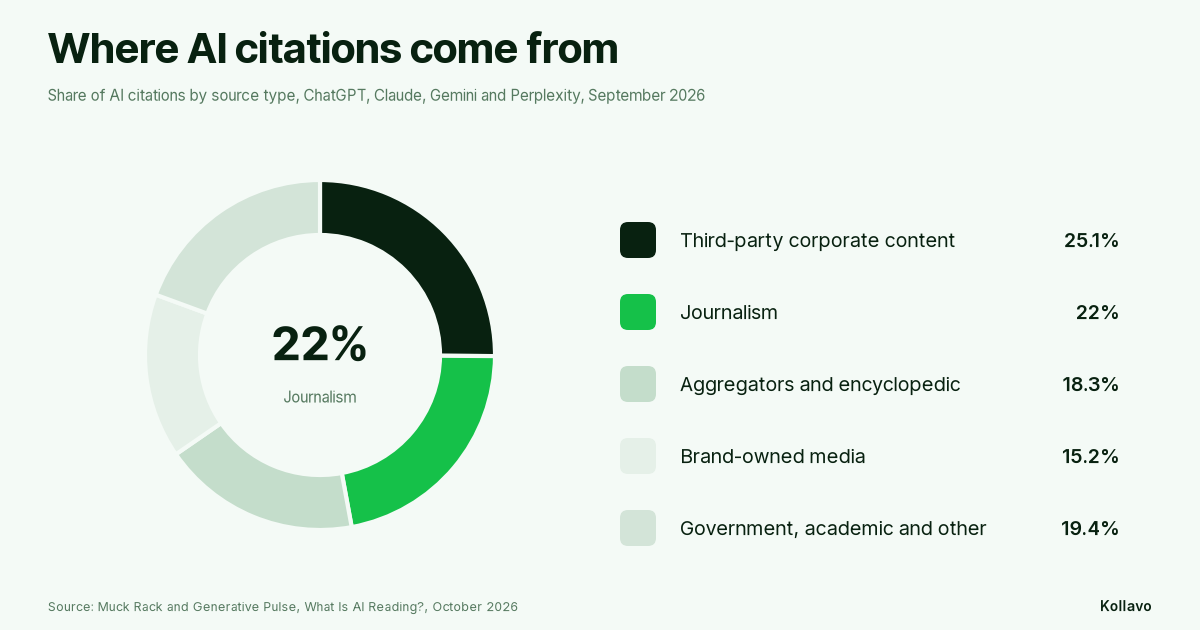
Yes, but the target has moved. Journalism dropped from 27% to 22% of AI citations between May and September 2026, the largest shift Muck Rack has recorded. ChatGPT drove most of it: journalism fell from 28.1% of its citations in January to 22% in September, and several major publishers went to near zero in ChatGPT even though they still allowed OpenAI's search crawler. Claude moved from about 28% to 24% and Gemini from 27.6% to 23.6%.
Brand-owned media gained a little (13.7% to 15.2%), but most of the share moved to other third-party sources: government and NGO sites (8.6% to 9.6%), aggregators and encyclopedic sites (17.4% to 18.3%), academic research (4.0% to 4.4%) and third-party corporate content (24.0% to 25.1%). That last category covers other companies' blogs, guides and comparison pages, where many "best X" answers come from. Government, academic and all other sources together make up the remaining 19.4%.
So "PR for AI" should mean third-party validation in general, not news coverage alone:
- Journalism still matters most for news and trend questions: 49% of citations on recency-implied queries in Muck Rack's earlier research.
- Trade and niche publications matter for category questions, because engines pick topic-specific outlets when the question is specific. Our guide to earning citations in trade publications covers the outreach side.
- Third-party comparison pages, listicles and reviews carry most "best tool for X" answers. See how to get AI mentions for that playbook.
Why each AI engine needs its own list
Engines draw from different parts of the web. Only 212 domains were cited by all four major providers in Muck Rack's September sample, and in the University of Toronto study GPT-4o's cited domains overlapped with Google's top 10 by just 4.0% on average. Crawler access matters too: 81% of major publishers blocking Claude's search crawler received almost no Claude citations, against 12% of those allowing it (Muck Rack). So build your target list per engine, from the prompts you care about.
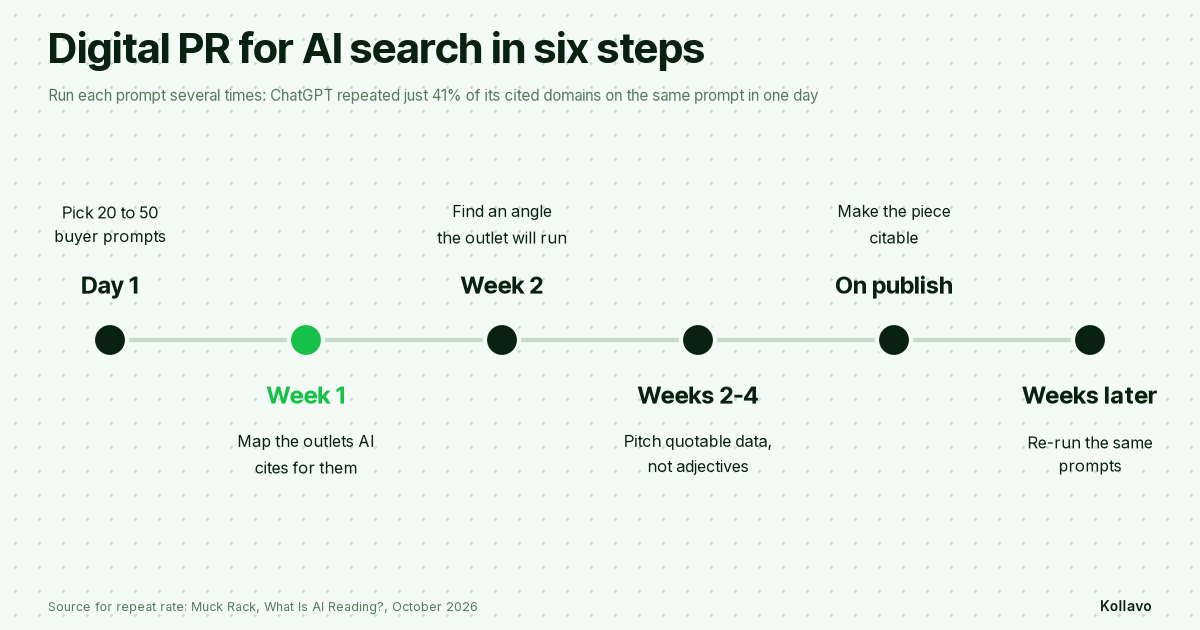
How to run digital PR for AI search in six steps
1. Pick the prompts that matter
Write down 20 to 50 questions a buyer would ask an AI assistant before choosing a product like yours ("best X for Y", "X vs Y", "how much does X cost"). The free AI prompt generator drafts them fast. These prompts, not keywords, are what you measure.
2. Map which outlets AI cites for them
Run every prompt on each engine you care about, several times, and record the cited URLs. Run them more than once: Muck Rack found ChatGPT repeated just 41% of its cited domains when the same prompt ran twice in one day, and Gemini 45%, against 94% for Perplexity. A single screenshot is not a target list. The free competitor citation map shows which domains are cited when competitors are named, and the citation gap audit lists the pages that mention them and not you.
Keep the outlets that appear across several prompts or engines. That is your PR target list.
3. Find an angle the outlet will run
Editors run stories, not product news. The best angles also contain a fact the engine can lift:
| Pitch format | Why it gets cited | Example angle |
|---|---|---|
| Original data | Gives the article a number nobody else has, so engines quote it | "We analyzed 10,000 support tickets: 38% were about X" |
| Expert commentary on news | Lands in fast-moving stories, which are cited heavily in their first days | A named expert's take on a regulation or a market move |
| Data-backed guide or explainer | Answers the "how" questions that AI engines retrieve | A step-by-step guide with a table of costs or timelines |
| Honest comparison or benchmark | Feeds "X vs Y" and "best X" answers directly | A transparent test of five tools with the method shown |
4. Pitch quotable data, not adjectives
Muck Rack's January 2026 update found that the press releases AI cited had about 2 times as many statistics as releases it did not cite, about 2.5 times as many bullet points and roughly 30% more objective sentences. The same logic applies to pitches and contributed articles. State the finding in one plain sentence, give the method in one more, and offer the data.
Skip pay-to-play shortcuts. In ChatGPT's citations of Forbes, editorial content outperformed the pay-to-play Councils program by about 1.7 to 1 (Muck Rack, October 2026). Wire releases have a role for hard facts, which we cover in do press releases get cited by AI?, but they rarely win recommendation prompts.
5. Make the published piece citable
When the piece runs, check that the part about you would survive being quoted out of context:
- Your brand is named in the sentence that answers the question, not only in a bio or a footer.
- The key claim sits in a short paragraph, list or table, close to a clear heading.
- The facts match your own site. AI engines cross-check, so keep your pricing, positioning and product names identical everywhere. Schema markup on your own pages helps machines read those facts.
- The page is crawlable: no hard paywall on the full text, and no block on the AI crawlers you care about.
6. Re-run the same prompts and keep publishing
Re-run your prompt set a few weeks after coverage goes live and compare mention and citation rate per engine. Expect a hit rate, not a guarantee. Some placements move nothing; good ones move several prompts at once.
More than half of the journalism AI cites was published in the past year, and citation rates peak in the first month after publication before dropping through month six (Muck Rack, May 2026). Coverage from 2024 is unlikely to carry your 2026 answers. Week-to-week swings are normal; see AI citation volatility.
How to measure digital PR for AI search
Coverage counts and domain authority are inputs. The outputs are these:
| Metric | What it tells you | How to measure |
|---|---|---|
| Mention rate per engine | Share of your prompts where the engine names you | Same prompt set, run several times per engine each month |
| Citation rate | Share of prompts where your site or your coverage is a cited source | Record cited URLs, not just brand names |
| Citation share vs competitors | Your share of all citations across the prompt set | Count citations to you and to each competitor |
| Coverage in cited outlets | How many of your target outlets now mention you | Check your target list against live URLs |
| AI referral visits | Traffic from ChatGPT, Perplexity, Gemini and Copilot | Analytics, filtered by referrer |
Report trends over several runs: a four-week average per engine is far more honest than one good screenshot.
What does digital PR for AI search cost?
Prices below are published starting points, checked in late October 2026.
| Option | What you get | Typical published starting price |
|---|---|---|
| In-house, with a monitoring tool | You run prompts, outreach and pitching yourself | Tool cost only; trackers start around $29/month (Otterly.AI Lite) |
| Managed placement service | Tracking plus submissions and placements on the sources AI cites | $99/month (Kollavo Managed) |
| GEO or PR agency retainer | Strategy, content, media relations and reporting run for you | About $3,000/month among agencies that publish rate cards |
Kollavo's Managed plan is built around steps 2 and 6: it tracks your prompts on ChatGPT, Gemini and Google AI Mode, finds the sources AI already cites for your category, and handles 10 to 15 directory and AI-source submissions a month, with your first placement included. Paid placements on Autopilot packs are always shown to you before anything is booked. Full details are on the pricing page. If you want a full program with media relations and content, our guide on how to choose a GEO agency covers what to ask. To compare monitoring tools, see our tool comparisons.
Mistakes that waste PR budget
- Chasing the biggest logo instead of the cited outlet. A trade title already cited for your prompts beats a famous site AI ignores for your topic.
- Measuring coverage instead of answers. Placements that never show up in an AI answer did not move AI visibility.
- One-off campaigns. Recency drives citations, so a burst of coverage followed by six quiet months fades.
- Inconsistent facts. If coverage says one price and your site says another, engines may repeat either, or neither.
FAQ
What is digital PR for AI search? It is the practice of earning coverage and mentions on the independent websites AI engines cite, so your brand is named in answers from ChatGPT, Gemini, Claude, Perplexity and Google AI Overviews. It uses classic PR skills but picks targets from AI citation data and measures success by mention and citation rate.
Does PR help you get cited by ChatGPT? It can, but target selection matters more than volume. Earned and third-party sources make up more than 84% of AI citations across major engines (Muck Rack, October 2026). ChatGPT's share of journalism citations fell to 22% in September 2026, so third-party guides, comparisons and trade outlets are often better ChatGPT targets than general news sites.
Is digital PR the same as link building? No. Link building aims to pass ranking value through links. For AI search, an unlinked mention in the right article can matter as much as a link: Ahrefs found branded web mentions correlated with Google AI Overview visibility at 0.664, against 0.218 for backlinks.
Do press releases help AI visibility? A little. Press releases rose to about 1% of AI citations in Muck Rack's January 2026 update, up from 0.2% in July 2025, and cited releases contained about twice as many statistics as uncited ones. They help record facts but rarely win "best X" prompts on their own.
How long does digital PR take to show up in AI answers? There is no fixed timeline. As a working rule, re-run the same prompts two to eight weeks after coverage goes live. Recent coverage is cited far more than older coverage, so treat it as an ongoing program.
Sources
Muck Rack and Generative Pulse, "What Is AI Reading?" October 2026 edition (released October 28, 2026), plus the January and May 2026 updates and earlier 2025 findings. Chen, Wang, Chen and Koudas (University of Toronto), "Generative Engine Optimization: How to Dominate AI Search" (arXiv, 2025) and "Navigating the Shift" (EDBT/ICDT 2026 workshops). Ahrefs, AI Overview brand visibility study (75,000 brands). Prices from the vendors' public pricing pages, late October 2026.