October 27, 2026 · Kollavo Team
Schema Markup for AI Search: What It Does for ChatGPT, Gemini and AI Overviews (2026)
Does schema markup help AI citations? Controlled tests say barely: adding JSON-LD to 1,885 pages moved ChatGPT and AI Mode citations by about 2%. How each AI engine treats structured data, which schema types still matter, and a checklist.
Short answer: Schema markup for AI is structured data (usually JSON-LD) that describes your page's entities and facts for machines. It helps search engines understand a page, but it does not get you cited by ChatGPT, Gemini or Google AI Overviews on its own. Google says there is no special schema needed for its AI features, and the largest controlled test so far (Ahrefs, 1,885 pages) found no reliable citation lift from adding it. Use schema to restate facts that are already visible on the page, then spend most of your effort on ranking, content and third-party sources.
This guide covers the evidence, how each AI engine treats structured data, which schema types still matter in 2026, and a short checklist. For the one-line definition, see our glossary entry on schema markup for AI.
What is schema markup for AI?
Schema markup is code that labels the things on a page using the shared Schema.org vocabulary: this is an Organization, this is a Product with this price, this Article was written by this Person, these are question-and-answer pairs. Most sites add it as a JSON-LD block in the page's HTML.
"Schema markup for AI" is the idea that the same labels help AI answer engines understand, trust and cite a page. That idea is half right. Structured data feeds search indexes and knowledge graphs, and several AI answers are built on top of those indexes. But the AI models that write the answer mostly read the visible text of the pages they retrieve, not the hidden JSON-LD. So schema can help a page get understood and eligible. It does not choose which page gets cited.
It also helps to separate schema from two things it is often confused with:
- llms.txt is a separate site-level text file that lists your key pages for AI tools. It is not structured data. (We have a free llms.txt generator if you want one.)
- Entity SEO is the broader work of making your brand, products and people consistently named and corroborated across the web. Schema supports it, but most of the work happens off your site.
Does schema markup help AI citations? What the research shows
Short version: correlation studies say "yes", controlled studies say "not really". Cited pages often have schema because they are well-built pages on well-run sites, which also rank well and earn links. When researchers isolate schema from those other signals, the effect mostly disappears.
| Study | What they tested | Result |
|---|---|---|
| Ahrefs, May 2026 | 1,885 pages that added JSON-LD (Aug 2025 to Mar 2026) vs 4,000 matched control pages, 30 days before and after | ChatGPT +2.2% and Google AI Mode +2.4%, both within noise; Google AI Overviews −4.6% vs controls |
| Ahrefs, same study (correlation step) | About 6 million URLs | AI-cited pages were almost 3x more likely to have JSON-LD than non-cited pages; 53% of cited pages had schema |
| Growth Marshal (Fischman), Feb 2026 | 730 AI citations from ChatGPT and Gemini across 75 commercial queries, 1,006 pages | No effect for schema presence once corrected; Google organic rank was the main predictor |
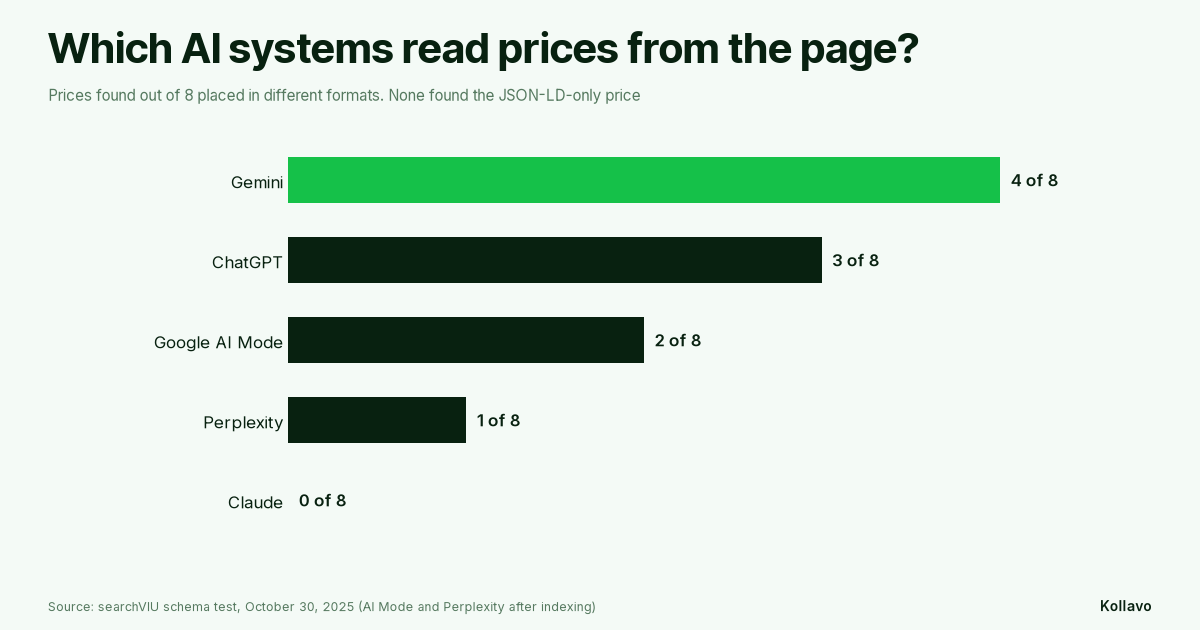
| searchVIU, Oct 2025 | One test page with 8 prices placed in different formats, asked to 5 AI systems | No system found a price that existed only in JSON-LD |
| Bouet, Roskilde University (RCT) | 8 invented brands, 4 with schema and 4 without, 28 prompts on Gemini 2.5 Flash with Google Search grounding | No evidence that schema increased brand mentions; the low-authority test pages were rarely retrieved at all |
Two details from these studies matter for how you act on them.
First, the Ahrefs study only looked at pages that were already heavily cited (100+ AI Overview citations before the change). It says nothing about pages that AI systems do not see at all, where schema might still help with crawling or indexing. The AI Overviews decline was small (about 12 daily citations per page, on pages getting hundreds) and both groups were already falling, so it is not proof that schema hurts.
Second, the Growth Marshal paper found one exception. Pages with Product or Review schema that filled in concrete attributes (price, rating, specifications) were cited more often than pages with only generic types like Article, Organization or BreadcrumbList: 61.7% vs 41.6%. But pages with no schema at all were cited 59.8% of the time, which was not significantly different. The author reads this as factual detail partly making up for weak authority. It fits the rest of the evidence: what helps is concrete facts, not the label around them.
What did predict citation in that study was ranking. Pages in position 1 on Google were cited in 43% of the queries where they appeared, falling to 5% at position 7. If you have a limited budget, that is where the leverage is. Our guide to AI citation optimization covers what moves those numbers.
How each AI engine treats schema markup
AI answer engines get web content in two ways: from a search index built ahead of time, or by fetching a page live while answering. Schema can matter in the first case. In the second, the test results show it is mostly ignored.
| Engine | How it gets your page | What we know about schema |
|---|---|---|
| Google AI Overviews and AI Mode | Google's search index, plus query fan-out searches | Google says there is no special schema.org markup needed; structured data should match visible text. AI Mode found 2 of 8 prices in the searchVIU test, only after indexing |
| Microsoft Copilot (Bing) | Bing's index | Microsoft's Fabrice Canel said at SMX Munich in March 2025 that schema markup helps Microsoft's LLMs understand content |
| ChatGPT search | Live fetch and search partners | Read visible HTML and visible microdata; missed every price that was only in JSON-LD (3 of 8 found) |
| Gemini app | Live fetch and Google Search grounding | Best in the searchVIU test (4 of 8), and the only one that read JavaScript-rendered text, but it still ignored JSON-LD |
| Perplexity | Its own index | Found 1 of 8 prices, only after indexing |
| Claude | Live fetch | Found product names but 0 of 8 prices |
Google's own wording is unusually direct. Its AI features documentation says a page only needs to be indexed and eligible for a snippet to appear as a supporting link, and that you do not need new machine-readable files, AI text files or markup: "There's also no special schema.org structured data that you need to add." In the same list of best practices it asks you to make sure "your structured data matches the visible text on the page".
The practical rule follows from this table: anything you want an AI engine to repeat must be in the visible text. A price, a feature, an author's credentials or an answer that lives only inside JSON-LD is invisible to most live-fetching AI systems. For more on how the different engines retrieve and pick sources, see how to get cited in Google AI Overviews.
Which schema types are still worth adding in 2026
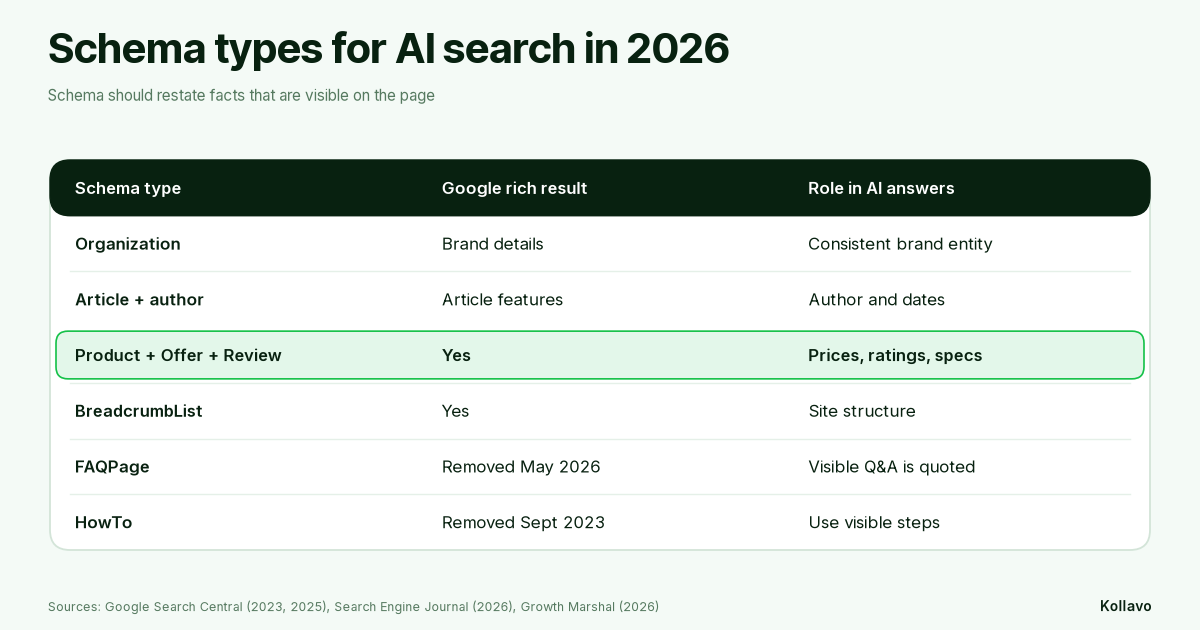
Schema is still worth doing well, mostly for ordinary search: rich results, clearer entity signals and cleaner data in Google's systems, which AI Overviews and AI Mode draw on. Google has also been retiring rich results. It limited FAQ rich results to government and health sites in August 2023, removed How-to rich results in September 2023, phased out seven lesser-used types in June 2025, and stopped showing FAQ rich results for all sites on May 7, 2026.
| Schema type | Google rich result in 2026? | Why it still matters for AI search |
|---|---|---|
| Organization | No rich result; feeds brand details | Names your brand, logo, official profiles (sameAs) consistently |
| Article with author (Person) | Article features | Ties content to a named author or team and a publish date |
| Product with Offer and Review | Yes (product snippets, merchant listings) | The one type with evidence of a citation advantage when prices, ratings and specs are filled in |
| BreadcrumbList | Yes | Clarifies site structure; low effort |
| LocalBusiness | Yes, with Business Profile | Address, hours and service area for local answers |
| FAQPage | No, removed for all sites May 2026 | Harmless to keep if it matches visible Q&A; the visible FAQ is what AI quotes |
| HowTo | No, removed September 2023 | No search benefit; write the steps as visible numbered lists |
If you already use FAQPage markup, you do not need to remove it. Google's guidance is that unused structured data causes no problems. Just do not expect it to do anything on its own. The value of an FAQ section is the visible question-and-answer text, which is easy for AI to quote. Our FAQ schema guide covers how to write those answers.
A schema checklist for AI search
Use this as a one-afternoon job, not an ongoing project:
- Write the facts in the page first. Prices, plans, specs, author bio, dates and direct answers belong in visible HTML. Schema only restates them.
- Add Organization schema once, site-wide. Use your exact brand name, logo, URL and
sameAslinks to your official profiles. Keep it identical to your about page and directory listings. - Mark up articles with an author and dates. Use Article or BlogPosting with an author (a Person or your team page),
datePublishedanddateModifiedthat match what readers see. - Fill product and pricing pages completely. Product, Offer and AggregateRating with real values. This is the one area with some evidence of an advantage over generic markup.
- Server-render the JSON-LD. Ahrefs only measured schema in the raw HTML and notes that AI crawlers appear to treat JavaScript-injected schema differently. Put it in the initial HTML.
- Validate and keep it consistent. Run Google's Rich Results Test and the Schema.org validator, and fix any value that disagrees with the visible page.
- Stop there and check access. Make sure AI crawlers are not blocked in robots.txt or by your CDN. A blocked page cannot be cited, with or without schema.
How to test schema on your own site
Because the studies disagree with common advice, the honest answer for your site is to test it. Ahrefs suggests a simple version of their method:
- Pick 5 to 10 pages that already get some AI citations, and 5 to 10 similar control pages.
- Record baseline citations for both groups in Google AI Overviews, AI Mode and ChatGPT.
- Add schema to the test pages only and change nothing else.
- After 30 days or more, compare the change in the two groups, not the before and after of one group.
AI citations are noisy from week to week, so use the same fixed prompt set and several runs per prompt. Our guides to LLM citation tracking and AI citation volatility explain how to set that up and how big a change has to be before it is real. You can spot-check a page with our free AI citation checker.
What to do instead if you want more AI citations
If schema is a small lever, the bigger ones are well documented:
- Rank in classic search. Google AI features use the same index and ranking systems, and in the Growth Marshal data citation odds fell about 24% with each lower rank position.
- Answer the question in the first lines. A direct 40 to 60 word answer under a heading that matches the question is easy to extract and quote.
- Get named on the pages AI already cites. For most commercial prompts, AI answers lean on third-party lists, reviews and comparisons. If your brand is missing from those pages, schema on your own site will not fix it.
That third point is where Kollavo comes in. We find the sources AI engines cite for your buyers' questions and get your brand placed in them. Start with a free AI audit to see where competitors are cited and you are not, see pricing for plans, or compare AI visibility tools if you are still evaluating options.
FAQ
Does schema markup help with AI search?
Indirectly. Schema helps search engines understand a page and makes it eligible for rich results, and Google and Bing AI features build on those indexes. But controlled studies, including Ahrefs' test of 1,885 pages, found no reliable increase in AI citations from adding schema alone.
Do ChatGPT and other LLMs read JSON-LD?
Mostly not when they fetch a page live. In searchVIU's test, no AI system found a price that existed only in JSON-LD; ChatGPT and Gemini read visible text and visible microdata. Engines that work from a search index, like Google AI Mode and Bing Copilot, can still benefit from schema through that index.
What is the best schema markup for AI?
Organization, Article with a clear author, and complete Product, Offer and Review markup on product and pricing pages. Product schema with real prices, ratings and specs is the only type with some evidence of a citation advantage over generic markup.
Is FAQ schema still worth it in 2026?
For Google rich results, no: Google stopped showing FAQ rich results for all sites on May 7, 2026. Keeping accurate FAQPage markup does no harm. The visible FAQ section is what matters, because AI engines quote the text, not the markup.
Can schema markup hurt AI visibility?
There is no good evidence that accurate schema hurts. Ahrefs saw a small AI Overviews decline (−4.6%) after pages added schema, but both groups were already falling and the cause is unclear. Mismatched markup, such as FAQ schema for questions the page never shows, can conflict with Google's guidelines.
Does Google need special structured data for AI Overviews?
No. Google's documentation says there are no additional requirements to appear in AI Overviews or AI Mode, and no special schema.org structured data to add. The page needs to be indexed and eligible to show a snippet, and its structured data should match the visible text.
Sources
Google Search Central, "AI features and your website"; Google Search Central Blog, "Changes to HowTo and FAQ rich results" (August 2023) and "Simplifying the search results page" (June 2025); Search Engine Journal, "Google Drops FAQ Rich Results From Search" (2026); Ahrefs, "We Tracked 1,885 Pages Adding Schema. AI Citations Barely Moved." (May 11, 2026); Kurt Fischman, Growth Marshal, "Does Schema Markup Predict AI Citation?", SSRN (February 2026); searchVIU, "Schema Markup and AI in 2025" (test of October 30, 2025); Bouet, synthetic-brand randomised controlled trial of Schema.org markup on Gemini, Roskilde University; Search Engine Land coverage of Fabrice Canel at SMX Munich (March 2025). All checked October 27, 2026.