October 23, 2026 · Kollavo Team
LLM Citation Tracking: How to Track AI Citations (Method, Metrics and Tools, 2026)
LLM citation tracking, done right: AI engines repeat the same list of brands less than 1 in 100 times, so track citation rates across repeated runs. Step-by-step method, metrics, and tools from $29/month.
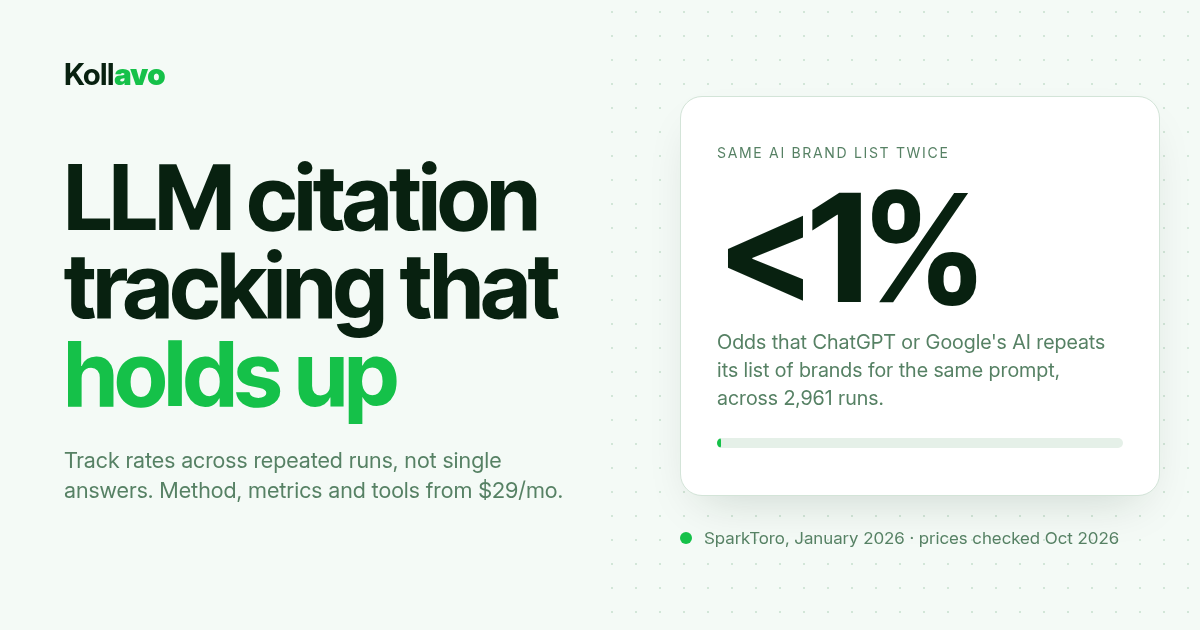
Short answer: LLM citation tracking means running a fixed set of buyer prompts through ChatGPT, Perplexity, Gemini and Google's AI answers on a schedule, and logging which URLs each answer cites, whether your brand is named, and who appears instead. Track a rate across repeated runs, not single answers: in a 2,961-run study by SparkToro and Gumshoe, there was a less than 1 in 100 chance that ChatGPT or Google's AI returned the same list of brands twice for the same prompt. You can do it by hand with a spreadsheet for 20 to 30 prompts, or use a tool: published plans start at $29/month (Otterly.AI Lite, 15 prompts) and run to $250/month (Scrunch Core, 125 prompts) before enterprise pricing.
This guide covers the method, the metrics, the tools and their real prices, and how to connect citations to traffic. If you already track citations and want to know what moves them, read AI citation optimization next.
What LLM citation tracking measures
An AI citation is a link to a source shown in an AI answer. A mention is your brand named in the text, with or without a link. Citation tracking records both, per prompt and per engine, over time.
For each prompt run, you want five fields:
| Field | What to record | Why it matters |
|---|---|---|
| Mentioned | Yes or no, and where in the answer | Shows whether AI recommends you at all |
| Cited URLs | Every source link in the answer | Shows which pages and domains the engine trusts for this question |
| Your cited page | Which of your URLs, if any | Tells you which page to protect or improve |
| Competitors named | Brands listed instead of or next to you | Feeds your citation share |
| Engine and date | ChatGPT, Perplexity, Gemini, AI Overviews, AI Mode | Engines cite different sources, and answers change week to week |
From those fields you get the four numbers worth reporting: citation rate (share of runs that cite one of your URLs), mention rate (share of runs that name you), citation share (your citations divided by all citations to you and tracked competitors), and the top cited domains for each prompt cluster. Our guide to LLM citation rate walks through the formulas, and the AI citation share explainer covers the competitive version.
Why you have to track rates, not single answers
AI answers are not rankings. In the SparkToro study, 600 volunteers ran 12 prompts through ChatGPT, Claude and Google's AI 2,961 times. The lists of brands almost never repeated, and the same list in the same order came up closer to once in 1,000 runs. List length changed too: some answers named two or three options, others ten or more (SparkToro, January 2026).
The authors' conclusion was not that tracking is pointless, but that ranking position is. How often a brand appears across many runs of the same prompt, its visibility percentage, held up as the more useful measure. That is the case for tracking:
- Run each prompt more than once per engine per check, or across several days, and record the share of runs that cite or name you.
- Ignore "rank #1 in ChatGPT" claims. Position inside a list is close to random.
- Watch trends over weeks. Citations also fade: our research on LLM citation decay shows why a page cited today can drop out within weeks without anything changing on your side.
How to track LLM citations step by step
1. Build a prompt set from real buyer questions
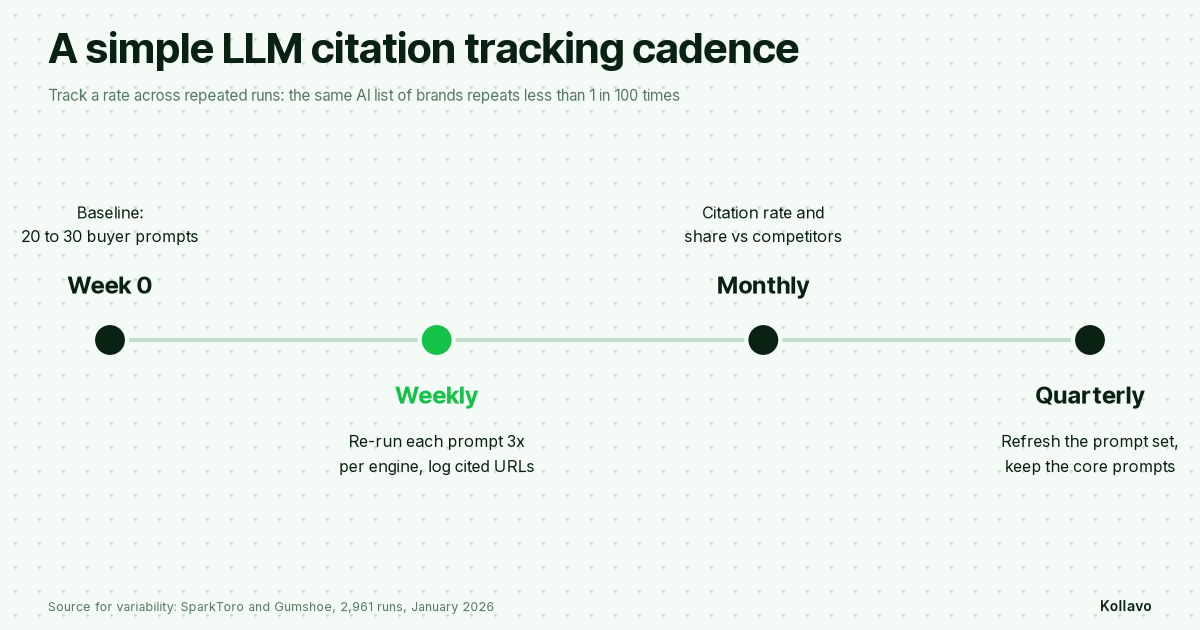
Start with 20 to 30 prompts across the funnel: category questions ("best tools for X"), comparison questions ("X vs Y"), problem questions ("how do I fix Z") and brand questions ("is X worth it"). Pull wording from sales calls, support tickets and the questions in your Search Console data. The free AI prompt generator maps the questions buyers ask about your category across the buyer journey if you need a starting list, and our prompt tracking entry explains how to keep the set stable.
Keep the prompt set fixed. If you change prompts every month, you can't tell a real change from a different question.
2. Choose the engines your buyers use
At minimum, cover ChatGPT, Perplexity, Gemini and Google. Treat Google AI Overviews and Google AI Mode as separate engines: Google runs them as separate features, and each can show a different answer with different sources. For Google specifically, the Google AI Mode tracker and our Google AI citation analysis guide show how to split the two.
3. Run each prompt several times and log every source
Run each prompt in a clean session with web search on, and save the full answer plus every cited URL. Three runs per prompt per engine is a practical minimum for a manual setup. A spreadsheet with one row per run and the five fields above is enough to start.
To sanity-check a single prompt quickly, the free AI citation checker shows whether an AI-style answer is likely to cite you and which brands it names instead.
4. Calculate rates and compare with competitors
Each week, calculate citation rate and mention rate per engine, then citation share against the three to five competitors that appear most often. The free competitor citation map shows which sources and domains AI likely cites for your competitors and where you're missing.
5. Turn the log into a source list
Group cited URLs by domain. The domains that keep appearing across prompts and engines are your target list: review sites, directories, listicles, trade publications and community threads. If competitors are cited there and you are not, that is a citation gap you can close with a listing, a correction or a genuine contribution.
6. Re-run on a fixed cadence
Weekly is enough for most teams. Refresh the prompt set quarterly, add prompts for new products, and keep the old ones so the trend line stays comparable.
LLM citation tracking tools compared (prices checked October 2026)
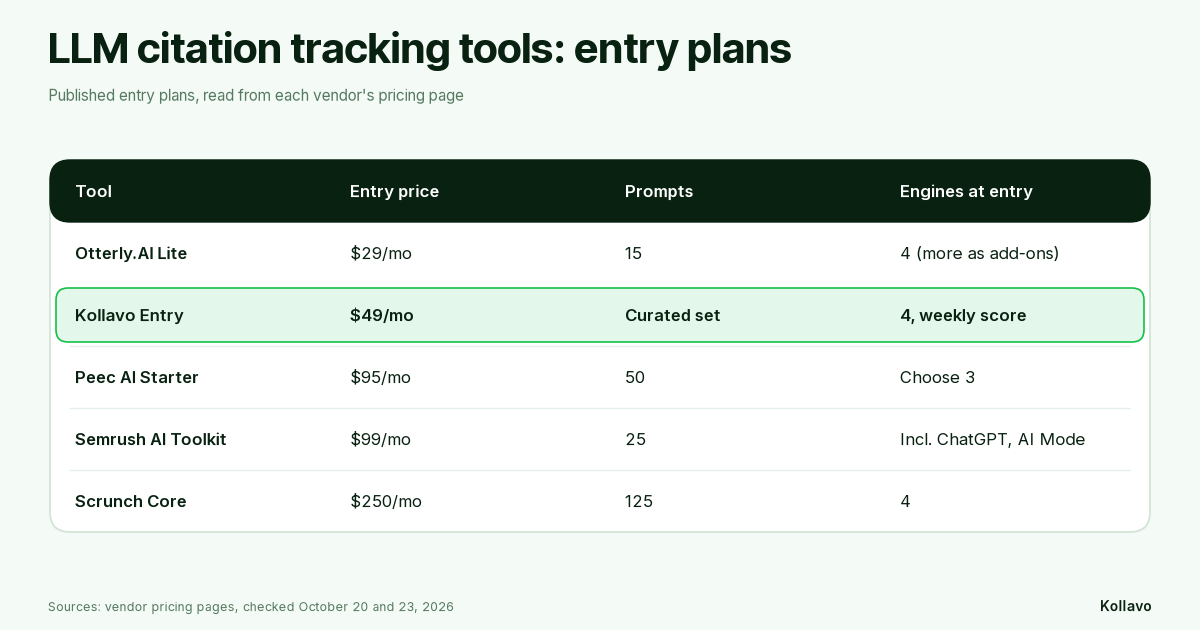
Manual tracking works up to a few dozen prompts. After that, a tool saves hours a week and gives you history. These are the published entry plans, read from each vendor's pricing page in October 2026:
| Tool | Entry price | Prompts at entry | Engines at entry | Tracking frequency | Notes |
|---|---|---|---|---|---|
| Otterly.AI Lite | $29/month | 15 | ChatGPT, Google AI Overviews, Perplexity, Microsoft Copilot | Daily | Claude, Gemini and Google AI Mode are paid add-ons; citation source tracking included |
| Kollavo Entry | $49/month | Curated prompt set | ChatGPT, Perplexity, Gemini, Google AI Mode | Weekly score | Share of voice, citation gap alerts and email alerts when visibility changes |
| Peec AI Starter | $95/month (€85 on the euro page) | 50 | Choose 3 models | Daily | Source analytics, citation share and gap analysis appear in its feature table; check which tier includes each |
| Semrush AI Visibility Toolkit | $99/month | 25 | Includes Google AI Mode and ChatGPT | Daily | Extra domains $99 each |
| Ahrefs Brand Radar | Custom prompts from $50/month; AI Visibility Index from $199/month | Varies | Several AI platforms | Daily, weekly or monthly | Ahrefs says custom prompts are free with paid Lite plans and above |
| Scrunch Core | $250/month | 125 | ChatGPT, Perplexity, Google AI Overviews, Copilot | 5,000 responses a month | Enterprise adds more engines and API access |
| Profound | Free 7-day trial, then enterprise pricing | 50 (trial) | ChatGPT, Gemini, Google AI Overviews (trial) | Daily | Enterprise tracks more engines; no public self-serve price |
Prices change often in this category. Check the vendor's page before you buy, and see our full GEO pricing breakdown for higher tiers and agency costs.
How to choose:
- Count your prompts first. 15 prompts is enough to test the habit, not to cover a category. Divide price by prompts: Otterly Lite works out to about $1.93 per prompt, Peec Starter $1.90 and Scrunch Core $2.00.
- Check engine coverage. If your buyers use Gemini or AI Mode, make sure they are in the plan, not an add-on you discover later.
- Look for alerts. If you want to know when citations drop, pick a tool that emails you on changes rather than one you have to remember to open.
- Ask what happens next. A tracker shows the gap. Someone still has to get you onto the sources AI cites.
For side-by-side reviews of these tools, see our AI visibility tool comparison.
Connect citations to traffic
Citations only matter if they lead somewhere. Two sources fill in the picture:
Analytics referrals. OpenAI says ChatGPT adds utm_source=chatgpt.com to links in ChatGPT search results, so you can filter those visits in Google Analytics (OpenAI Help Center). That tag is fragile: in October 2026, ChatGPT links briefly lost the parameter, and an Adobe analysis of about 500 pages found roughly 31,000 fewer ChatGPT visits a day while direct traffic rose by about 26,000 a day. OpenAI confirmed a bug and the fix rolled out on October 15 (Search Engine Land). If you report AI referrals, annotate October 8 to 15, 2026. Our guide to AI referral traffic tracking covers the GA4 setup for every engine.
Search Console. Google counts traffic from AI Overviews and AI Mode inside the regular "Web" search type, with no separate AI filter (Google Search Central). Search Console tells you that Google sent traffic, not which AI answer cited you. That is why prompt-level tracking is still needed.
Crawler access. None of this works if engines can't fetch your pages. ChatGPT search relies on OAI-SearchBot, and sites that block it won't appear in ChatGPT search answers. Check your robots.txt for each engine's search crawler before you start tracking.
Common LLM citation tracking mistakes
| Mistake | What goes wrong | Fix |
|---|---|---|
| Checking a prompt once | One answer is a sample of one; lists rarely repeat | Run each prompt several times and track a rate |
| Reporting "position" | Order inside AI lists is close to random | Report mention rate and citation share |
| Changing prompts every month | Trends become meaningless | Keep a fixed core set, add new prompts on top |
| Tracking only your brand | You miss why competitors win | Log every cited domain and competitor named |
| Treating all Google AI as one engine | AI Overviews and AI Mode are separate features with their own answers | Track them separately |
| Stopping at the dashboard | Tracking alone changes nothing | Turn the cited-domain list into a placement plan |
How Kollavo helps
Kollavo tracks your visibility across ChatGPT, Perplexity, Gemini and Google AI Mode, shows share of voice against competitors, and alerts you when competitors are cited where you aren't. Managed plans then get you listed on the sources AI already cites, with a live tracker of every submission. Start with a free AI audit or the LLM visibility score, and see pricing (Entry from $49/month).
FAQ
What is LLM citation tracking?
LLM citation tracking is the practice of running a fixed set of prompts through AI engines like ChatGPT, Perplexity, Gemini and Google AI on a schedule, and recording which sources each answer cites, whether your brand is mentioned, and which competitors appear. The output is a citation rate and citation share per engine over time.
How do I track brand citations in LLMs for free?
Pick 20 to 30 buyer prompts, run each one three times per engine with web search on, and log the answer, the cited URLs and the brands named in a spreadsheet. Repeat weekly. Free tools like Kollavo's AI citation checker speed up single checks.
Which LLM citation tracking tools send alerts when citations drop?
Kollavo's Entry plan includes email alerts when your visibility changes and citation gap alerts when competitors appear where you don't. Semrush positions its daily prompt tracking for catching sudden drops. Check each vendor's plan page for alert options before you buy.
How often should I track AI citations?
Weekly works for most brands. AI answers change from run to run and citations fade over weeks, so a weekly rate based on several runs per prompt is more reliable than daily single checks. Refresh the prompt set quarterly.
Is LLM citation tracking the same as tracking AI referral traffic?
No. Citation tracking shows whether AI answers cite or name you. Referral tracking shows how many people clicked through, for example ChatGPT visits tagged with utm_source=chatgpt.com. You need both: citations explain why traffic moves, and referrals show whether citations pay off.
Sources
Rand Fishkin and Patrick O'Donnell, "AIs are highly inconsistent when recommending brands or products", SparkToro (January 2026; 600 volunteers, 12 prompts, 2,961 runs). OpenAI Help Center, "Publishers and Developers FAQ". OpenAI, "Overview of OpenAI Crawlers". Search Engine Land, "ChatGPT drop in UTM tracking was a bug" (October 2026). Google Search Central, "AI features and your website". Vendor pricing pages for Otterly.AI, Peec AI, Semrush (AI Visibility Toolkit knowledge base), Ahrefs Brand Radar, Scrunch, Profound and Kollavo, read October 20 and 23, 2026.