October 21, 2026 · Kollavo Team
How to Get AI Mentions: Get Your Brand Named in ChatGPT, Gemini and AI Overviews
How to get AI mentions: 85% of brand mentions in AI answers come from third-party pages. Seven steps, backed by 2025-2026 studies, to get your brand named in ChatGPT, Gemini, Perplexity and Google AI Overviews.
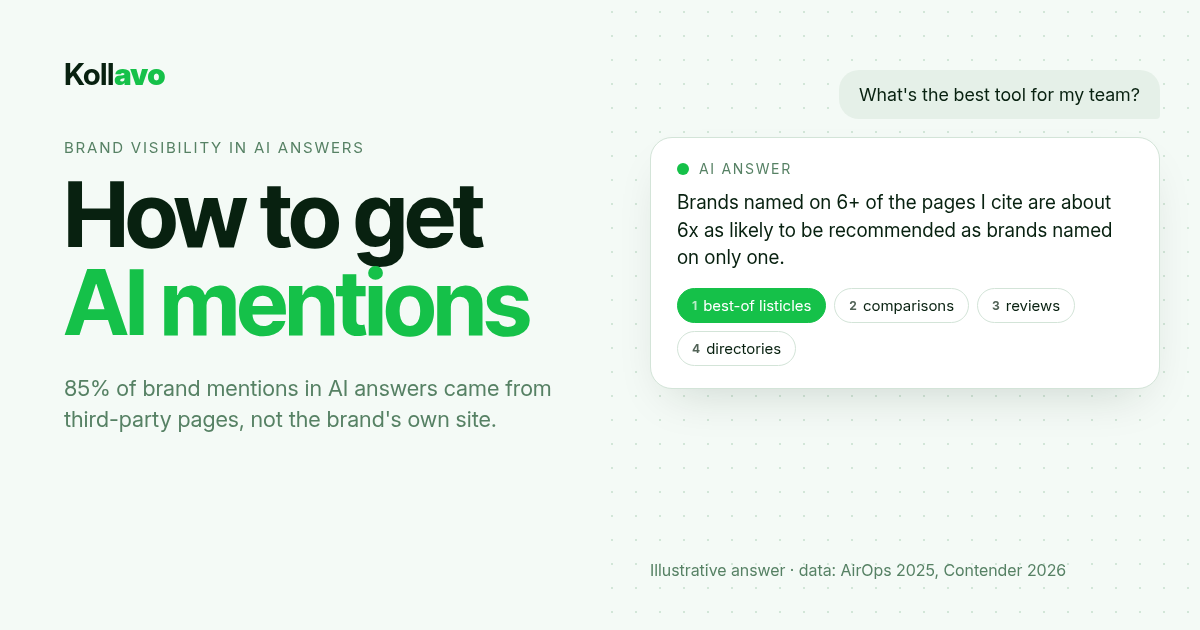
Short answer: To get AI mentions, get your brand named on the third-party pages AI engines read when they answer buyer questions: "best of" listicles, comparison articles, review sites and directories. In AirOps' analysis of 21,311 brand mentions, 85% came from third-party sources and only 13.2% from the brand's own site. Contender found brands that appear in pages ChatGPT cites are 6.2 times as likely to start being recommended. Your own site still matters, but mostly as the source of facts those pages repeat.
AI mentions are now a buying channel. Below is what the research says decides which brands get named, and a seven-step plan to become one of them.
AI mentions vs AI citations
The two terms get mixed up, but they measure different things:
| AI mention | AI citation | |
|---|---|---|
| What it is | Your brand is named in the answer text | Your URL is listed as a source |
| Example | "Top options are Acme, Beta and Gamma" | A link to acme.com/pricing under the answer |
| Typical prompt | "Best X for Y", "X vs Y", "alternatives to X" | Factual, how-to and pricing questions |
| Where it usually comes from | Third-party pages the engine read | The page that holds the fact |
| What it drives | Shortlists and brand searches | Clicks to the cited page |
You can be mentioned without being cited, and cited without being mentioned. Victorious found that on early "problem awareness" prompts, AI engines used educational content from company websites to build answers but named the brands in just 0.10% of those answers. This guide is about mentions. For the citation side, read how to get cited by AI.
What the research says about AI brand mentions
| Finding | Figure | Source |
|---|---|---|
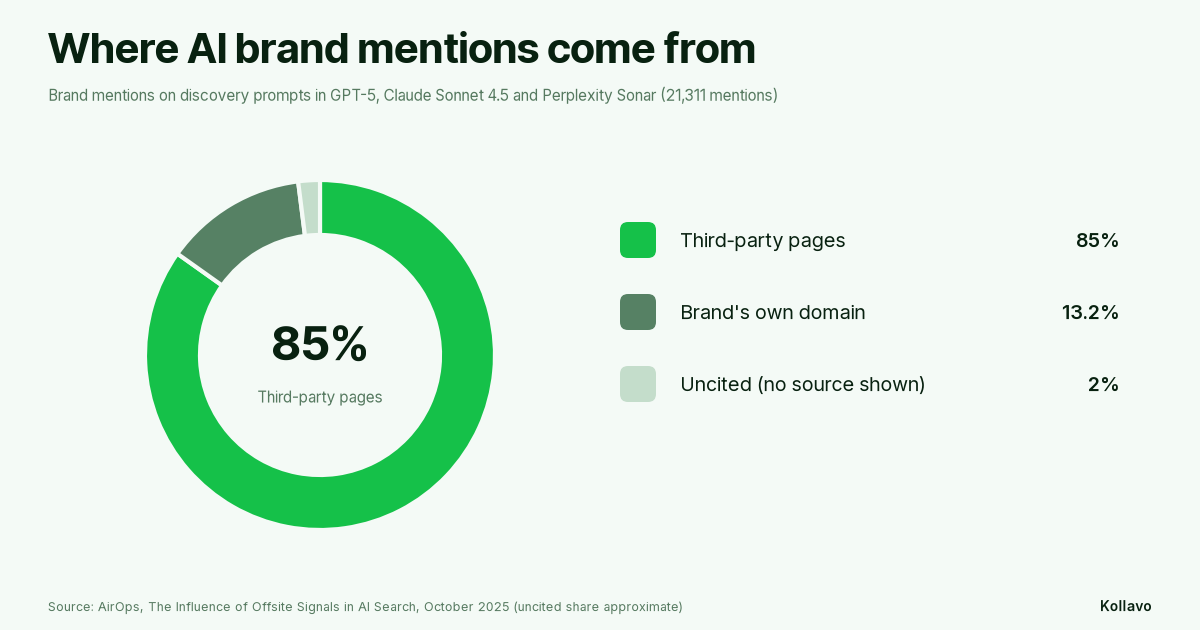
| Brand mentions in AI answers that came from third-party pages | 85% (13.2% from the brand's own domain, about 2% uncited) | AirOps, 21,311 mentions, Oct 2025 |
| Third-party mentions that came from listicles, comparisons or reviews | Nearly 90% | AirOps, Oct 2025 |
| Brands ChatGPT recommends that also appear in the pages it cites | At least 92.7% | Contender, 46 B2B software prompts, Oct 2025 to Jan 2026 |
| Chance of gaining a ChatGPT recommendation: in cited pages vs not | 3.7% vs 0.6% (6.2x) | Contender |
| Brands AI described accurately vs brands it never named in category answers | 96% vs 89% never named | Victorious, 175 brands, 8 AI platforms, Q2 2026 |
| Mention rate for brands with fewer than 2,000 web pages mentioning them | 3% | Victorious, Q2 2026 |
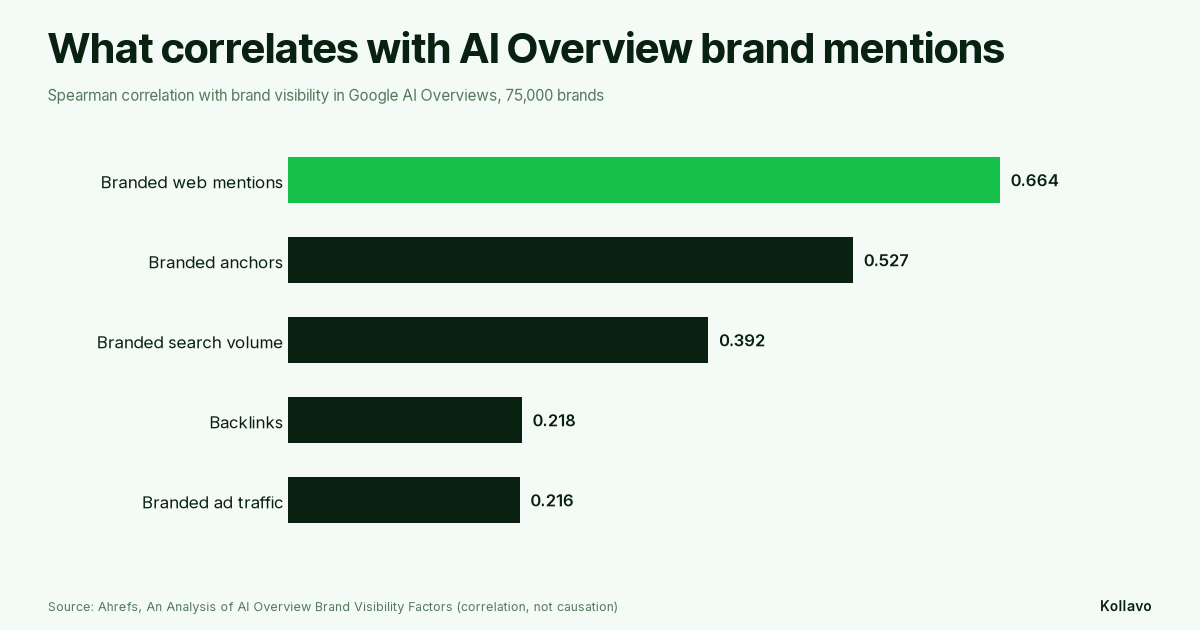
| Strongest correlate of Google AI Overview brand visibility | Branded web mentions (0.664) | Ahrefs, 75,000 brands |
| Brands that appeared on only one AI platform | Nearly 68% | AirOps, Oct 2025 |
Most of these studies report correlations, and several were run by vendors that sell AI visibility services (so do we). Read them as direction, not as guarantees. They do agree on one thing: AI engines name the brands that other sites already name.
Why AI already knows your brand but doesn't name it
Victorious asked eight AI platforms (ChatGPT, Claude, Gemini, Copilot, Perplexity, Google AI Overviews, Google AI Mode and Meta AI) to describe 175 brands. They got 96% right. Then they asked the questions a buyer asks when comparing options, and 89% of the brands never came up.
Recognition is not the bottleneck. When a buyer asks "what is the best X", most engines now search the web first. Contender saw ChatGPT run a web search on 95.5% of B2B software recommendation prompts, up from 29% when it first checked the same question set in October 2025. The answer is then assembled from whatever pages come back, and those pages are mostly written by someone other than you. In Victorious' category research prompts, 99.99% of 49,391 citations pointed to third-party sites, and only 4 of 150 brands earned a citation to their own domain.
So the practical question is not "how do I make the model know me" but "how do I get onto the pages it reads".
How to get AI mentions: 7 steps
1. List the prompts where you want to be named
Write down the 20 to 50 questions a buyer asks before choosing a product like yours: "best [category] for [use case]", "[competitor] alternatives", "[you] vs [competitor]", "[category] pricing". These are the prompts where engines name brands. Victorious found brands were named more than 12 times as often in category research answers as in early educational ones.
Our free AI prompt generator builds this list from your category, and the query fanout generator shows the sub-questions an engine searches behind each prompt.
2. Find the pages AI reads for those prompts
Run each prompt in ChatGPT, Perplexity, Gemini and Google AI Mode and note the URLs each one cites. Then open those pages and check two things: is your brand on them, and in what position? The free competitor citation map speeds this up, and our guide to finding the sources AI cites for your competitors walks through it by hand.
Expect a short list per engine. ChatGPT cites only a few pages per answer, so the same handful of roundups often decides the whole shortlist. Our AI citation statistics roundup has the per-engine numbers.
3. Get onto the listicles, comparisons and reviews that are already cited
This is where most mentions come from. Nearly 90% of third-party mentions in the AirOps data came from listicles, comparisons or reviews. Prioritize in this order:
| Page type | How to get on it | Effort |
|---|---|---|
| "Best X" listicles that AI already cites | Pitch the author an update with a clear differentiator, pricing and a screenshot | Medium |
| Comparison and alternatives pages | Offer accurate facts about your product; many publishers refresh these yearly | Medium |
| Review sites (G2, Capterra, Trustpilot and niche ones) | Complete your profile and ask real customers for reviews | Low to medium |
| Directories in your category | Submit a complete listing with the same name, description and category everywhere | Low |
| Community threads (Reddit, Quora, forums) | Answer honestly as yourself; never astroturf | High, slow |
Victorious saw citations on category research prompts shift toward directories and comparison sites, which is why directory listings are a cheap early step. If the cited pages include Reddit threads, our analysis of whether Reddit gets cited by AI explains what actually works there.
4. Aim for many cited pages, and a high position on each
One placement rarely moves the needle. Contender found 96% of brands that newly appeared in a cited URL still did not get recommended. Two factors made the difference:
- Quantity. Brands that appeared in 6 or more cited URLs were about 6 times as likely to be recommended as brands in just one.
- Position. Brands listed nearer the top of cited pages were recommended more often, and their single best position predicted it better than their average. AirOps found 80% of the brands it studied often appeared among the first three companies discussed in the cited content.
In Contender's regression, the number of cited URLs naming a brand explained 35% of the outcome on its own and position 31%. So for every prompt, the goal is to be on several of the cited pages, high up on at least one.
5. Grow your total web mentions, not only your links
Beyond the specific pages AI cites, the overall count of sites talking about you matters. In Ahrefs' study of 75,000 brands, branded web mentions had the strongest correlation with AI Overview visibility (0.664), well ahead of backlinks (0.218). Victorious found the same pattern across eight platforms: third-party web mentions (0.45) and referring domains (0.49) were the strongest signals, and brands with fewer than 2,000 web pages mentioning them were named only 3% of the time.
Ways to add mentions that also reach buyers:
- Publish original data others want to quote. Our guide to earning citations in trade publications covers the pitch.
- Appear on podcasts, webinars and partner blogs in your niche.
- Get listed in "tools we use" and integration pages of products you connect with.
- Use the same brand name and one-line description everywhere, so every mention clearly points to you.
6. Make your own site the source of truth
Third-party pages copy facts from somewhere. In the AirOps data, product pages made up 19.3% of first-party mentions and homepages another 7.1%, mostly on prompts that ask for details rather than options. Make those facts easy to lift:
- Say in one sentence on your homepage what you are, who it's for and the category name buyers use.
- Publish clear pricing, plan limits and a features page.
- Add comparison and alternatives pages that are honest about where competitors win.
- Write answer-first content with tables and sources. In the GEO study from Princeton and IIT Delhi (KDD 2024), adding citations, quotations and statistics lifted visibility in generated answers by 30% to 40%.
Google's guidance is that there are no extra requirements to appear in AI Overviews or AI Mode beyond being indexed and eligible for a snippet (Google Search Central). Technical SEO basics still apply.
7. Track mentions per engine and keep earning them
Engines disagree. AirOps found nearly 68% of brands appeared on only one of the three platforms it tested. A preprint from MentionLayer covering 2,729 businesses in four cities found 69.5% were not mentioned by any of five AI systems, and only 1.5% by all five. It also found presence on Reddit, Quora, Wikipedia, LinkedIn and review directories was linked to mentions in Claude, ChatGPT and Perplexity, but not in Gemini or Google AI Overviews.
Mentions also need upkeep. In Contender's data, brands that stayed in cited pages kept their ChatGPT recommendation 75% of the time, against 13% for brands that dropped out. Cited pages get replaced quickly, as our guide to LLM citation decay shows, so re-check your prompts every week or two. Track mention rate and share of voice in AI search per engine, not one blended score.
Which AI engines respond to which signals?
| Engine | What the data links to mentions | Source |
|---|---|---|
| Google AI Overviews | Branded web mentions: 0.65 correlation among the top 50 sites | Ahrefs, June 2025 |
| Perplexity | Branded web mentions: 0.30 (weak); a cited URL made a mention 6.03x as likely | Ahrefs; MentionLayer |
| ChatGPT | Branded web mentions: 0.15 (very weak); presence in cited pages: 6.2x | Ahrefs; Contender |
| ChatGPT, GPT-5 | Lowest share of first-party mentions, 4% to 11% | AirOps |
| Claude and Perplexity | Highest share of first-party mentions, 13% to 21% | AirOps |
The pattern: for Google's AI surfaces, overall web prominence goes a long way. For ChatGPT, what matters most is being on the specific pages it retrieves for each prompt.
Mistakes that keep brands out of AI answers
| Mistake | Why it fails |
|---|---|
| Publishing only on your own blog | 85% of mentions come from other sites |
| Chasing high-authority links alone | Victorious found high-authority links added only a modest lift |
| Getting one listicle placement and stopping | 96% of brands newly in one cited URL still weren't recommended |
| Measuring one engine | Nearly 68% of brands appeared on only one platform |
| Paying for fake reviews or spammy threads | Publishers and platforms remove them, and it damages trust |
| Checking once a quarter | Cited pages change within weeks |
How Kollavo helps you get AI mentions
Kollavo does steps 2, 3 and 7 for you. Start with a free AI audit to see which prompts name your competitors and not you. The Entry plan ($49/month) tracks your mentions weekly across ChatGPT, Perplexity, Gemini and Google AI Mode. Managed + Directory Launch ($99/month) adds 10 to 15 directory and AI-source submissions every month, prioritized by the sources AI engines cite first. See pricing, or how we compare with other AI visibility tools.
FAQ
What are AI mentions?
An AI mention is when an AI assistant such as ChatGPT, Gemini, Perplexity or Google AI Overviews names your brand in its answer. It differs from an AI citation, where your URL is listed as a source. Mentions drive shortlists; citations drive clicks.
How do I get my brand mentioned by ChatGPT?
Get onto the pages ChatGPT cites for your buyers' prompts, usually "best of" lists, comparisons and reviews, and on as many of them as you can, high up. Contender found brands in cited pages were 6.2 times as likely to start being recommended as brands that weren't.
Do backlinks help with AI mentions?
Somewhat, but mentions matter more. In Ahrefs' study of 75,000 brands, branded web mentions correlated with AI Overview visibility at 0.664, against 0.218 for backlinks. A mention without a link still counts.
How long does it take to get AI mentions?
Engines that search the web, such as ChatGPT search, Perplexity and Google AI Overviews, can pick up a new page as soon as it is indexed and ranks for the sub-queries they run. Building enough third-party mentions to be named consistently usually takes months, not days.
How do I check if AI mentions my brand?
Ask each engine the buyer prompts you care about and record which brands it names. To get a quick estimate, use the free LLM visibility checker. To see which sources an engine cites, use the AI citation checker.
Sources
AirOps, "The Influence of Offsite Signals in AI Search" (October 2025, 21,311 brand mentions, GPT-5, Claude Sonnet 4.5 and Perplexity Sonar). Mike Sonders, Contender, "How much can you influence which brands ChatGPT recommends?" (February 2026, 2,654 cited URLs). Victorious, Q2 2026 Quarterly Search Report, as published in Search Engine Journal (July 2026, sponsored). Ahrefs, "An Analysis of AI Overview Brand Visibility Factors (75K Brands Studied)" and "Google Seems More Biased Towards Big Brands Than ChatGPT and Perplexity". MentionLayer, "Off-Page Signals Have Model-Specific Effects on Generative AI Search Visibility" (Zenodo preprint, 2,729 businesses). Aggarwal et al., "GEO: Generative Engine Optimization", KDD 2024. Google Search Central, "AI features and your website".