October 22, 2026 · Kollavo Team
AI Citation Optimization: What Gets Pages Cited by ChatGPT, Gemini and AI Overviews
AI citation optimization, backed by 2026 data: ChatGPT cited the top retrieved page 58.4% of the time, and matching real buyer prompts beat FAQ blocks and schema. Seven steps to get your pages cited.
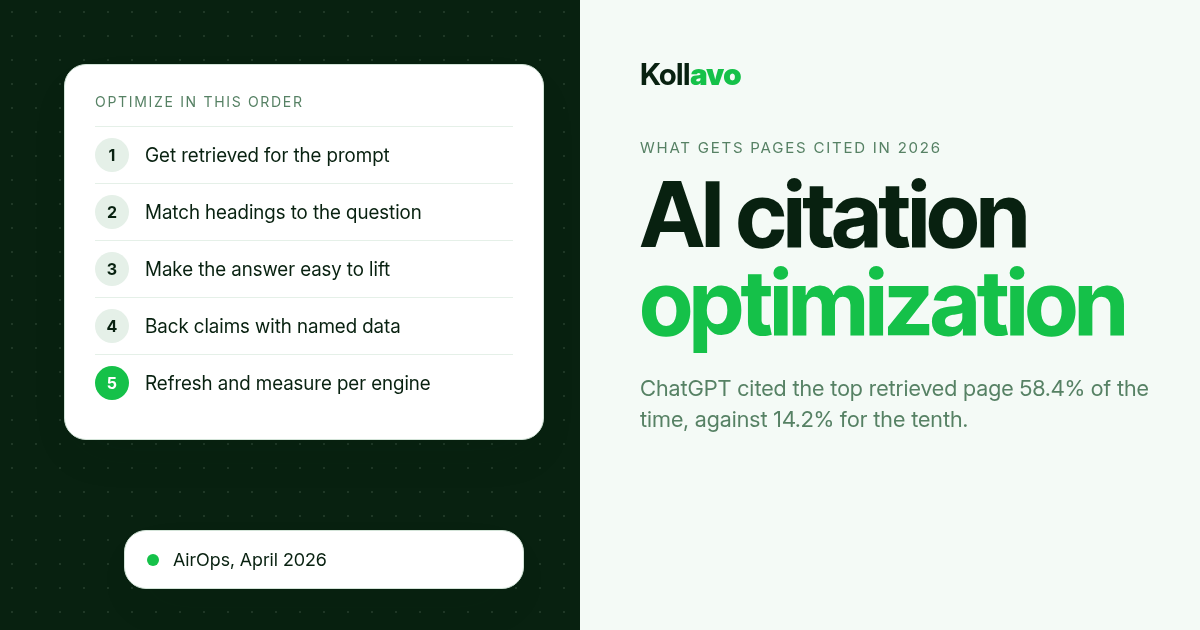
Short answer: AI citation optimization is the work of making a page the source an AI engine picks when it builds an answer. Most of that choice happens before the model writes a word. In AirOps' study of 16,851 ChatGPT queries, the top retrieved page was cited 58.4% of the time against 14.2% for the tenth. A September 2026 study of about two million citations found that how closely a page matches the prompts buyers actually ask was the strongest page-level predictor, while FAQ blocks, schema and page speed barely moved the needle once the domain was accounted for. So optimize in this order: get retrieved, match the question, make the answer easy to lift, then keep it fresh.
This guide is about optimizing pages you already have, or are about to publish, so engines like ChatGPT, Gemini, Perplexity and Google AI Overviews cite them. If you want the wider strategy, start with how to get cited by AI. If your problem is that AI never names your brand at all, read how to get AI mentions first, because that is mostly won off your site.
What AI citation optimization means
An AI citation is a link to your page shown as a source in an AI answer. AI citation optimization (also called LLM citation optimization) is the set of changes that raise the share of answers that cite you for the prompts you care about. It sits inside GEO, but it is narrower: it is page-level work, measured per prompt and per engine.
Every web-connected engine goes through roughly the same four gates:
- Query rewrite. The engine turns the user's prompt into several searches. Google says AI Overviews and AI Mode may use a "query fan-out" technique, running related searches across subtopics to find supporting pages (Google Search Central). See our explainer on query fan-out.
- Retrieval. Your page has to come back for at least one of those searches.
- Selection. The engine reads the retrieved pages and keeps only some. AirOps found that only 15% of the pages ChatGPT retrieves end up cited.
- Synthesis. The model writes its answer and attaches links to the passages it used.
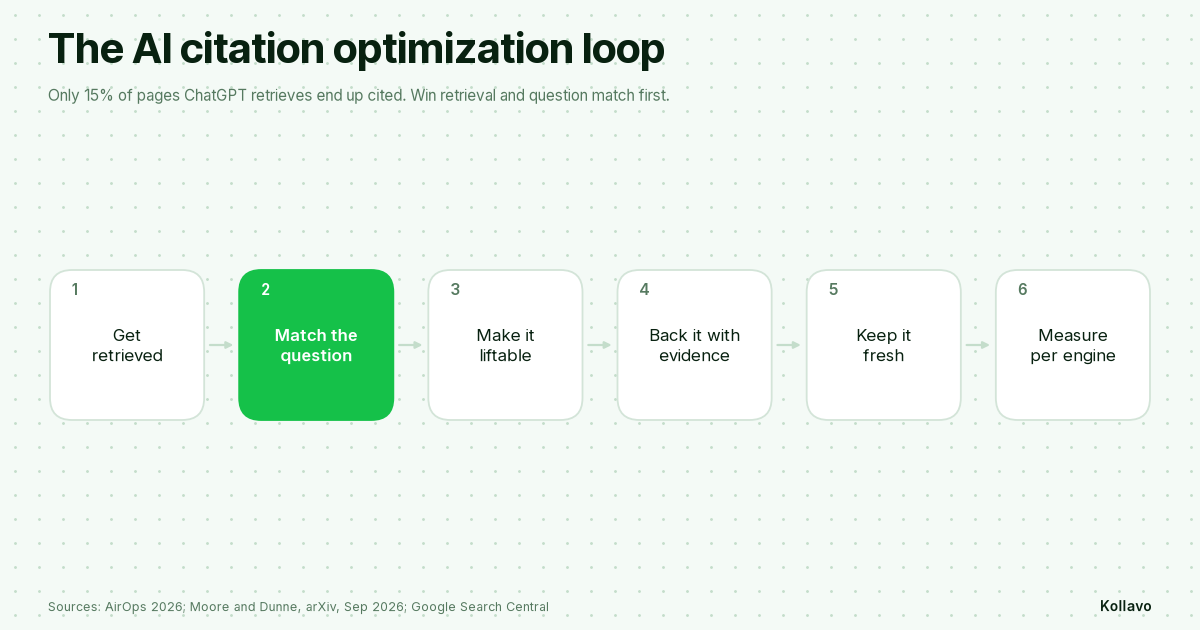
Most "AI SEO checklists" only work on gate 4. The data says gates 2 and 3 matter more.
What the 2026 data says actually drives AI citations
Three large studies published in 2026 looked at cited pages versus pages that were retrieved but not cited. They agree on more than they disagree.
| Finding | Number | Source |
|---|---|---|
| Top retrieved page cited by ChatGPT | 58.4% (vs 14.2% at position 10) | AirOps, 16,851 queries, Apr 2026 |
| Pages with the strongest heading-to-query match cited | 41.0% (vs roughly 30% for weaker matches) | AirOps, Apr 2026 |
| Pages with JSON-LD markup cited | 38.5% (vs 32.0% without) | AirOps, Apr 2026 |
| Share of retrieved pages that earn a ChatGPT citation | 15% | AirOps, 2026 |
| Strongest page-level predictor of citations | Prompt-content alignment | Moore and Dunne, ~2 million citations, Sep 2026 |
| FAQ section / TL;DR block / author bio effect after domain controls | Small (coefficients +0.07 / +0.05 / +0.02) | Moore and Dunne, Sep 2026 |
| Domain-level authority vs best non-alignment page feature | About 6x more important | Moore and Dunne, Sep 2026 |
| AI Overview citations that rank in Google's top 10 | 37.9% (76.1% in mid-2025) | Ahrefs, Mar 2026 |
Here is what that means in practice.
Retrieval comes first. A page that is not retrieved cannot be cited, and the top retrieved result wins most often. For Google's AI features, that still means classic SEO: Google says a page only needs to be indexed and eligible for a snippet, with no extra technical requirements. But Ahrefs' March 2026 data shows only 37.9% of AI Overview citations also rank in the top 10 for the same query, down from 76.1% in July 2025. Fan-out searches pull in pages that rank for the sub-questions, not just the head term.
Matching the question beats covering everything. In the AirOps ChatGPT study, pages that answered the main query narrowly outperformed broad "ultimate guides", and pages between 500 and 2,000 words did best. Pages over 5,000 words were cited less often than pages under 500. The Moore and Dunne study (an observational analysis of roughly two million citations from ChatGPT, Claude, Google AI and Gemini over six months, across 10,042 pages from 19 B2B SaaS companies) found the same thing from another angle: the overlap between a page's text and the full set of prompts buyers ask was the dominant page-level predictor (arXiv).
Structure helps, but less than you have been told. JSON-LD, FAQ blocks and TL;DR boxes show positive effects in raw data. Once Moore and Dunne compared pages within the same domain, those effects became small or vanished, and Core Web Vitals showed no significant effect. Their explanation: big brands both get cited more and tend to have these features, which makes the features look more powerful than they are. The authors also note their data is observational and limited to B2B SaaS, so treat it as a strong hint rather than a law.
Evidence still counts. The original GEO paper from Princeton and IIT Delhi researchers tested edits on 10,000 queries. Citing sources, adding quotations and adding statistics raised visibility in generated answers by 30% to 40%, and keyword stuffing did little or nothing (Aggarwal et al., KDD 2024). For pages ranked fifth, citing sources lifted visibility by 115.1%. More on this in our AI citation statistics roundup.
The right format depends on the question
AirOps' second 2026 report ("From Retrieved to Cited") looked at 217,508 pages ChatGPT retrieved for 7,500 commercial prompts, split into four buying stages. The winning format changed by stage.
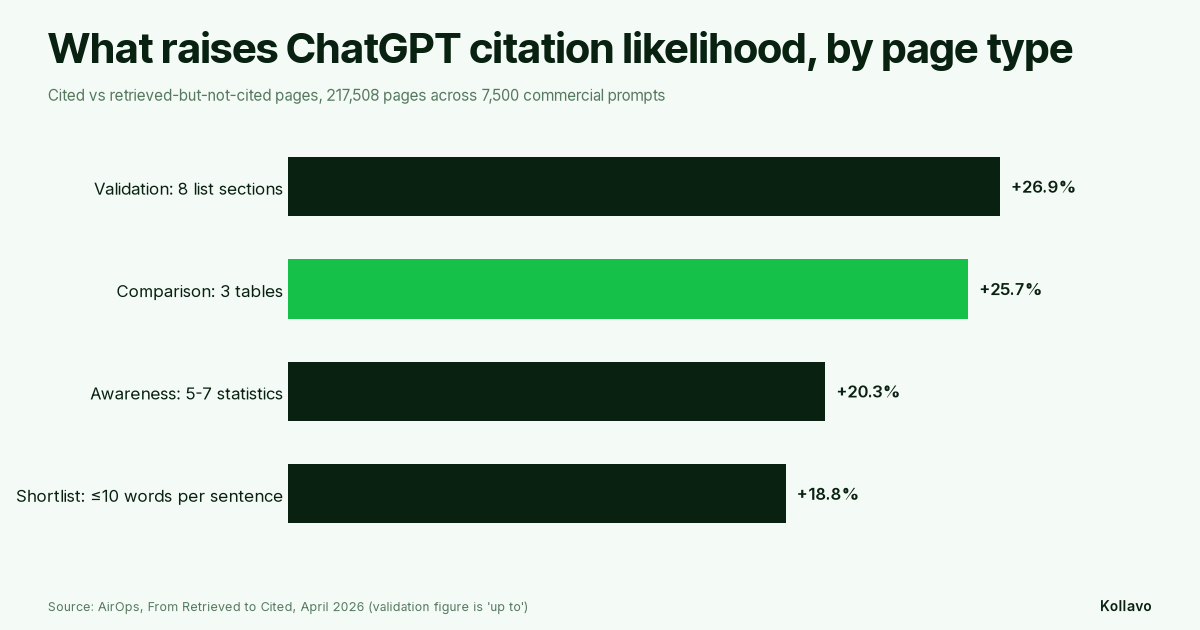
| Buying stage | Example prompt | What earned more citations | Lift |
|---|---|---|---|
| Awareness | "how do I fix X" | 5 to 7 statistics backing claims | +20.3% |
| Awareness | same | 1,301 to 1,500 words | +10.8% |
| Research (shortlists) | "best X for Y" | Sentences averaging 10 words or less | +18.8% |
| Research (shortlists) | same | 10 images | +16.4% |
| Comparison | "X vs Y" | 3 tables | +25.7% |
| Comparison | same | 7 distinct price points | +15.7% |
| Validation | "does X integrate with Y", "X pricing" | 8 list sections | up to +26.9% |
| Validation | same | 15+ price points | +11.0% |
Two patterns held at every stage: pages with 7 to 26 list sections were 6% to 15.2% more likely to be cited, and pages averaging 11 to 14 words per sentence had about a 7% higher likelihood. These are ChatGPT results on commercial prompts, so other engines may weigh things differently. But the lesson travels: build the page for the decision the reader is making.
How to optimize a page for AI citations: 7 steps
1. Start from real prompts, not keywords
List the 20 to 50 questions buyers ask about your category, in their words. Pull them from sales calls, support tickets and Search Console queries (long, conversational queries are often AI-style prompts). The free AI prompt generator gives you a starting set, and the query fan-out tool shows the sub-questions an engine may search for each one.
2. Check where you are retrieved today
For each priority prompt, see whether your page ranks for the main query and for its fan-out sub-queries. If it does not rank anywhere, on-page polish will not help. Fix indexing, internal links and topical gaps first. Use the AI citation checker to see which URLs each engine actually cites now.
3. Match headings and the opening to the question
Put the question, or a close variant, in an H2, and answer it in the first 40 to 60 words below. AirOps found the strongest heading-to-query match lifted ChatGPT's citation rate to 41.0% from roughly 30%. Keep one page per question cluster: a focused page beats a page that tries to rank for everything. Our guides to answer capsules and structuring content so LLMs quote it show the format.
4. Make the answer easy to lift
Write short, self-contained paragraphs that still make sense when quoted alone. Use lists for steps and criteria, and tables for anything compared across rows. Name the subject instead of writing "it" or "this tool", so the passage keeps its meaning out of context.
5. Back claims with named evidence
Add specific statistics with the source and date next to them, and quote credible sources. On discovery pages, aim for the 5 to 7 statistics AirOps saw winning. On comparison and pricing pages, show exact prices and plan limits. Never round or invent a number to make it look cleaner.
6. Keep it fresh, on purpose
In the AirOps ChatGPT study, pages published 30 to 89 days earlier did best, and pages older than two years were cited less. Profound measured a median citation half-life of 11 days after a page's peak. Review your top pages monthly: update facts, dates and examples, and show a visible "updated" date. See LLM citation decay for the full pattern.
7. Measure citation rate per engine
Engines overlap very little in what they cite, so track each one separately. Re-run the same prompts weekly and record whether you were cited, which URL, and in what position. The metric that matters is citation share across a fixed prompt set, not a single screenshot.
Mistakes that waste AI citation optimization work
| Mistake | Why it fails | Do this instead |
|---|---|---|
| Adding FAQ schema to every page and calling it done | Effect is small once domain strength is controlled | Fix question match and retrieval first |
| Writing one 6,000-word guide for every query | Pages over 5,000 words were cited less than short ones | One focused page per question cluster |
| Optimizing pages that are not retrieved | Only retrieved pages can be cited | Check rankings for the prompt and its fan-out first |
| Keyword stuffing | Little or no gain in the GEO paper | Use the buyer's phrasing once, in headings and the answer |
| Judging results from one check | Citations change daily and fade within weeks | Track a weekly rate per engine |
| Ignoring off-site sources | Domain authority outweighs page tweaks | Earn mentions on the pages engines already cite |
That last row matters. The Moore and Dunne study found most citation variance sits between domains, not within them. Page optimization is necessary, but brands that only work on their own site cap their results. Pair it with getting named on the third-party lists and reviews that AI engines already cite.
How Kollavo helps
Kollavo tracks your citations across ChatGPT, Gemini, Perplexity and Google AI Overviews, shows which pages win citations for your competitors, and gets you placed in the sources engines cite. Start with a free AI audit, see pricing (plans from $49/month), or compare Kollavo with other AI visibility tools.
FAQ
What is AI citation optimization?
AI citation optimization is the process of making your pages the sources AI engines link to in their answers. It covers getting retrieved for the right searches, matching headings and openings to real prompts, writing passages that are easy to quote, backing claims with named data, and keeping pages fresh.
Is LLM citation optimization different from SEO?
It builds on SEO but is not the same. Retrieval still depends on ranking for the main query and its fan-out sub-queries, but only 37.9% of AI Overview citations rank in Google's top 10 for the same query (Ahrefs, March 2026), and the page then has to beat other retrieved pages to be selected.
Does schema markup help get AI citations?
A little. AirOps found ChatGPT cited 38.5% of pages with JSON-LD against 32.0% without. But a study of about two million citations found structured data and FAQ blocks had small or no effect once domain strength was controlled. Add it, but do not expect it to fix a page that does not match the question.
How long should a page be to get cited by AI?
In AirOps' ChatGPT study, pages of 500 to 2,000 words performed best, and pages over 5,000 words were cited less often than pages under 500. Length should follow the question: answer it fully, then stop.
How do I measure AI citation optimization results?
Pick a fixed set of prompts, run them on each engine weekly, and record whether your page is cited, which URL and in what position. Track the share of answers that cite you over time rather than single checks, since citations change from day to day.
Sources
AirOps, ChatGPT citation study of 16,851 queries and 50,553 responses, as reported by Search Engine Land (April 16, 2026). AirOps, "From Retrieved to Cited: How Commercial Content Earns Citations in AI Search" (April 1, 2026, 217,508 retrieved pages, 7,500 commercial prompts). Ben Moore and Liam Dunne, "What Drives Citations in Production Large Language Models?" (arXiv, September 28, 2026). Ahrefs, "Update: 38% of AI Overview Citations Pull From The Top 10" (March 2, 2026). Profound, "The half-life of an AI citation is 11 days" (September 30, 2026). Aggarwal et al., "GEO: Generative Engine Optimization", KDD 2024. Google Search Central, "AI features and your website".