October 28, 2026 · Kollavo Team
GEO Agency: What It Does, What It Costs and How to Choose One (2026)
What a GEO (generative engine optimization) agency actually does, how it compares with SEO agencies, tools and managed services, published rate cards from $3,000/month, 8 questions to ask before you sign and the red flags to walk away from.
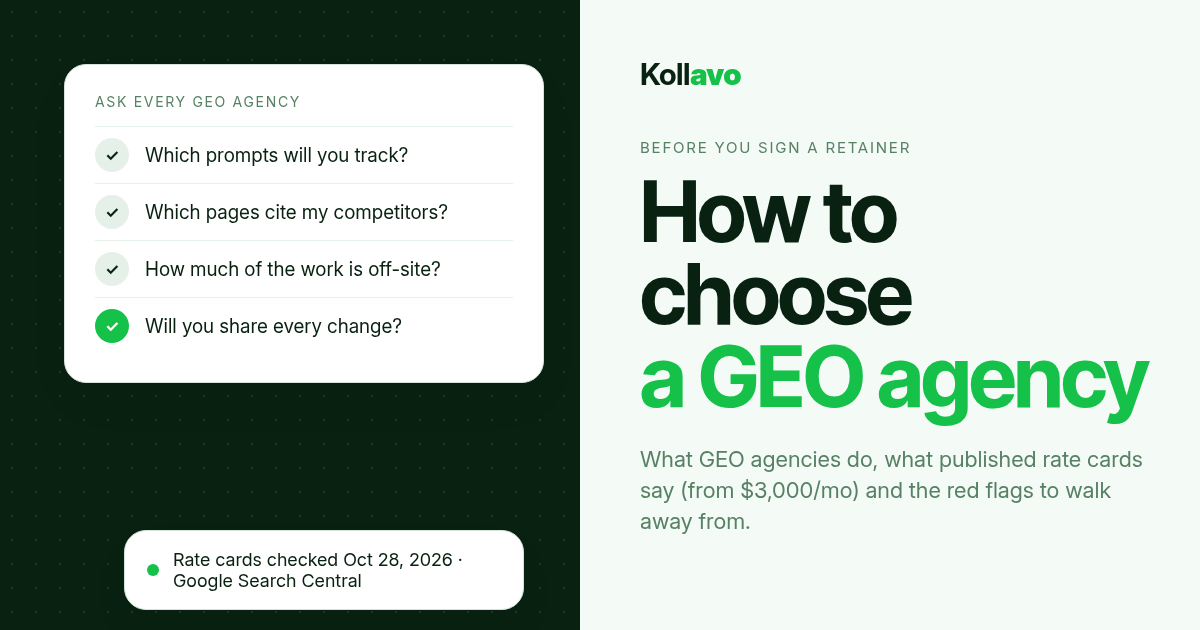
Short answer: A GEO agency (generative engine optimization agency) is a team you pay to get your brand named and cited in AI answers from ChatGPT, Gemini, Perplexity and Google AI Overviews. A good one tracks a fixed set of buyer prompts, finds the pages AI cites instead of you, fixes your own content, and earns placements on those third-party sources. Agencies that publish rate cards start at about $3,000/month. Choose one that reports citation rates across repeated runs, explains every change, and never guarantees a citation.
This guide covers what a GEO agency actually does, how it differs from an SEO agency, a tool or a managed service, the questions to ask before you sign, and the red flags that should end the call. For a full price breakdown, see our GEO pricing guide.
What does a GEO agency do?
Generative engine optimization is the work of making a brand show up in AI-generated answers. The term comes from a 2023 research paper by Princeton and IIT Delhi researchers, which found that adding citations, quotations and statistics to a page could raise its visibility in generative engine responses by up to 40% (Aggarwal et al., KDD 2024). An agency packages that work, plus the off-site work AI engines reward, into a monthly service.
In practice, a GEO engagement has four workstreams:
| Workstream | What it involves | What good looks like |
|---|---|---|
| Measurement | A fixed set of buyer prompts tracked across engines, with your mention and citation rate per engine | A written prompt list you approve, run repeatedly, with a baseline before any work starts |
| Citation gap analysis | Finding the pages AI cites for those prompts when it names competitors and not you | A list of real URLs (listicles, reviews, directories, articles), not generic advice |
| On-site content | Answer-first pages, comparison pages, FAQs, sourced statistics, technical fixes | Changes you can see and approve, tied to specific prompts |
| Off-site placements | Getting your brand onto the third-party pages AI already cites | Named target pages, outreach status, and live URLs you can check |
The last workstream matters most for most brands. In AirOps' study of 21,311 brand mentions in AI answers, 85% came from third-party pages and only 13.2% from the brand's own domain. Ahrefs found branded web mentions had the strongest correlation with Google AI Overview visibility (0.664) across 75,000 brands. An agency that only rewrites your blog is working on the smaller half of the problem. Our guide on how to get AI mentions explains why.
GEO agency vs SEO agency vs tool vs managed service
GEO overlaps with SEO more than many agencies admit. Google says there are "no additional requirements to appear in AI Overviews or AI Mode, nor other special optimizations necessary," and that SEO best practices still apply (Google Search Central). What is genuinely new is measuring prompts instead of keywords and earning a place on the sources AI quotes.
| Option | What you get | Who does the work | Published starting price | Best for |
|---|---|---|---|---|
| AI visibility tool | Prompt tracking, citation and competitor reports | You | $29/month (Otterly.AI Lite) | Teams with time and a writer |
| SEO agency with a GEO add-on | Rankings work, some AI reporting | The agency | Varies; often bundled into SEO retainers | Brands whose main gap is still Google rankings |
| Managed placement service (Kollavo) | Tracking plus submissions and placements on cited sources | The service | $99/month | Brands whose gap is mostly off-site |
| Full GEO agency | Strategy, content, technical work, outreach, reporting | The agency | About $3,000/month | Teams that need a content and PR program run for them |
If you are still deciding whether you need people or software, compare the main tools on our compare page first. A tool tells you where the gap is. Someone still has to close it.
How much does a GEO agency cost?
Most GEO agencies don't publish prices. Among those that do, we checked the rate cards on October 28, 2026:
| Agency | Entry price | What the entry tier includes (as stated on its site) |
|---|---|---|
| WebFX | $3,000/month (Bronze), on a 6-month commitment | 50 prompts monitored across 10 LLMs, 3 flexible assets a month. Silver is $5,250, Gold $7,500, top published tier $68,250 |
| RevenueZen | $3,000/month (Foundation) | Six tiers up to $15,000/month (Total Market) |
| Obility | $5,450/month (SEO & GEO Core) | Add-ons include brand mentions at $1,000/month, with publisher fees paid by the client, and Reddit visibility at $2,500/month |
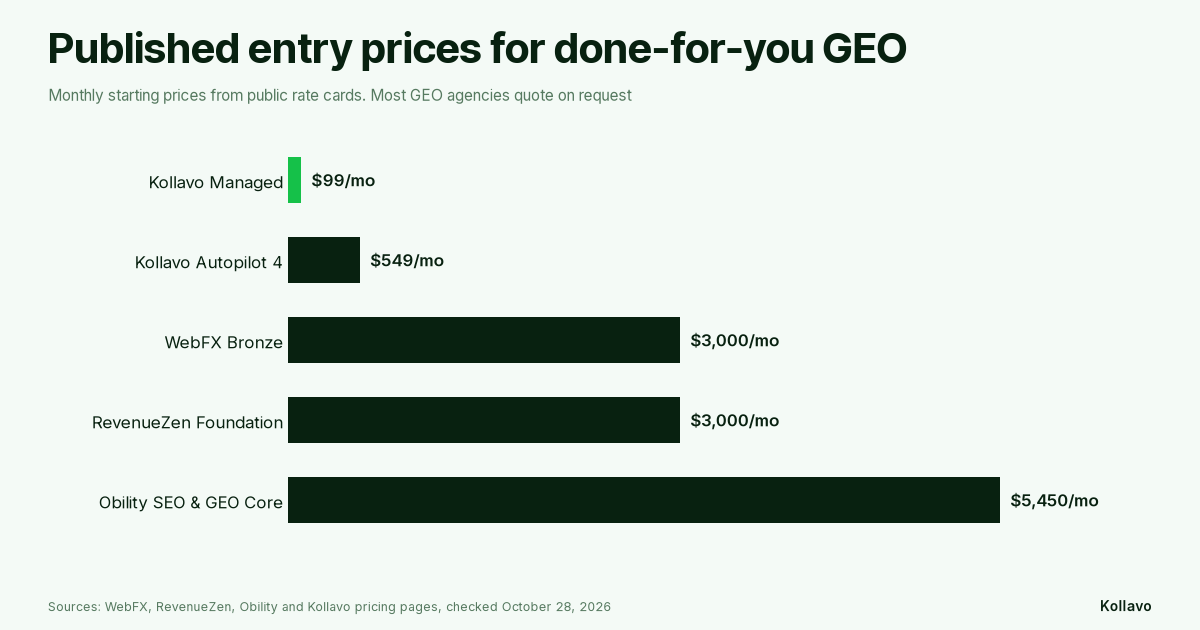
Two things move the real cost more than the sticker price. First, commitment: WebFX's 6-month minimum means a first commitment of at least $18,000. Second, off-site fees: placements on paid publications often sit outside the retainer. Ask whether publisher fees are included before you compare quotes. Our GEO pricing guide covers tools, agencies and placement services side by side.
How a good GEO engagement runs
Whatever the agency calls its method, a sound engagement follows the same loop. If a proposal skips the first or last step, you have no way to tell whether the work did anything.
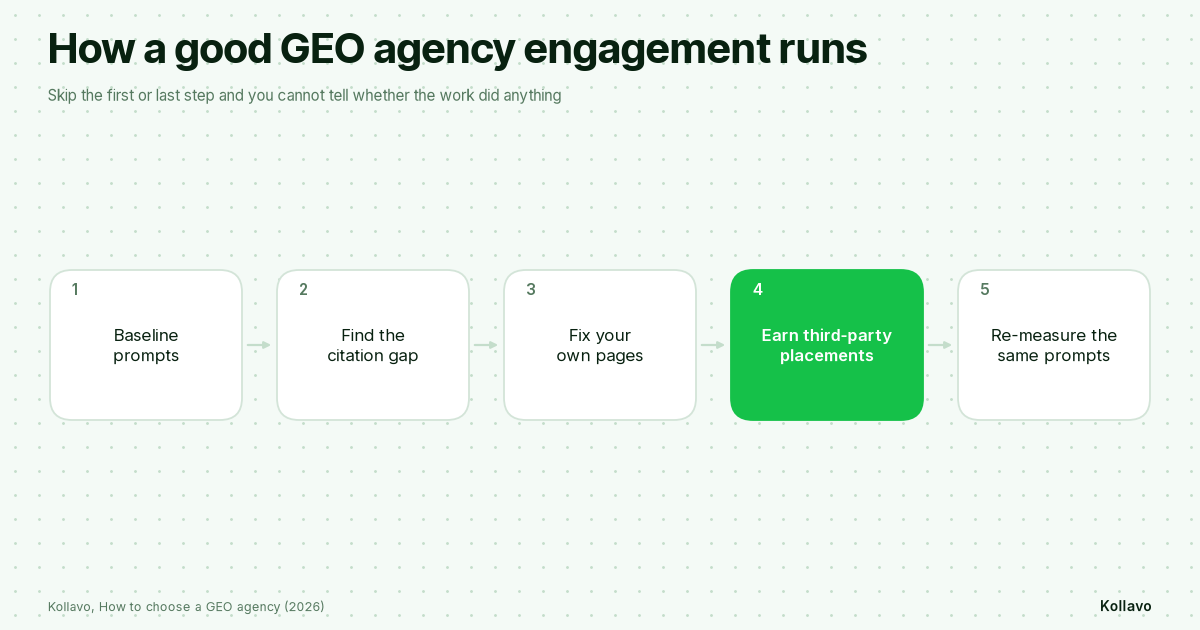
- Baseline. Agree on 20 to 50 buyer prompts ("best [category] for [use case]", "[competitor] alternatives", "[category] pricing") and measure your mention rate on each engine before work starts. See prompt tracking.
- Citation gap. List the pages cited when AI names competitors and not you. Our free citation gap audit does a first pass.
- On-site fixes. Answer-first pages and comparison content for the prompts you are missing.
- Off-site placements. Outreach to the specific listicles, reviews and directories from step 2.
- Re-measure. Run the same prompts the same way and compare rates, not single answers.
How to choose a GEO agency: 8 questions to ask
Google's own advice on hiring an SEO is a good template for GEO too. Its suggested questions include "Can you show me examples of your previous work?", "How do you measure your success?" and "Will you share with me all the changes you make to my site?" (Google Search Central, "Do you need an SEO?"). Adapted for AI search:
| Question | A good answer | A weak answer |
|---|---|---|
| Which prompts will you track, and can I approve the list? | A written list of buyer prompts, agreed up front | "We track your brand in AI" with no list |
| Which engines, and how often? | Named engines, each prompt run repeatedly | One screenshot per month |
| How do you measure success? | Mention and citation rate per engine against the baseline | Traffic or rankings only |
| Which pages cite my competitors today? | Real URLs from a gap analysis | Generic "authority building" |
| What share of the work is off-site? | A clear plan for placements, with target pages | Content only |
| Are publisher fees included? | A stated cap or a per-placement quote | "It depends", after you sign |
| Will you share every change and placement? | A live log with URLs and dates | A monthly PDF summary |
| What is the minimum term? | Stated in the proposal | Discovered in the contract |
Also check references. Google suggests asking past clients whether the work "produced positive results." For GEO, ask them how their citation rate moved, not how many articles they received.
Red flags when hiring a GEO agency
Guaranteed citations or rankings. Google is blunt: "No one can guarantee a #1 ranking on Google." Nobody can guarantee a ChatGPT recommendation either. AI answers vary from run to run: in a SparkToro study of 2,961 runs, there was less than a 1 in 100 chance of getting the same list of brands twice for the same prompt.
A "special relationship" with OpenAI or Google. Google warns against SEOs that claim one. The same applies to any agency claiming insider access to an AI engine.
Reporting from single screenshots. Because answers change so much, one answer proves nothing. SISTRIX found that 74% of the domains cited in ChatGPT Search were new each week. Insist on rates across repeated runs; our guide to LLM citation tracking shows how, and AI citation volatility explains what normal movement looks like.
Keyword stuffing for AI. In the GEO paper, keyword stuffing was one of the methods that didn't work, while adding sources, quotations and statistics did.
Selling technical files as the fix. llms.txt files and schema markup are fine to have, but neither is a citation fix on its own. Google says no special optimizations are needed for its AI features, and Ahrefs' test of 1,885 pages found adding schema barely moved AI citations. See schema markup for AI.
Secrecy. Google advises caution "if a company is secretive or won't clearly explain what they intend to do." If you can't see the prompt list, the target pages and the placements, you can't judge the work.
When you don't need a GEO agency
An agency makes sense when you need a team: a large content backlog, technical SEO, digital PR and reporting for leadership. You may not need one if:
- Your gap is mostly off-site. If AI keeps citing the same review sites, directories and listicles and you're missing from them, you're paying for placements, not strategy.
- You have a writer and some time. A tracking tool plus your own content and outreach can close a small gap.
- You haven't measured yet. Start with a baseline. Our LLM visibility score and a free AI audit show where you stand before you spend on a retainer.
For SaaS teams weighing a tool against a consultant, our GEO for SaaS guide walks through the trade-off.
Where Kollavo fits
Kollavo is a done-for-you service for the off-site part of GEO. It tracks your visibility in ChatGPT, Perplexity, Gemini and Google AI Mode, finds the sources AI cites for your competitors, and gets you listed and placed on them. Entry is $49/month for monitoring, Managed is $99/month with 10 to 15 directory and AI-source submissions a month, and Autopilot packs run from $549/month for 4 placements to $1,399/month for 12, with publisher fees covered up to a per-source cap. Plans can be cancelled anytime. Full details are on the pricing page.
It is not a replacement for a full agency if you also need dozens of new pages and a technical overhaul. It is built for brands whose main problem is that AI recommends competitors from pages they're not on.
FAQ
What is a GEO agency?
A GEO agency helps brands get mentioned and cited in AI-generated answers from ChatGPT, Gemini, Perplexity and Google AI Overviews. The work combines prompt tracking, citation gap analysis, on-site content changes and placements on the third-party pages AI engines already cite.
How much does a GEO agency cost?
Agencies that publish prices start around $3,000/month: WebFX's Bronze tier and RevenueZen's Foundation tier are both $3,000, and Obility's SEO & GEO Core is $5,450 (checked October 28, 2026). Many agencies quote only on request. Tools start at $29/month and managed placement services like Kollavo at $99/month.
Is a GEO agency different from an SEO agency?
Partly. Google says SEO best practices still apply to AI Overviews and AI Mode, so good SEO is the base. A GEO agency adds prompt-level measurement across AI engines and off-site work to get your brand onto the sources AI cites. Many SEO agencies now sell this as an add-on.
Can a GEO agency guarantee ChatGPT citations?
No. AI answers vary between runs, and no agency controls which sources an engine picks. Treat any guaranteed citation, ranking or "special relationship" with an AI company as a red flag, as Google advises for SEO guarantees.
How do I measure a GEO agency's results?
Agree on a list of buyer prompts before work starts, record your mention and citation rate on each engine, then rerun the same prompts the same way each month. Compare rates over several runs rather than single answers, and ask for a log of every page changed and placement earned.
Do I need a GEO agency or a tool?
A tool is enough if you have time to act on what it finds. Hire an agency if you need a full content, technical and PR program. If your gap is mainly missing placements on cited third-party pages, a managed placement service costs less than a retainer.
Sources
Aggarwal et al., "GEO: Generative Engine Optimization", KDD 2024 (arXiv 2311.09735). Google Search Central, "Do you need an SEO?" and "AI features and your website" (both checked October 28, 2026); Published rate cards on the WebFX AI SEO pricing page, RevenueZen pricing page and Obility pricing page (checked October 28, 2026). AirOps, "The Influence of Offsite Signals in AI Search" (October 2025, 21,311 brand mentions). Ahrefs, "An Analysis of AI Overview Brand Visibility Factors (75K Brands Studied)". Rand Fishkin and Patrick O'Donnell, SparkToro, "AIs are highly inconsistent when recommending brands or products" (January 2026, 2,961 runs). SISTRIX, "AI Citation drift: How stable are sources in AI search results?" (May 2026, 82,619 prompts). Ahrefs, test of 1,885 pages adding schema (May 2026). Otterly.AI and Kollavo pricing pages (checked October 2026).