November 9, 2026 · Kollavo Team
AI Citation Report: What to Include and How to Build One (With a Real Example)
What an AI citation report should include: scope, mention rate, citation rate, share of voice, competitor table, cited sources, gaps and actions. Plus a real 3-week example from our 52-question ChatGPT panel, how to read noise, and tools that export reports.
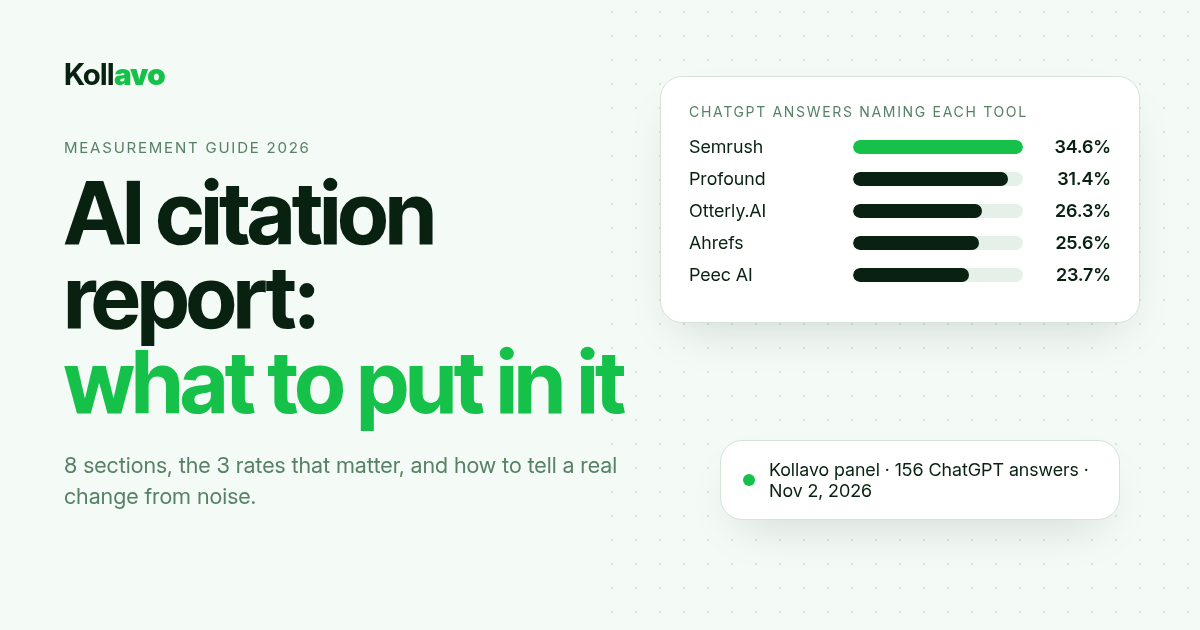
Short answer: An AI citation report is a recurring summary of how often AI engines such as ChatGPT, Gemini, Perplexity and Google AI Overviews mention your brand and cite your pages for a fixed set of buyer questions, compared with competitors and with the previous period. A useful report has eight parts: the scope (prompts, engines, runs, dates), three headline rates (mention rate, citation rate and share of voice), the change since last period, a competitor table, the domains and pages AI cited, your gaps, the actions you took, and method notes. The most important rule is to separate signal from noise. In Kollavo's own 52-question ChatGPT panel, Semrush was named in 32.1% of answers on October 23, 2026, 26.9% on October 26 and 34.6% on November 2. Nothing obvious changed between those runs. A report that does not show how big normal week-to-week movement is will mislead whoever reads it.
This guide shows what to put in an AI citation report, how to calculate each number, how to read changes, and which tools can produce the report for you. It uses our weekly panel as a worked example, so every number below is real.
What an AI citation report is (and is not)
An AI citation report answers one question for a stakeholder: are AI answers recommending us more or less than before, and why? It is not a rank report, and Search Console cannot give it to you on its own.
| Classic SEO rank report | AI citation report | |
|---|---|---|
| Unit of measurement | Keyword position on a results page | Brand mentions and cited URLs inside generated answers |
| Stability | Positions move slowly | Answers change from run to run for the same prompt |
| Headline metric | Average position, clicks | Mention rate, citation rate, share of voice |
| Competitor view | Who ranks above you | Who is named or cited instead of you |
| Main action list | Pages to optimise | Third-party sources to get onto, pages to fix |
| Data source | Search Console, rank tracker | Prompt panel or AI visibility tracker |
Google says that traffic from AI Overviews and AI Mode is counted in the Performance report's "Web" search type (Google Search Central), and there is no separate AI filter. You can see clicks, but not whether or where you were cited. That is why an AI citation report needs its own data: a fixed set of prompts, run on a schedule. Our guide to AI prompt tracking covers how to set that up.
The 8 sections of an AI citation report
| # | Section | What goes in it | Why it matters |
|---|---|---|---|
| 1 | Scope | Number of prompts, engines, runs per prompt, run dates, location, model if known | Without a fixed scope, period-over-period numbers are not comparable |
| 2 | Headline rates | Mention rate, citation rate, share of voice | Three numbers a stakeholder can remember |
| 3 | Change vs last period | Point change for each rate, plus your normal noise band | Stops people celebrating or panicking over noise |
| 4 | Competitor table | The same rates for 5 to 10 named competitors | Context: did you move, or did the whole category move? |
| 5 | Cited sources | Top cited domains and pages, new entries since last period | The sources AI trusts are your placement targets |
| 6 | Gaps | Prompts where competitors are named or cited and you are not | Turns the report into a to-do list |
| 7 | Actions | What you shipped since last report, and what is next | Links work to outcomes over time |
| 8 | Method notes | Engine outages, prompt changes, model changes | Explains breaks in the series |
How to calculate the headline rates
- Mention rate = answers that name your brand ÷ all answers in the period.
- Citation rate = answers that link to at least one page on your domain ÷ all answers.
- Share of voice = your brand mentions ÷ all tracked brand mentions in the same answers. Our glossary entry on citation share and the guide to share of voice in AI search cover the variants.
Count answers, not prompts. If you run 52 prompts 3 times each, the denominator is 156 answers. For a deeper list of metrics, see how to measure AI visibility.
A real example: our weekly AI citation report
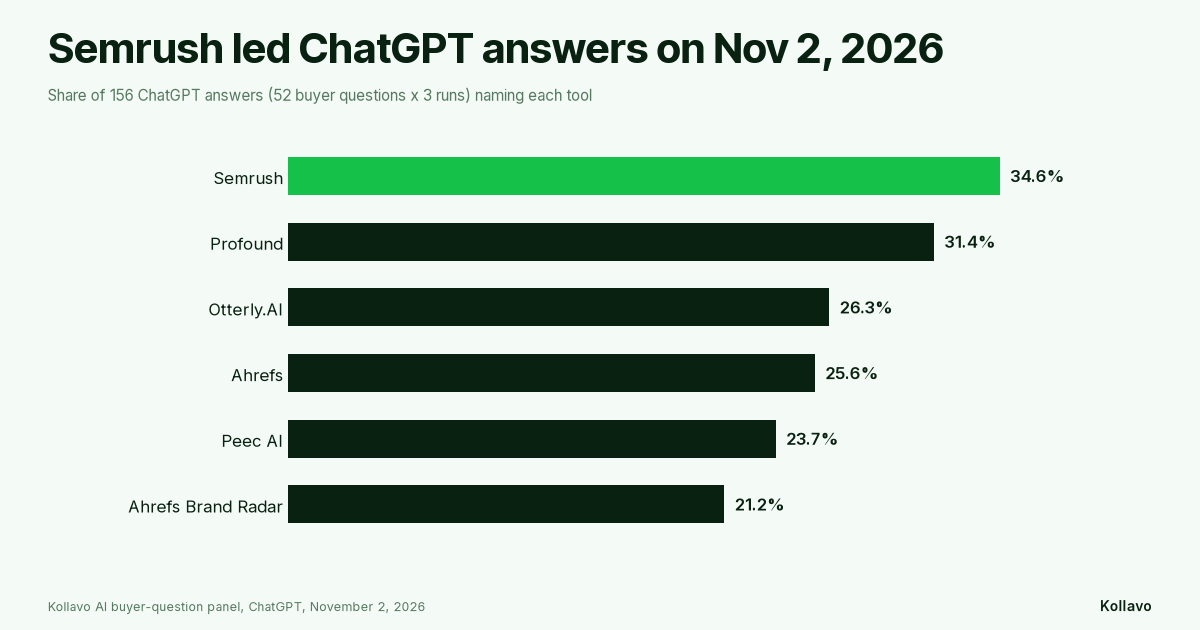
Every week Kollavo runs a panel of 52 buyer questions about AI visibility tools, such as "What is the best AI visibility tracking tool for a B2B SaaS company?". Each question is asked 3 times in ChatGPT, which gives 156 answers per run. Here is the report's competitor section for the last three runs.
| Brand | Oct 23, 2026 | Oct 26, 2026 | Nov 2, 2026 | Change, last week |
|---|---|---|---|---|
| Semrush | 32.1% | 26.9% | 34.6% | +7.7 pts |
| Profound | 32.7% | 31.4% | 31.4% | 0.0 pts |
| Otterly.AI | 26.3% | 25.0% | 26.3% | +1.3 pts |
| Ahrefs | 24.4% | 21.8% | 25.6% | +3.8 pts |
| Peec AI | 25.6% | 27.6% | 23.7% | −3.9 pts |
| Ahrefs Brand Radar | 17.9% | 21.2% | 21.2% | 0.0 pts |
Share of the 156 ChatGPT answers in each run that named the brand. Source: Kollavo AI buyer-question panel.
What the report says, and what it does not
A careless reading of the November 2 report would say "Semrush gained 7.7 points in a week." Look at the series instead. Semrush fell 5.2 points the week before, then came back. The number of answers citing a semrush.com page went 46, 41, 46 across the three runs. The most likely explanation is ordinary run-to-run variation, not a change in Semrush's position.
Across the six brands above, the average week-over-week move was 2.7 points and the largest was 7.7 points. That is our noise band. On a 156-answer panel, we treat any single-week move under about 5 points as noise, and only call a trend when a rate moves the same way two runs in a row or moves while competitors stay flat.
Independent research supports the caution. SparkToro and Gumshoe had volunteers run the same 12 prompts 2,961 times and found less than a 1 in 100 chance that an AI tool would return the same list of brands twice (SparkToro). Our AI citation volatility guide explains why answers churn.
The cited-sources section
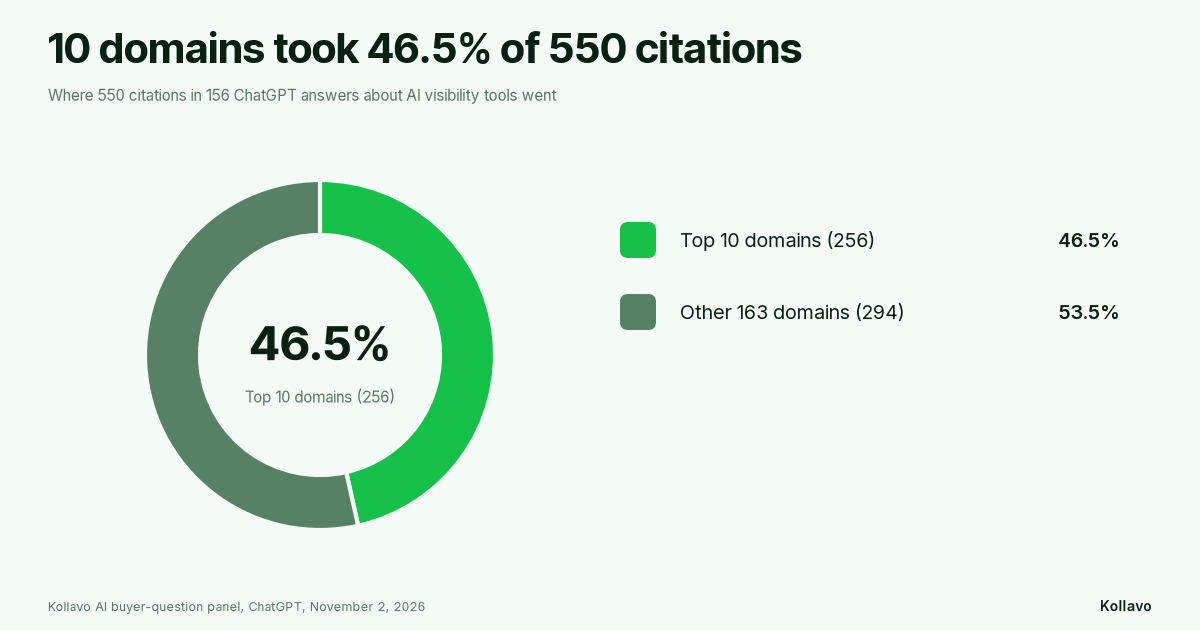
The same November 2 run produced 550 citations: ChatGPT linked at least one page in 138 of 156 answers (88.5%), with a median of 3 cited pages per answer. Those citations came from 173 domains.
| Finding (Nov 2, 2026 run) | Figure |
|---|---|
| Answers with at least one citation | 138 of 156 (88.5%) |
| Cited pages per answer (mean / median) | 3.5 / 3 |
| Distinct cited domains | 173 |
| Share of citations going to the top 10 domains | 46.5% (256 of 550) |
| Domains cited in only one answer | 114 of 173 (66%) |
| Most cited domain | semrush.com (58 citations) |
Two lessons for any AI citation report. First, citations are concentrated: ten domains took almost half of them, and all ten were vendors' own sites, help centres or product documentation (semrush.com, tryprofound.com, developers.google.com, peec.ai and otterly.ai led). If you sell software, your own docs and pricing page are part of the report. Second, the long tail is real: two thirds of cited domains appeared only once. List the top sources, but don't treat a one-off citation as a placement target until it shows up again. For wider benchmarks, see our roundup of AI citation statistics.
How to build an AI citation report yourself
You can build a credible report in a spreadsheet. You need a fixed prompt list, a log, and a summary tab.
1. Fix the scope
Pick 25 to 100 buyer prompts across the funnel: "best [category] for [audience]", "[competitor] alternatives", "[you] vs [competitor]", "how much does [category] cost". Choose the 2 to 4 engines your buyers use. Decide on runs per prompt (3 is a practical minimum) and keep all of this fixed between reports.
2. Log one row per answer
| Column | Example |
|---|---|
| Run date | 2026-11-02 |
| Engine | ChatGPT |
| Prompt ID and text | q01, "best AI visibility tool for B2B SaaS" |
| Run number | 1 of 3 |
| Brands named | Profound; Semrush; Otterly.AI |
| Your brand named? | No |
| Cited URLs | Full list |
| Your domain cited? | No |
| Competitor domains cited | semrush.com |
Use a fresh, logged-out session for manual runs so chat history does not shape the answer. Ten prompts, three engines and three runs is already 90 rows per report, which is why most teams switch to a tool after the first month. Our LLM citation tracking guide has the full method.
3. Summarise into the 8 sections
Build the headline rates with COUNTIF over the answer log, one block per engine. Keep engines separate: they cite very different sources, so a blended number hides most of the story. Add a "gaps" filter for rows where a competitor is named or cited and you are not. The free citation gap audit and competitor citation map can seed that list.
4. Add context from Search Console and analytics
AI answers send few clicks, but they still send some. Add AI referral sessions from your analytics (our guide to AI referral traffic tracking shows how) and branded search impressions from Search Console. Present them as supporting signals, not as the citation metric.
Weekly or monthly?
| Audience | Cadence | Format |
|---|---|---|
| The person doing the work | Weekly | Raw log + gaps list |
| Marketing lead | Monthly | 8-section report, 1 page |
| Leadership or client | Monthly or quarterly | Headline rates, trend line, top 3 actions |
Weekly runs are useful for catching drops early. But with a noise band of several points, a monthly report built on four weekly runs is far more reliable than any single week. When a drop persists over several runs, check for citation decay on the pages that used to be cited.
Tools that produce AI citation reports
If you'd rather not maintain a spreadsheet, most AI visibility trackers export a report. Here is what their help documentation says about reporting, as of November 2026:
| Tool | Reporting and export (as documented) | Entry price |
|---|---|---|
| Semrush AI Visibility Toolkit | Prompt Tracking exports to Excel, CSV and Google Sheets; PDF export on the Landscape and Overview tabs; scheduled daily, weekly or monthly email exports (Semrush KB article 1503) | $99/month |
| Otterly.AI | CSV exports of prompts and citations and a PDF brand report on all plans; Looker Studio connector on Standard, Premium and Enterprise plans (Otterly help centre) | $29/month Lite |
| Peec AI | Chart CSV export, full chat export as CSV, API URL reports, and a Looker Studio (Data Studio) connector that needs a Peec API key (Peec help centre) | $95/month Starter |
| Kollavo Entry | Weekly visibility score on ChatGPT, Gemini and Google AI Mode, share of voice, citation gap alerts, exportable PDF reports and email alerts | $49/month |
| Kollavo Managed | Everything in Entry, plus 10 to 15 source submissions a month, a live placement tracker and a monthly report | $99/month |
Prices are monthly list prices from each vendor's pricing page in November 2026, and some vendors show euro prices to European visitors. For a wider comparison, see LLM ranking checkers compared and, if an agency produces the report for you, what to expect in GEO pricing.
Common mistakes in AI citation reports
- Reporting one run as the result. One answer per prompt is a sample. Report rates over at least 3 runs.
- Leaving out the noise band. Without it, a 5-point swing looks like a campaign win.
- Changing the prompt set between reports. Add new prompts as a separate segment, and keep the original set as the trend line.
- Blending engines. ChatGPT, Perplexity and Google AI Overviews cite different sources. Report each separately.
- Mixing branded and unbranded prompts. Branded prompts inflate your mention rate. Split them.
- Listing cited sources without actions. The sources section is only useful if it feeds the gaps and actions sections.
- Reporting average "position" in the answer. The order of brands changes almost every run. Use it as colour, not as a KPI.
FAQ
What is an AI citation report?
An AI citation report is a recurring summary of how often AI engines mention your brand and cite your pages for a fixed set of buyer questions. It shows mention rate, citation rate and share of voice, compares them with competitors and the previous period, and lists the sources AI cited and the gaps to close.
What metrics should an AI citation report include?
At minimum: mention rate (answers naming you ÷ all answers), citation rate (answers linking to your domain ÷ all answers) and share of voice (your mentions ÷ all brand mentions). Add the change since last period, a competitor table, the top cited domains and a gaps list.
How often should I produce an AI citation report?
Run prompts weekly and report monthly for most teams. In our 52-question ChatGPT panel, brand answer rates moved 2.7 points a week on average and up to 7.7 points with no obvious cause, so a monthly view built on several runs is more reliable than one week.
Can Google Search Console show AI citations?
No. Google counts AI Overviews and AI Mode traffic inside the Performance report's "Web" search type, with no separate AI filter. Search Console shows clicks and impressions, not whether an AI answer cited you. You need a prompt panel or an AI visibility tracker for that.
How many prompts do I need for a reliable AI citation report?
Start with 25 to 100 buyer prompts, each run at least 3 times per period, on the 2 to 4 engines your buyers use. Keep the set fixed between reports so changes are comparable.
What is a good AI citation rate?
There is no universal benchmark, because rates depend on the prompt set and engine. Compare yourself with named competitors on the same run. In our November 2, 2026 panel, the most-named tool appeared in 34.6% of answers and the sixth in 21.2%.
Next step
Run the free LLM visibility checker on your top buyer questions to get a first baseline, then decide whether to keep a spreadsheet or use a tracker. If you want the report and the work it points to, Kollavo Entry tracks your visibility weekly from $49/month, and Managed adds monthly placements in the sources AI cites. You can also start with a free AI audit.
Once the report shows where you are missing, follow our guide on how to get cited by AI to close the gaps.